Alchemy is a form of chemistry and speculative philosophy practiced in the Middle Ages and the Renaissance and concerned principally with discovering methods for transmuting baser metals into gold. The word “alchemy” calls up the picture of a medieval laboratory in which a wizard broods over the crucible that is to bring within his reach the Philosopher’s Stone, and with that discovery the formula for the transmutation of metals.
That is why I was surprised to read Mitsubishi ( a Japanese multinational conglomerate comprising a range of autonomous businesses which share the Mitsubishi brand, trademark and legacy) hopes to go beyond just low energy nuclear reactions to low energy nuclear transmutations.
“These transmutations will be an energy source that will be portable, will produce rare earth materials, and will have the capacity to transmutate radioactive waste. They’ve changed the acronym from LENR to LENT. And, unlike competitors such as Rossi and Defkalion, they plan on using resources other than palladium, platinum and nickel.” ( http://cleantechauthority.com/defkalion-announces-lenr-date-mitsubishi-enters-lenr-market/ )
Low Energy Nuclear Reaction (LENR) using nickel and hydrogen is a clean, very very cheap, and super abundant energy technology, but can it also be used for transmutation? Nuclear transmutation is the conversion of one chemical element into another.
“Artificial transmutation may occur in machinery that has enough energy to cause changes in the nuclear structure of the elements. Machines that can cause artificial transmutation include particle accelerators and tokamak reactors. Conventional fission power reactors also cause artificial transmutation, not from the power of the machine, but by exposing elements to neutrons produced by a fission from an artificially produced nuclear chain reaction. Artificial nuclear transmutation has been considered as a possible mechanism for reducing the volume and hazard of radioactive waste.” ( http://en.wikipedia.org/wiki/Nuclear_transmutation )
In February 2011 scientists were given access to a sample of pure nickel powder which had been used in a LENR reactor for 2.5 months. Their analysis showed that the powder contained several other substances, mainly 10 percent copper and 11 percent iron. ( http://www.nyteknik.se/nyheter/energi_miljo/energi/article3144827.ece )
According to Robert Godes LENR is not a nickel-hydrogen fusion reaction. Nickel is merely a catalyst, and it is the hydrogen that yields heat.
““A tiny amount of hydrogen protons are converted into neutrons. These newly produced neutrons are soon captured by hydrogen ions or other atoms in a metallic (e.g. nickel) lattice near to where the hydrogen ions were converted to neutrons. The captured neutrons generate heat because the new atoms that are one neutron heavier shed excess binding energy as heat to the lattice, resulting in a dramatically clean, low-cost, hi-quality heat output.”
To summarize, it is a fact that conventional fission power reactors cause artificial transmutation by exposing elements to neutrons. Furthermore, according to Godes, the LENR Ni-H reaction occurs when hydrogen protons are converted into neutrons and captured by hydrogen ions or other atoms in the nickel lattice. Finally, evidence for LENR transmutation is the sample of nickel powder used in a LENR reactor for several months which showed several other substances, including copper and iron.
Can Mitsubishi discover the formula for the practical transmutation of metals, fulfilling the dream of mankind since the Middle Ages? We already strongly suspect that LENR transmutes nickel into copper and iron, so alchemy suddenly doesn’t seem so speculative anymore.
[latexpage]
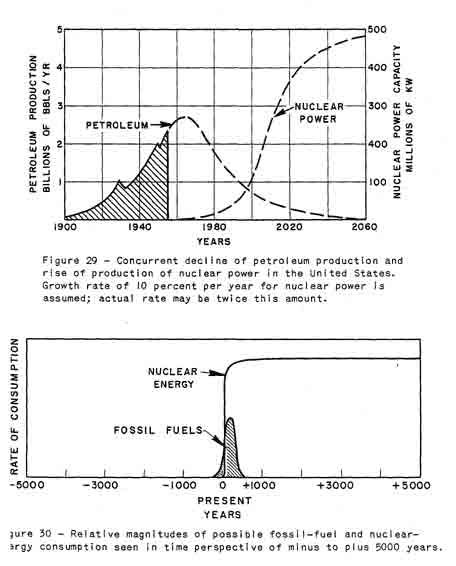
We are living in a world dependent on a finite source of fuel subject to M. King Hubbert’s production curve over time. This graph is from his 1956 Nuclear Energy and Fossil Fuels. It shows an increase in petroleum production, the production reaching a peak, and then, production falling.
Since 2005, global oil production has remained flat.
The Post Carbon Institute‘s video YOU ARE HERE: The Oil Journey recounts the century-and-a-half Oil Age and gives a context for Peak Oil, whose effects we live with now on the down-slope of the curve. Narrated by the great documentary voice of Peter Coyote, the half-hour video profiles the relationship between the economic and social benefits gained from fossil fuel energy, benefits that are now altering as access to fossil fuel becomes more difficult.
Fossil fuels are “concentrated and portable”, but most of the easily accessed oil, coal and gas is gone. What remains is harder to retrieve, of a lower quality, more costly to produce, and coming with a continually diminishing Energy Return on Energy Invested ERoEI.
The PCI comprises a group of researchers and writers gathered together to sound the alert on Peak Oil, the condition of a peak in production in oil, and develop strategies that will allow human communities to survive a post-petroleum world. They believe a Renewable Energy Economy based on conventional alternative energy is inevitable, but it will be “smaller, slower and more localized”.
Alternatives “should be invested in”, but a problem remains. The ERoEI for conventional alternatives like solar and wind is not nearly as high as fossil fuels like oil, coal, or gas. According to their 2009 report, PCI concludes that “None of the conventional alternative energy sources will maintain our current energy level of use” and “The amount of investment capital to develop the technology is just not there”.
Like many in the Peak Oil-Collapse community, PCI is wary of believing there will “always be a new technology to come along” to keep the economy going. They are skeptical of the attitude that “only innovation and investment can solve our environmental problems”.
And I would too, if I didn’t already know of the solution that cold fusion offers.
Cold fusion scientists generally refer to Energy Return, a simple ratio of thermal Energy Out to equivalent electrical Energy In. The first prototypes of commercial cold fusion are steam generators that have demonstrated energy returns of 400 and higher.
However, as the technology is based on a not-fully-understood reaction between hydrogen and a bit of metallic powder, initial technologies for agency and industrial use are claiming more modest 6 to 25 times thermal energy return over the equivalent electrical energy input.
But the potential is even greater. This is a nuclear fusion-sized power which could provide an energy density a hundred-million times greater than the chemical burning of fossil fuels.
Cold fusion uses a fuel of hydrogen H and its isotope deuterium D, both found in water. One in every 6400 hydrogen atoms in the ocean is a deuterium atom. Deuterium combined with oxygen makes heavy water D20, just like hydrogen combined with oxygen can form regular water H20.
Researcher Jed Rothwell, author of Cold Fusion and the Future, writes of the abundance of deuterium, the first form of hydrogen to be used in cold fusion:
“There are $2 \hspace{1 mm} \times \hspace{1 mm} 10^{13}$ tons of heavy water on earth, enough to last 3.2 billion years at present energy consumption rates.”
But since simple hydrogen also works, this guarantees a virtually inexhaustible fuel source.
Regarding energy density, he writes:
“Deuterium fusion yields $3.45 \hspace{1 mm} \times \hspace{1 mm} 10^{14}$ joules per kilogram (345 million megajoules).
Gasoline has 45 megajoules per kilogram (or 132 megajoules per gallon).
Therefore, a kilogram of deuterium gas has roughly as much energy as 7.6 million kilograms of gasoline (2.6 million gallons).” [p 33]
The metals that “host” the reaction are transition metals like palladium and nickel. Only a few grams are needed for tens of kilowatts of thermal energy. The 1.25 grams of nickel contained in one US 5 cent piece could generate as much energy as in 5 barrels of oil. Only a tiny portion of the metal is consumed in the reaction; the rest is recyclable.
The first commercial cold fusion generators make steam, not electricity. Currently, independent labs are working to make the steam viable to turn a turbine, and create electrical power. When the electricity generated is used to power the generator, then we have a new level of energy return.
Peak Oilers have verified the predictions of M. King Hubbert’s fossil fuel production curve, but haven’t looked to the right-hand side of the graph, and our nuclear energy future.
There is no fission nuclear future using dangerous and dirty radioactive fuel.
There is no hot-fusion mega-facilities ready to come online any time soon.
But there is a third choice in nuclear power. Cold fusion.
Clean, abundant, energy-dense, and revolutionary.
Thanks to Peak Oilers, we now know where we’re at.
Let’s start looking at where we want to be.
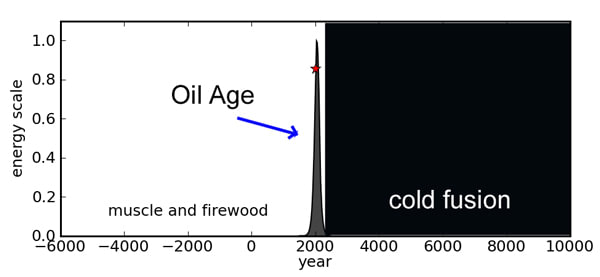
The Oil Age is a blip. Cold fusion can take humanity beyond what is foreseen.
Cold Fusion Now!
Related Links
M. King Hubbert on Nuclear Energy by Ruby Carat March 22, 2011
New PCI Study Concludes No Combination of Alternative Energy Systems Can Replace Fossil Fuels by Richard Heinberg November 13, 2009
Answering “Nine Critical Questions to Ask About Alternative Energy” by Jed Rothwell January 20, 2011
Cold Fusion and the Future by Jed Rothwell download .pdf
Oil to Nickel: The Ecat Energy Equivalence by Ruby Carat October 4, 2011
We undergo periodic ”paradigm shifts” rather than solely progressing in a linear and continuous way. These paradigm shifts open up new approaches to understanding what was considered invalid before. This implies that the notion of truth, at any given moment, cannot be established solely by objective criteria and is defined by consensus reality.
For instance, most people’s notion of the truth is the “Scarcity paradigm.” An example of the Scarcity paradigm is the belief that while food production expands linearly, population grows exponentially.
In other words, comparing worldwide population growth rates to global resource consumption rates it seems clear that we are running out of resources (and time). Right now there is almost seven billion people and by mid-century it will probably be around ten billion.
We are running out of food, water, fish, and oil to satisfy this rapidly growing population.
Since 2005 the price of wheat, corn, and rice has more than tripled, which reflects a dwindling of global food stocks. We are already farming around 80% of the arable land with reports on climate change showing crop production declining by ten to twenty percent in the next ten years. By 2030 demand for food is expected to increase 50%.
Only half a percent of the world’s water is fresh, and many aquifers have been nearly pumped dry, so demand will far outstrip the supply in the next 30 years.
Bottom trawling destroys about 6 million square miles of sea floor each year, and according to most projections we will be the generation that will run out of wild fish.
But worse is running out of oil because the modern world was built with it and runs on it. It takes about ten calories of oil to produce one calorie of food. Around half of the fuel consumed is oil product and more than half of that oil is used for transportation, a very fast growing sector of the world economy. It is estimated that demand for oil will increase 50% by 2025.
On the other hand, oil production has been flat since 2005. Peak oil, the point when maximum oil extraction has been reached (after which it will go into terminal decline) is near.
Such facts bring about cynicism, pessimism, and despair. Most people believe that the world is going downhill fast and there is nothing anyone can do about it. The hole is too deep to climb out of, and any information that confirms that suspicion will be remembered, while conflicting data will not even register – a confirmation bias.
Furthermore, there is a direct link between imagination and perception. We are saturated with “if it bleeds it leads” news reports. Our brain evolved prioritizing immediate threats, and while many dangers are probabilistic, our mind can’t easily differentiate between the improbable and the likely.
This knee jerk things-are-going-down-hill moaning pessimism is incredible from people living amid luxury and security that their ancestors would have died for. Innovation has played a huge role in averting disaster.
For instance, mankind was reaching the limit of our ability to feed ourselves when early 20th century chemists invented a technology to produce fertilizer. The Haber process sustains one-third of the population today, and it is estimated that half the protein within human beings is made of nitrogen that was originally fixed by this technology.
Optimism rather than pessimism is a sounder basis for a paradigm accessing reality. A true measurement of something’s worth is the hours it takes to acquire it, and we undoubtedly have more free time and more ways to spend it than our ancestors.
We’ve seen enormous progress in the last couple of centuries. Today, most poverty-stricken Americans have a TV, telephone, electricity, running water, a refrigerator, and indoor plumbing, luxuries the richest men on the planet didn’t have one hundred years ago.
In particular, there is a new clean, very very cheap, and super abundant energy technology emerging called “Low Energy Nuclear Reaction” (LENR for short). It uses hydrogen and nickel to produce heat. No nuclear materials are used for fuel, and none are produced.
“Over 2 decades with over 100 experiments worldwide indicate LENR is real, much greater than chemical…” —Dennis M. Bushnell, Chief Scientist, NASA Langley Research Center
“Total replacement of fossil fuels for everything but synthetic organic chemistry.” —Dr. Joseph M. Zawodny, NASA
Unfortunately, the Scarcity paradigm is preventing people from believing this. The real possibility of electricity too cheap to meter is dismissed due to a confirmation bias. People’s minds can’t readily imagine this new energy technology being real, so they perceive that it is impossible.
Since any new technology needs investment for research and development, this Scarcity paradigm is a self-fulfilling prophesy. While there are new technologies emerging to address a score of scarcity issues like clean water, food availability, sewage disposal, security, housing, communication, education, information, environmental degradation, and transportation, many hinge on the abundance of cheap energy.
To summarize, most people believe that the world is going downhill fast and there is nothing anyone can do about it. Our mind can’t easily differentiate between the improbable and the likely. The tragic result is that we have difficulty imagining things getting better, which leads to the knee jerk rejection of likely solutions. If we could make the shift from the Paradigm of Scarcity, which so many people have so much invested in, to the Paradigm of Abundance, which seems too-good-to-be-true, a positive feedback will occur, where every new innovation will speed the next.
Our future will be so bright we’ll have to wear shades. The only catch is that we have to believe.
Last summer, Cold Fusion Now left their HQ in beautiful Eureka, California for an extended stay with family on the east coast. We visited our local power plant, and headed out, stopping in Los Angeles to do art actions, send letters, and make a movie.
Then, a tour across the United States and the history of cold fusion took us just about from corner to corner. We returned back to the left coast this year low-budget style, going through hill and dale across the southern US, burning gasoline and taking the inventory of effects of The End of Oil Age.
The expectation of a flip in the arrangement for living on this planet spreads through an undercurrent of anxiety at the real mess we are in. Many people here in the US are in a type of stunned muteness as their notions of the world dissolve before them, and don’t understand why.
I’d say we spoke with a hundred+ individuals one-on-one in the context of a new energy paradigm and distributed the last of the stickers on hand (one thousand stickers distributed in total over two years). We spoke with people in the streets, and scientists in the lab. Everywhere, an eager ear to hear the news.
It’s all about accelerating the meme of hope: we don’t have to live this way.
We can choose another path and create that reality with each thought – and action.
C’mon along as Cold Fusion Now recounts the actions taken on the Cross-Country 2012 return to the Left Coast!
Miami, Florida
DJ Le Spam and the Spam Allstars
Half-a-year in Florida was spent researching and writing. While I was supposed to be writing a book about how the alphabet created math and science during the Ionian Revolution, I couldn’t stay away from the almost constant news about cold fusion. But there was a break. Almost every week for months, I went to DJ LeSpam‘s casa, and we jammed up mucho musica on stringed instruments. I have been learning the ukulele, and he played guitar, tres, and banjo.
DJ Le Spam is sound artist Andrew Yeomanson who started the Spam Allstars ensemble in the mid-nineties with yours truly, who played saxophones and flute back then. [visit] Though I left the area for a teaching job, Andrew kept the music alive. Today, the band gigs 3-4 times each week in Miami and South Florida. DJ Le Spam also curates museum performances and plays at nationally- and internationally recognized events. He is a bona fide expert in early Cuban jazz and regularly spins rare recordings at private functions.
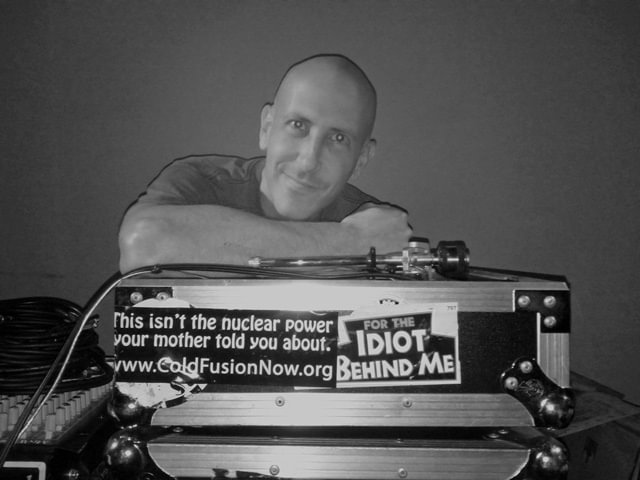
Miami, Florida DJ Le SPAM has fusion-powered gear.All these activities occur with a Cold Fusion Now sticker right upfront his main instrument. Last year for a local Halloween community event, the band played the NBC6 Miami television station with the sticker in full TV Body view. [visit] At a few gigs that I attended during my stay, one a huge Coral Gables-area block party, the other a small intimate club in La Pequena Habana, I spoke with lots of people and gave away info and stickers with the Cold Fusion Now website address.
As there’s nothing like art to communicate the impossible and inspire the incredible, I wrote a movie script for Andrew and his moviemaking pal Juan Maristany [visit] to make involving his car, his cat, and cold fusion. It’s called “A Car, A Cat, and Cold Fusion“. The plot involves a Hammond Organ, which contains some 3 grams of palladium in its electronics, Ernie Ball nickel guitar strings, a 1960s-era black sports car, and Andrew’s kitten Lil “Crisis” Crissy, a tiny bundle of fluff rescued from a Miami parking lot. You’ll have to wait for that action on screen; I’ll only say that there are Superwaves and the fight for free energy as the backdrop!
Andrea Rossi
I hooked up with Cold Fusion Now’s Eli Elliott and we got the opportunity to interview Andrea A. Rossi [video], the inventor of the first commercial cold fusion energy generator. We drove from Broward County down to Miami Beach to meet with Mr. Rossi for an hour between 3 and 4 o’clock at which time he’d have to step out.
We met him at his office in Miami Beach. It was situated close to Lincoln Road where cafes, boutiques, and art galleries lined the walkway. We parked inside the garage and took the elevator up to his place. He kindly offered coffee and drinks. We didn’t have much time and hurried to decide where to sit.
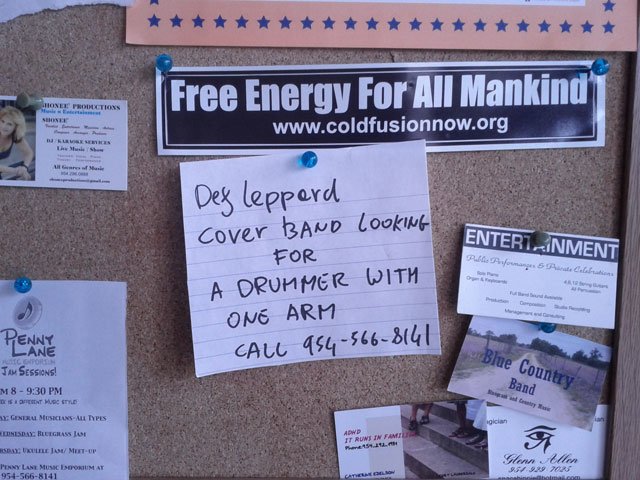
Armando's Penny Lane Music Bulletin Board.There were books stashed everywhere; neatly stacked magazines on space, books on fiction, non-fiction, physics, and paperback mystery novels. We brought him a doumbek and some CDs of the Spam Allstars and Armando, the local banjo player who emigrated from Roma, Italia and owns Penny Lane Music Emporium in Ft. Lauderdale. [visit]
I went through some of the questions I would ask Mr. Rossi while Eli set up the cameras and microphone. There was only one he wouldn’t answer.
Eli and Andrea together for a Polaroid after the shoot.“I was wondering if we could go down to the new factory location and take a few pictures?”, I asked innocently.
“I’m sorry”, he said, smiling and shaking his head regrettably. “I cannot tell you the location of the factory.”
“Oh we don’t have to disclose the location – we’ll go blindfolded!”, I assured.
Laughing, he said “No, no, we need to work in peace.”
Drat. That sure woulda been a scoop.
But who can argue? I dropped the matter knowing that these small, independent companies working on new energy need all the support they can get. There is plenty of friction surely coming down the pike as powerful forces behind regulators slow the dissemination of this breakthrough technology to save a dying economy. We as supporters want to make it easy as possible for these companies to operate and thus accelerate the process of moving away from dirty fossil fuels and dangerous nuclear power plants to clean, abundant cold fusion energy.
Man in the Street Miami, FloridaThe interview went by so quickly, I had three times as many questions than I had time to ask. After Polaroids, Eli and I packed up and departed. We walked around Miami Beach and soaked up the sub-tropical vibe.
We met this fellow on the street, a good spirit, struggling, whose name I cannot remember now. We spoke about what was going down on the new energy front. When his friend came by, the two walked away. My friend here began telling his friend what I was saying about cold fusion, ‘It’s nuclear power from the hydrogen in water’.
Therein lies the power of conversation. No matter where you are, no matter who you’re with, talking about cold fusion only creates a larger set of minds thinking positively about the future.
St. Petersburg
Jack Kerouac
Ruby puts a message in Jack Kerouac's box.On the way out of Florida, Eli and I made a stop in St. Petersburg where his family has a house. Eli is an artist, writer, independent filmmaker who is really into the Beats, the Beat Generation artists, that is. So we went on by to Jack Kerouac‘s’ house, which lay empty and sad-looking with legal-ownership in dispute. We picked up some trash and shook the front-door mat out to spruce things up and I dropped a sticker in the mailbox in Jack’s name for whoever might find it.
We then went to the bar where Jack Kerouac hung out, which was pretty far from his house. [visit] Since Kerouac didn’t drive, it’s speculated that he traveled on bus, since no one seems to remember him on a bike.
During the friendly conversation that can occur at a local pub, a former tattoo-artist-now-cartoon-graphic-artist at the bar asked where we were headed next, and I said, “Well, I’m going to the Nuclear and Emerging Technology for Space Conference outside of Houston. A fellow is going to speak on a new energy technology that he feels could power spacecraft for long voyages.”
The guy looked up at me, stunned; the pool player chuckled to himself, and whole bar went silent.
“Huh?”
Eli’s been through it before, so he knew what to expect when I started ministering the Cold Fusion to the crew. Needless to say, the bar where Jack Kerouac drank held an enthusiastic bunch, lifted-up by the possibilities offered by this revolutionary new energy. I was encouraged to put a Cold Fusion Now sticker on the bulletin board, and I did, to be seen by the many locals, poets, musicians and tourists that come by to honor this great voice of a generation.
The Woodlands, Texas
George H. Miley
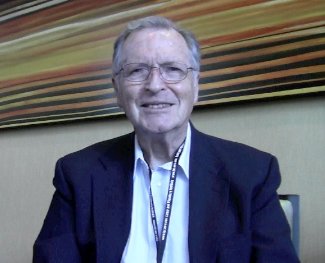
It was along Highway 90 through the Gulf Coast to The Woodlands, Texas for the NETS conference. At NETS, I spoke with Professor George H. Miley of the University of Illinois Urbana-Champagne who would be speaking to rocket scientists about low-energy nuclear reactions LENR in his talk A Game-Changing Power Source based on LENR. [visit]
He was reticent about being videoed, but did agree to some later in the interview which I’ll be editing in the coming months. However, I was glad get audio of our conversation as it helped to describe his theoretical ideas on LENR loosely summarized as they were in the interview transcription.
Professor Miley is assisted in his LENR research by undergraduate students at the school, but at this conference, he was accompanied by two super-smart and hard-working graduate students. They weren’t so familiar with Dr. Miley’s LENR research as they had their hands full with the plasma thruster technology they were designing, as well as passing exams, but they both indicated how much they enjoyed working with Dr. Miley and how much fun it was designing rocket engines. Of course, Professor Miley was sitting right there! But it was all in fun, and the students were having a great time connecting and speaking with the other planetary scientists and spaceship designers.
The very personable Dr. Miley was kind and accommodating with his time. He spoke with the demeanor of someone who is very ‘even-keeled’. He has been researching cold fusion since 1989 and lived the history of this ostracized community, yet he has no anger about the injustices perpetrated during these past two decades. A consummate professional scientist, the hurdles and blockades only inspired him to succeed even more at unlocking the secrets of this mysterious energetic reaction between hydrogen and tiny pieces of metal.
Yes, Dr. Miley prefers to speak through science, and he certainly does. An octogenarian, he’s got the energy and looks of a much younger man. At the conference, he was busy attending meetings, talks, supervising students’ talks, poster sessions, and of course, speaking himself on LENR. I was grateful that he took the time to speak with me and explain his research in simple terms so that I could better represent this science to a larger audience.
Session 462 Advanced Concepts: LENR, Anti-Matter and New Physics
I sat upfront during the Session Advanced Concepts session hoping to get good pictures and audio, but I was only able to get an audio recording for transcription purposes. [visit]
The talks were alot of fun, with close to two dozen or so attending the late-Friday afternoon session. I might have been the only woman there, and I was surely the only non-rocket-scientist in attendance.
After the lectures, one of the organizers associated with Johnson Space Center JSC came up wondering who I was, and what was my purpose there. I told him I was passing through at an opportune time to meet up with Dr. Miley, and that I did clean energy advocacy for cold fusion. “Oooooh, I heard there would be someone here like that.” So, the JSC crew was alerted to my impending presence beforehand! Well, they did a great job with the lectures and all got a Cold Fusion Now sticker with the website on it to learn more about this impending new energy technology that offers a solution for both domestic and off-world energy problems.
Roswell, New Mexico
Roswell Museum of Art and Culture
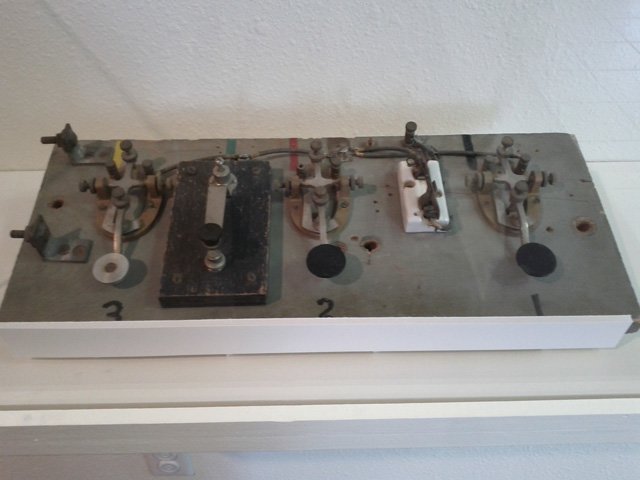
Goddard's launch control board composed of telegraph keys. The first key fired the igniter, releasing a weight that knocked open the gasoline valve as it fell. The other keys were for aborting the process. After NETS, I made my way through Texas and up into Roswell, New Mexico, a town I always like stopping in. This time, I checked out the Roswell Museum and Art Center [visit] where they have a fabulous Robert Goddard exhibit [visit].
Robert Goddard was an early rocket pioneer who, with funding from Charles Lindbergh, set up a lab in the Roswell area during the 1930s. The museum had a reproduction of his workshop and lots of little -and big- parts of rockets and tools that he used to build his craft.
On the way out of the museum I stopped by the front desk to sign-in as a Visitor, and struck up a conversation with the proprietors. Somehow, I got started on clean energy advocacy for cold fusion, (how did that happen?) and the one fellow said, “Yeah, they’ve been keeping that back for years, but now there’s a fellow, hmmm what’s his name… who’s coming out with some device…..”
“Oh wow, do you mean Andrea Rossi and his Ecat?”, I said.
“Yeah, that’s it!”
Well, it’s always nice to meet someone with the knowledge that cold fusion is real and almost ready, and we stood and had a little session on the topic. The second guy hadn’t really heard much about it, but he was interested, so I gave them both stickers with the website address, and they said they’d check it out.
Alamogordo, New Mexico
Museum of Space History
Starchaser Rocket Booster outside the Museum of Space HistorySouth of Roswell is Alamogordo and The Museum of Space History. It sits in the foothills above Alamogordo and White Sands, a huge expanse of white gypsum dunes that collected over millions of years from an ancient lake. [visit] The White Sands Missile Range is adjacent, as is the Trinity Site [visit], the spot of the first atomic bomb test.
The museum has lots of early space program artifacts and historical missile technology. They had a Sputnik reproduction, and outside was this rocket booster from Starchaser that looked like it just arrived. [visit]
Oliver Lee State Park
The desert at Oliver Lee State Park.I camped out by Oliver Lee State Park [visit], a beautiful oasis in dry surrounding desert. I met a Volunteer manning the Park Office and we had a great conversation. He told me about the Aborigines in Australia who have a special class of people called the Listeners. Their only job is to listen, not give advice or reprimand, just listen. If you’ve got a problem, you go to them and just let loose, and you won’t be judged, or consoled, but you will be able to get something off your chest. That, in and of itself, was enough to restore balance to the soul, in many cases.
As we spoke of the insanity of this world, and what it would take for people to learn how to live in peace with each other, with respect for all life on this planet, this retired, full-time RVer Volunteer Ranger’s words of wisdom on what I could do in my own small way to contribute to this world I seek were simple and stunning. He said,
“It doesn’t cost you nothing to say a kind word, and it doesn’t cost you nothing to listen.”
Wow. And all I had to give him was a Cold Fusion Now sticker.
When I came back from my hike, he made a point to tell me he’d check out the website. Going away, I thought to myself that I would really start to listen more. So good am I at talking; it’s that listening that needs more practice.
Santa Fe, New Mexico
Edmund Storms
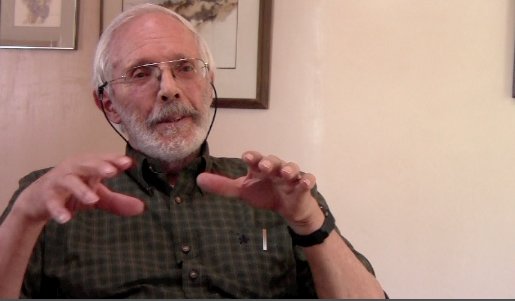
Edmund Storms speaks with Cold Fusion Now on a variety of issues.An opportunity to listen presented itself straightaway as I then rolled on up I25 to speak with Dr. Edmund Storms who lives and works in Santa Fe.
He was finishing writing A Student’s Guide to Cold Fusion [visit] after completing a full-survey of the field, becoming up-to-date with the most recent experimental results. Looking at a wide range of published papers, he was searching for a connection, trying to piece together a logical structure that would allow him to name the conditions of this Rumplestiltskin-like reaction.
He spoke about his views on the Nuclear Active Environment NAE, now believing it’s the tiny cracks and spaces that are key to initiating a reaction. When hydrogen (or deuterium) are caught in the just the right-sized space, and jiggled with the right resonant frequency, the nuclei will somehow “fuse” together creating the much sought-after excess heat effect that is the focus of worldwide research.
If he’s right, naming the NAE is only the first step. There still needs to be a model for how the nuclei overcome the Coulomb barrier and join together during the reaction. Dr. Storms will be partnering with colleagues to test his hypothesis in the coming months, as well as writing a shorter, article-sized version of his ideas in A Student’s Guide. But, if his hypothesis bears out, it may mean that cold fusion can occur in all kinds of materials. Hydrogen would only need just the right space, and just the right frequency, and what an energy breakthrough that would be.
Our initial discussions were not on tape, so focused was I on following his words, but later we sat down for a video interview and I asked him some pointed questions about the current developments in the field. I’ll be editing that in the coming months.
The Storms' kick up the dust around their Western outpost in these steel horses. Note the properly groomed bumpers.Carol Talcott Storms is herself an early cold fusion researcher now artist who partners with her husband Edmund on all issues both domestic and scientific. I was able to snap a picture of their parked vehicles, which carry them around this Western town proclaiming the new energy science happening right in their own backyard.
On the way out of town, I spoke with the proprietor of Nicholas Potter Bookseller, a rare and used-book shop in old town Santa Fe, [visit] about the research occurring right in his own neighborhood and he was impressed. A special author book signing event might be a great opportunity to get The Science of Low Energy Nuclear Reaction for his shelves! [more]
Magdalena, New Mexico
The Very Large Array Radio Observatory
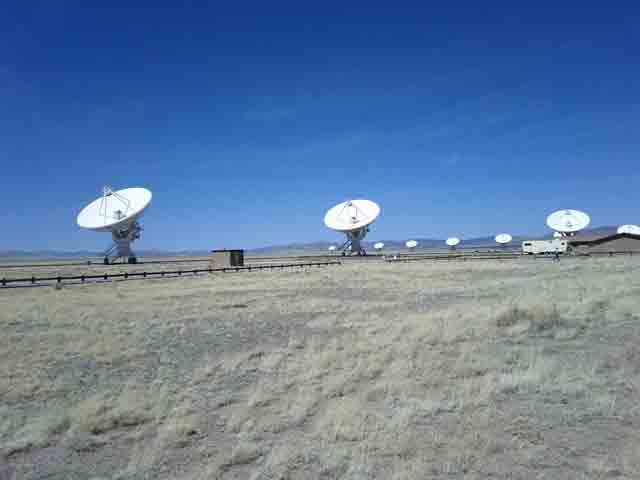
Very Large Array of dishes capture radio waves from space.The next stop was the Very Large Array Radio Observatory 60 miles west of Socorro, New Mexico in a very remote area. [visit] It was there they filmed the movie Contact based on Carl Sagan‘s novel of the same name. Of course, when I got there, it was closed, sort of.
There was some kind of event going on for astronomers, and everyone had badges – except me. But the door was open, and so I sneaked in to leave a few Cold Fusion Now stickers on the table, and snuck out. No conversations were held as I wasn’t supposed to be there, but I snapped a few photos of the dishes and started back to the main highway.
And that’s when my truck broke down. (See what you get for sneakin’ around!)
Magdalena, New Mexico Palimpsest: Bank, Cafe, Ice-Cream, Print Shop My poor ole truck Baby squealed in pain just two blocks from the only garage within 30 miles. Miraculously, I was in the tiny town of Magdalena. It was Friday afternoon at 5PM local time and I’d have to wait till Monday for parts.
Magdalena is an old Western cattle town, now economically-depressed. There’s no grocery store, food items are purchased locally at the gas station mart, but the auto garage had excellent mechanics who knew right away what was needed and fixed it promptly when parts arrived Monday morning. Thank you Winston’s Auto and Wrecker Service!
Truth or Consequences, New Mexico
America’s Spaceport
There is a town in New Mexico named Truth or Consequences, but the locals call it T or C. I trekked there to see Spaceport America, the new facility being built by Sir Richard Branson for his Virgin Galactic fleet of spaceships. [visit] The New Mexico Space Authority also kicked in and there will be other private space company launches as well. I’ve wanted to tell Sir Richard about the new energy industry that’s ready to pop and blow all other markets away, and give him a Cold Fusion Now sticker, for a long time now.
Spaceport America still under constructionI took the 30-mile drive outside of T or C to the Spaceport. I was unable to access the building when I visited on my way east. As I approached this time, I could see the cement trucks and cranes from a distance, and knew it was still a construction zone. At the perimeter, I met the very same Security Guard that I had met last summer. He remembered me, too.
“May I go and check out the Spaceport?”, I asked.
“Nope, sorry, still under construction, but you can come back on the weekend for the tour.”
Well, I wasn’t going to be able to stick around the whole week for the tour. I pulled over in the little spot he directed me to, and snapped a few shots of the still-forming structure. Apparently, they’ve been having alot of engineering issues that have put the project over a year behind schedule, and it may be two years behind. There’d be no opportunity to personally lobby Sir Richard this time around.
Artesian Bath House and RV Park
Hot-spring mineral bath from the 1930s in Truth or Consequences, New MexicoIn T or C, I pulled into the Artesian Bath House and RV Park [visit]. A parking spot for the night with a $3 hot-spring mineral bath was waiting for me. The owner was a long-time resident of the area and had collected many Indian arrowheads and totems during long hikes in the wilderness. He gave me an arrowhead and some Apache tears as a gift, and I gave him an ancient Egyptian Eye of Horus and a Cold Fusion Now sticker. After exchanging wampum, I continued westward.
Tucson, Arizona
I left New Mexico timidly, hoping my truck would make it through the barren southwest desert. In Tucson, Arizona, I holed up to write-up the Miley interview. The website had been neglected for quite some time while I’d been away, with lots of broken links and such due to the transition to a new platform made right before I left Florida. Fixing things would have to wait until I made it through this trip, but people were wondering “Where’s the news about George Miley?”
Saguaro National Park
Saguaro Cactus off 77 north of Tucson (not in the park).While in Tucson, I visited the Saguaro National Park. [visit] where I took pictures that somehow disappeared. What a bummer. The Saguaro is the iconic cactus of the Southwest and the park is filled with incredibly beautiful stands of Saguaro at whose feet lay the early spring-flowering desert flora.
When leaving the park, a couple down from Phoenix was sitting at the picnic table and asked where I was from. That started a conversation about energy, and before you knew it, they had a sticker in their hand, and were intrigued about investment opportunities. I told them to learn more about it on the website first before doing anything with their dollars, and said my goodbyes to these most pleasant and positive people.
Titan Missile Museum
I also bounced over to the Titan Missile Museum, a silo site with a decommissioned Titan missile still inside. [visit] Titan missiles carried devastating nuclear bombs and were part of the MAD Mutually Assured Destruction strategy during the Cold War years. Portions of the movie Star Trek First Contact were filmed there as well. Scenes where Zephram Cochrane readied the first rocketship with warp drive used this very silo in 1996.
Titan Missile Control Room with 1 second to launch.Unfortunately, the pictures I took here vaporized as well, but I caught a little video and here’s a still. During the tour conducted by a former Titan missile unit member, I learned that one of the first positions for women in the active-duty armed forces was the position of the person to Press the Button for launch. Wow.
The resident historian Chuck Penson, featured in the video at the beginning of the tour, [visit] followed our group around down in the underground rooms, and though I couldn’t find him afterwards, I left a Cold Fusion Now sticker for him at the front desk.
zed short
While in Tucson, I also met up with zed short, author of the short-story “The Believers” [read] and the play “Waiting for the E-cat: A comedy in two acts“. [read] He lives in a very remote desert region, and so he came up to meet me in town. We talked about the recent news and had a great conversation on how to move forward with this campaign for ultra-clean energy. He put a sticker on his pickup and I encouraged him to continue to write in service to a new paradigm of living.
Cold Fusion Now knows the importance of including artists in the new energy movement, for they give words and feeling to worlds not-yet-born so that we may recognize and become familiar with the new.
Biosphere2
Biosphere2 looking at large greenhouse and habitat modules.North of Tucson, is Biosphere 2, originally built to research man-made environments for space habitation, now a huge facility for studying the interactions and effects between elements of ecological systems. [visit]
I took the tour and saw incredible landscapes of desert, coastal, and rainforest reproduced on a small-scale in a huge greenhouse. These micro-environments are used as test cases to describe the real thing on Earth. Currently, scientists are testing the effect of less water in the rainforest biome. While they won’t be killing it by withholding all water, they’ll be reducing the amount of water provided to the forest and monitoring the effects. Obviously, parallels between these artificially-created micro-environments to Earth’s rainforests will only go so far, but having even the smallest amount of data can give some direction to managing the last natural areas of the planet.
At the end of the tour, back in the lobby, I knocked on the door on the manager’s office.
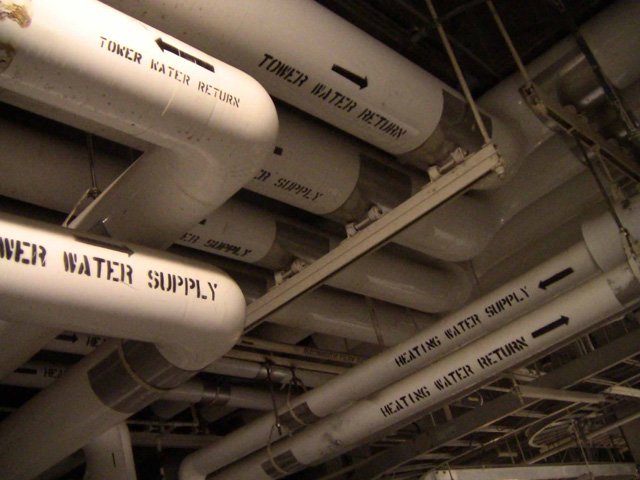
Underneath the Biosphere2, there are many pipes carrying lots of hot water.“Hi, I do clean energy advocacy for cold fusion, and I believe your facility here might benefit from this new technology. Would you mind passing these stickers along to the people involved in heating and power?”
Curious, but encouraging, the woman replied smiling, “Why yes, I’d be happy too, thank you.”
I spent a moment telling her what cold fusion was, and she seemed intrigued. As I left, she carried the stickers out with her, walking away to presumably deliver them.
Meteor Crater, Arizona
50,000 year old meteor crater is one of the best preserved on the planet.I was on my way to stay with friends in Las Vegas with a route that would take me by Meteor Crater, a huge hole in the ground made by a meteor 50,000 years ago. [visit] In the early twentieth-century Daniel Barringer spent decades mining and researching the rock, metal, and glass left by the impact.
Plaque to Daniel Barringer describes heroic scientific effort.From reading the information plaque on the observation deck, you would walk away thinking that Mr. Barringer was a tireless man of science, his lone effort dedicated to proving the space-origins of the pit. I thought of the parallels to cold fusion scientists today and sighed.
But then a Guide appeared and I asked about Mr. Barringer.
“Oh no! He was trying to get rich by mining the metal left. He thought that he’d be able to find a big cache of the meteorite buried somewhere, and make alot of money by mining it out.”
I had to laugh, thinking, well that’s how it is, isn’t it. Taking a chance to win big – or just make a living, and you end up making breakthrough discoveries about this history of our planet, but penniless. Doesn’t that sound familiar? For many researchers in the new energy field, they are just trying to pay the rent, hoping to strike it rich with a new form of power that will give human beings a second chance at a technological future on a clean and green world.
A storm was coming in that weekend, and no “rim tours” were being held due to the really heavy winds. Could I escape the storm going north?
Grand Canyon
This picture is no substitute for physically experiencing Grand Canyon.Grand Canyon is one of the most impressive natural formations on Earth. [visit] Words cannot express the overwhelming grandeur that this stretch of rock commands. On this day, it was packed with visitors from all over the world snapping photos which never convey the feeling of standing before this ancient sculpture of time.
But the storm was coming in here too. It rained, it hailed, and was so windy I could barely stand upright. In the few moments of weather transition, I snapped a few photos myself and drove on down the mountain to southern Utah to escape the storm.
Glen Canyon Dam at Page, Arizona
Glen-Canyon-Dam Page, Arizona
Glen Canyon Dam looking down.I passed by Glen Canyon Dam, which provides electrical power to the region. It is an incredible feat of engineering, and I looked upon it amazed at the abilities of human beings.
But I kept thinking how all this infrastructure will one day be obsolete, as cold fusion slowly infiltrates society, and despite being technically spectacular, I said “with good riddance”. Power grids are inefficient, and water in the desert is not to be toyed with. And dams don’t last forever. At some point, their lifetime is reached, and they need to be rebuilt. What a huge use of resources!
When electricity can be made by small, portable cold fusion units, free of the grid, our lives will change completely and we’ll have an opportunity to explore life as we’ve never explored it before.
Kanab, Utah
Zion National Park
Zion National Park in a desert snowstorm.The storm hit big in Kanab, Utah. I decided to hang around another day till the roads cleared up. At the Sun and Sand Motel, I spoke with a professional truck driver interested in science and cold fusion. Both he and the motel owner got stickers, which will go on their trucks. We then took a ride to Zion National Park to see it in the snow. [visit]
There’s nothing like a personal touch when enlarging a movement for clean, abundant new energy. You talk to somebody, and they talk to two people, and those two people talk to two people each, and you can see how this can avalanche.
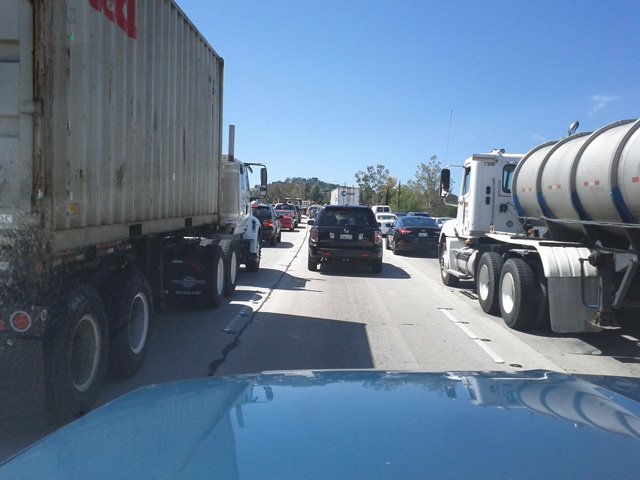
I had been on the road for almost a month, and living out of my truck was taking a toll. I had to cancel the Las Vegas stop, and headed to Los Angeles, where I’d be staying for the summer.
Spaceport at Mojave, California
Rocket engineers will see this when they come in for lunch at the Mojave Spaceport.On the way, I stopped at my favorite little desert hideaway, Mojave. There’s not much to Mojave, but they do house the most cutting edge private space companies in the country. That’s where Scaled Composites, designers and manufacturers of the SpaceShipOne and SpaceShipTwo crafts are building the fleet for Virgin Atlantic.
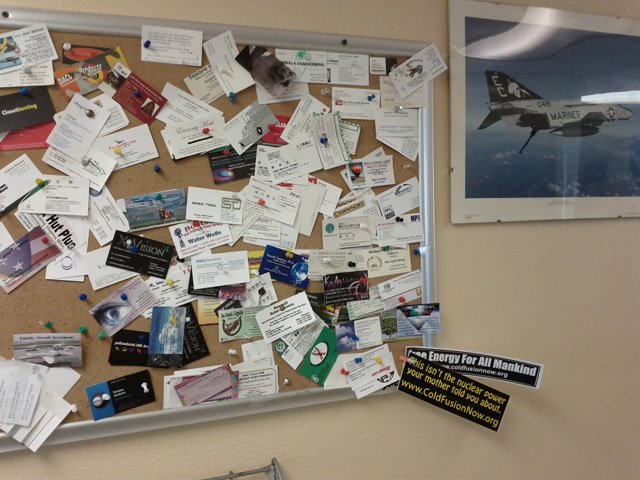
I stopped in the Spaceport’s Voyager Restaurant while I finished writing up the Session 46 Advanced Concepts. (And all typos, grammatical errors, and mixed metaphors are now corrected! Thanks Steve Schor.) I put a couple of my last stickers on their bulletin board, so all the space heads would see it when they came in for lunch, and said goodbye.
Last Stop for Now: Los Angeles
In Los Angeles, the Welcome Wagons greeted me.I was happy to get to Los Angeles. There is much work to do. A new documentary will be forthcoming featuring our own James Martinez. There will be alot of new eyeballs coming to cold fusion as the next year unfolds, and we’ve got to be prepared for an onslaught of attention.
I regret missing my friends up in New England. Missing out on Cold Fusion 101 was a drag. Sadly, I was not financially able to stay up there during the winter and camping options are limited in the city. And not stopping in to see the many labs along my route was disappointing, but hey y’all: You haven’t escaped yet!
I have the feeling there will be other tours, and other trips, and who knows when some woman in a big blue truck will show up at your door and hand you a sticker! Cold Fusion Now continues to drive the most important issue facing humanity to new heights, for our survival as a species may depend on this revolutionary cold fusion energy technology.
You can see from this travelogue that being a clean energy advocate is easy and fun. It just means talking to the people you meet about what’s going on, and giving them a place to go for more information. I hope that you are inspired to take on the challenge, and do what you can to support
The following is a further posting in a series of articles by David French, a patent attorney with 35 years experience, which will review patents of interest touching on the field of Cold Fusion.
April 23, 2012 –For some of us who have not been following the ColdFusion scene very carefully, Brillouin Energy Corp may seem like a new upstart. Actually, they have been around for some time. But they have now “come out” with a very complete and informative release that describes their initiatives, and reported “breakthrough” in the ColdFusion universe. Here is a summary description from Pure Energy Systems. Their slogan is apparently: “Understanding how LENR works will enable us to be first!”
This website is very generous in explaining their theory for generating energy through a lattice assisted nuclear reaction – “LANR”. This theory is based upon electron capture with a twist. Coherent phonon waves within a host lattice created by pulsating electrical current provide energy levels in excess of the 782 KeV threshold needed to produce a neutron out of the combination of an electron and a proton. The accumulating neutrons eventually form 4H – “hydrogen 4” which is an entity I had never heard about. It is an atom that contains one proton and three neutrons. Apparently, once created hydrogen 4 can convert to 4He – “helium 4” with the emission of a beta particle and without releasing penetrating gamma ray radiation. Beta particles, high-speed electrons, are likely to be readily absorbed within a metal lattice and its surrounding containment; accordingly, they are not readily detected. They would certainly not represent a radiation hazard by themselves.
The website contains a generous dose of mathematics. I do not pretend to understand the physics, particularly the analysis of Hamiltonians. I am going to have to study that subject further. But there is a story in the patent applications that have been assigned to Brillouin at the US Patent Office, and in the corresponding applications filed elsewhere in the world.
Apparently, as early as December 29, 2005 the inventor Robert E. Godes initiated a first US Provisional patent application which has served as a priority document for a number of filings. The year later follow-on US non-provisional ran into trouble on the basis that it was directed to “Cold Fusion”. As is usual, the US Examiner issued a rejection which was subject to being withdrawn if the applicant could prove that the invention as described works, i.e. the invention delivers on its promise. Apparently Godes, then operating on behalf of Profusion Energy, Inc. of Alameda, California as the assignee/applicant, encountered continuing resistance. Fortunately, as this application was part of the US patent system, after having been rejected in this first application another filing was made in the form of a US “Continuation” application.
This procedure is virtually unique to US law. A properly-filed US Continuation application enjoys all of the filing dates of the earlier application upon which it is based. The consequence is that there is still a US patent applicationpending which dates back to 2005 and which, if supported by proof of utility, could have significant impact on the exploitation of LENR systems in America.
Meanwhile, the earlier US priority filing and the subsequent non-provisional application made a year later gave rise to a PCT filing. That PCT filing, in turn, has matured into filings in Europe, Japan and China. This PCT application probably contains “new matter” not included in the original priority filing, but at the same time probably parallels the content of the first and second US non-provisional filings. A comparison of the documents would have to be made to determine this issue properly.
Note that there are a large number of countries for which patents have not been filed for this technology. In all of these countries, the invention as described in the published US and PCT applications on or about September 6, 2007 is available for use without obligation. Publication has made this invention unpatentable in all countries where applications were not already pending.
There are actually two PCT filingsthat have been made naming Robert E. Godes as an inventor; only one apparently relating to cold fusion; the other apparently relates to solid-state electronics technology which may be collateral to cold fusion issues. This second application should also be checked to determine its relevance.
Note, this search summary of published applications focuses on cases naming Robert E. Godes as an inventor. It is possible that further Brillouin applications are pending in the names of other inventors. Also, one or more further filings by Godes could be pending but unpublished if they are still within the 18 month secrecy window.
Of the applications now in national entry status derived from the PCT filing, the European applicationis the one of most interest. Examination has been requested for this application but has not commenced.
Using the US claims as probably being exemplary of what this series of patents aspires to control, we can now examine Claim 1 to see what can and cannot be done, if and when a patent issues containing this claim, without seeking permission from Brillouin Energy Corp. Claim 1 reads as follows:
1. An apparatus for energy generation comprising:
a body, referred to as the core, of a material capable of phonon propagation;
a mechanism for introducing reactants into said core;
a source of current pulses for establishing current pulses through said core, said current pulses inducing phonons in said core so that reactants, when introduced into said core, undergo nuclear reactions; and
a closed loop control system, coupled to said mechanism
– for introducing reactants and to said source of current pulses,
– for specifying operating parameters of said mechanism for introducing reactants and of said source of current pulses,
– for sensing one or more operating conditions, and for modifying one or more operating parameters,
thereby controlling the number of nuclear reactions and the depth of the nuclear reactions in said core so as to provide a desired level of energy generation while allowing energy released due to the nuclear reactions to dissipate in a manner that substantially avoids destruction of said core.
One of the first observations that can be made is that this claim stipulates that the coherent sound waves, the phonons, are generated by establishing “current pulses through said core”. Apparently, sound waves created by a piezoelectric effect, magnetostriction and or applied electrostatic fieldsare not intended to be within the scope of these exclusive rights. This might get changed in the course of examination if the Brillouin patent attorneys reconsider this claim. But they can only enlarge its scope if there is support for the larger ideas in the final, non-provisional filing for this application. That is the way patent procedure works.
Otherwise the above claim is a pretty well-written claim. Notice that it does not rely on any sort of theory. It simply describes a procedure which the application represents will deliver a useful result. That is what patents and patent claims are all about. You do not patent a theory. You patent how to get to a useful result.
Nevertheless, the full disclosure in the patent document is very interesting as a source of guidance for a theory that might work. Even if the theory put forward in the application is not correct, the patent, and its claims, can still be valid if the instructions for producing a useful result are accurate.
This application has already gone through the US Patent Office once when it ran into trouble for failure to satisfy the Examiner that it describes how to achieve the useful result. On this second pass, a different outcome may occur, depending on the nature of the evidence that is filed to support the promises that are being made.
Special learning point: you should not promise much in a patent application. A patent disclosure is not a sales pitch. You should simply say, effectively: “The invention delivers some degree of useful result.”
In conclusion, the Pure Energy Systems article first referenced above contains an excellent outline of the theorythat this company is apparently operating on. If they have managed to achieve reliable production of energy at the elevated temperatures that they represent in their website, they are going to have a breakthrough winner that should attract the attention of the world.
A Student’s Guide to Cold Fusion
by Edmund Storms April 2012download .pdf
Abstract “Evidence supporting cold fusion (LENR) is summarized and requirements an explanation must take into account are justified. A plausible nuclear-active-environment is identified by ruling out various possibilities and by identifying an environment that is common to all methods used to produce LENR. When this environment is combined with a plausible mechanism, many testable predictions result. These insights and proposals are offered to help clarify understanding of LENR and to suggest future studies.“
Dr. Edmund Storms is a former Los Alamos National Lab researcher who began his career in cold fusion just after the announcement by Drs. Fleischmann and Pons in 1989. While investigating the claims with team members, including Dr. Carol Talcott, he measured the production of tritium, a form of hydrogen, from active cells thereby confirming that nuclear reactions were taking place in the small table-top device. The investigation of this phenomenon has occupied Dr. Storms’ attention ever since. He is the author of The Science of Low-Energy Nuclear Reaction, a 2007 summary of the field sufficiently detailed for use as a textbook. [visit]
Dr. Storms recently conducted a full survey of the field assimilating the progress made by researchers around the world since the last edition of the Guide. These advances have been added to the new edition, along with fresh insight and analysis.
His recent review of research has also provided him with a hypothesis for the form of the Nuclear Active Environment NAE, those special conditions within a cold fusion cell that allows a reaction to take place. The proposed NAE is outlined at the end of the Guide.
If the hypothesis proves correct, this will hasten development of cell design by providing details of the environment that the cold fusion reaction needs to initiate. Experiments are now being planned at Storms’ Kiva Labs to determine if the proposal is correct.
A Student’s Guide to Cold Fusion is a good introduction to the field of condensed matter nuclear science as it relates to low-energy, or lattice-assisted nuclear reactions. The first part of the Guide is accessible to the non-scientific reader, while the subsequent parts go into more detail, challenging the minds of even professional scientists.