Andrea Rossi EcatSK demo

“The EcatSK is available now for industrial applications. If you want safe, reliable, competitively priced heat, we encourage you to contact us.”

That was the announcement on the EcatSK demonstration broadcast live on the Network at http://www.ecatskdemo.com/ January 31, in an event dedicated to Swedish scientist Dr. Sven Kullander.

From the Press Release:

“The E-Cat SK produces kilowatts of energy while consuming only grams of inexpensive and abundant fuel (hydrogen, nickel, lithium) over a period of six months.”

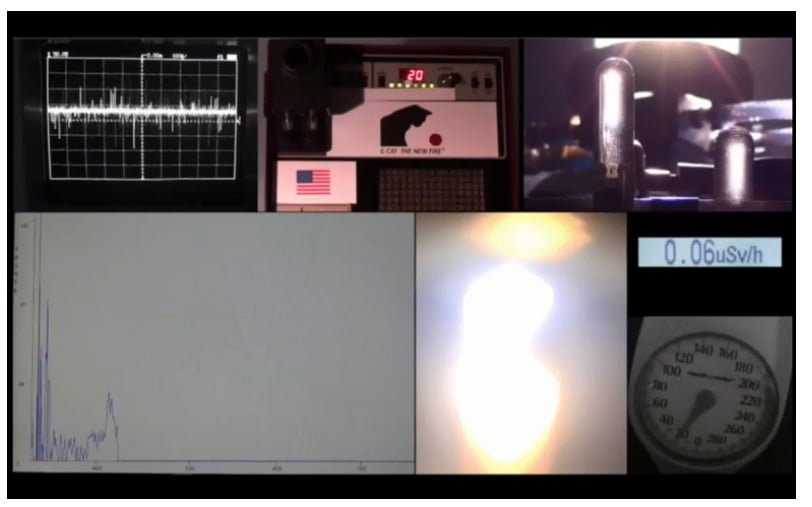
A screenshot from EcatSKdemo.com shows:
Watch a video of the demo here on Youtube.

But videos don’t translate into the real, physical world, yet.

LENR bad-boy Andrea Rossi, inventor of the EcatSK, draws ire from working scientists in the CMNS field for his theatrics and demonstrations that have yet to be confirmed by the community-at-large. He does not attend conferences or meetings, does not publish in JCMNS, and has little contact with active CMNS researchers. Documents from the very public trial with former partner Industrial Heat showed a decidedly uncooperative Leonardo Corporation working outside the bounds of normal business expectation.

Listen to the Cold Fusion Now! podcast episodes with Abd ul-Rahmann Lomax, who documented the trial, and Mats Lewan, who authored An Impossible Invention, a book that follows the development of Andrea Rossi’s Ecat.

But if LENR had a Human Resources center, they would be hard-pressed to find anything that resembled a mainstream scientific organization. The people who would tread into the pariah science of cold fusion, conduct advanced nuclear research in basement labs at their own expense, banned from publishing any corroborated results, and derided by their peers adorned with money and fame – are by self-selection uniquely fashioned individuals, and that quality intensifies at the fringes of the fringe.

Andrea Rossi escaped the US with $10 million and moved his enterprise to Sweden, where the QuarkX and new EcatSK have been developed. The EcatSK reactive material based on nickel and light-hydrogen has had a long history of making big heat.

Precedence for excess heat from nickel-hydrogen systems

In August of 1989, University of Siena Professor of Physics Francesco Piantelli discovered the anomalous heat effect in Nickel-Hydrogen systems, and made exceptionally large output power in the process. His collaborations with Professors Sergio Focardi and Robert Habel began in 1990.

Mathieu Valat of MFMP (L) and Francesco Piantelli (R).

Seventeen years later, Andrea Rossi asked Dr. Focardi to evaluate his then-Energy Catalyzer, and got a positive review. The relationship continued through Sergio Focardi’s death in 2013.

Sergio Focardi portrait after October 6, 2011 demonstration of E-Cat.

Dismissed as a con man taking advantage of an elderly scientist, we believe this early LENR pioneer deserves more credit. Cold Fusion Now! accepts that Andrea Rossi can make a reaction happen, but has problems controlling the reaction to make a technology, just like everybody else in this field.

Mats Lewan, author of An Impossible Invention, a book on the development of the Ecat, writes on his blog, that the new device “uses only minute amounts of abundant elements such as hydrogen, nickel, lithium and aluminium”.

Has this fuel changed from previous mixtures?

Nickel is a catalyst for the fuel

In Analysis of New Rossi PCT filing based on US Patent 9,115,913 issued 25Aug15 patent lawyer David French writes:

Among the embodiments are those in which the fuel mixture includes lithium and lithium aluminum hydride, those in which the catalyst includes a group 10 element, such as nickel in powdered form, or in any combination thereof.

In other embodiments, the catalyst in powdered form, has been treated to enhance its porosity. For example, the catalyst can be nickel powder that has been treated to enhance porosity thereof. [In those embodiments that include an electrical resistor, the].The apparatus can also include an electrical energy source, such as a voltage source and/or current source in electrical communication with the [resistor.] heat source.

Among the other embodiments are those in which the fuel wafer includes a multi-layer structure having a layer of the fuel mixture in thermal communication with a layer containing the electrical resistor. heat source.

In yet other embodiments, the fuel wafer includes a central heating insert and a pair of fuel inserts disposed on either side of the heating insert.

Read full article Analysis of New Rossi PCT filing based on US Patent 9,115,913 issued 25Aug15 by David French for more on brackets.

Furthermore,

The powder in the fuel mixture consists largely of spherical particles having diameters in the nanometer to micrometer range, for example between 1 nanometer and 100 micrometers. Variations in the ratio of reactants and catalyst tend to govern reaction rate and are not critical. However, it has been found that a suitable mixture would include a starting mixture of 50% nickel, 20% lithium, and 30% LAH. Within this mixture, nickel acts as a catalyst for the reaction, and is not itself a reagent. While nickel is particularly useful because of its relative abundance, its function can also be carried out by other elements in column 10 of the periodic table, such as platinum or palladium.

Reproductions of the Rossi Ecat have been conducted world-wide, with mixed results. The successful fuel recipe with the combinations and concentrations of critical elements is still unknown.
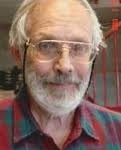
“Any element that reacts with hydrogen appears to support LENR – titanium, nickel, zirconium have all been explored. The big challenge is to find out what it is about those hydrides that is unique and makes it possible to initiate a nuclear reaction.” says Dr. Edmund Storms, a nuclear chemist and LENR researcher. “Rossi found that nickel is important, but there’s a certain lack of understanding of what Rossi did.”

“Rossi identified nickel as being where the nuclear reaction was occurring. But that is actually not the material he was using initially; he was using a nickel catalyst. A nickel catalyst is not pure nickel. It’s nickel that has been applied to some inert substrate. That’s the way catalysts work.”

Edmund Storms spoke with Ruby on the Cold Fusion Now! podcast and gave a tutorial on catalysts.

“There’s an acting metal that can break the hydrogen bond, and then, there’s an inert substrate on which the hydrogen atom can diffuse, causing what’s called spillover hydrogen. It’s that spillover hydrogen that is active for the reaction, not the hydrogen in the nickel. So there’s reason to think the nickel is not where the action is.”

Historical example of catalytic fusion

An example is found in the work of Les Case, a chemical engineer with four degrees from MIT who discovered what he called catalytic fusion using palladium and deuterium systems. Case found that a catalyst made by depositing palladium – in finely divided form – on charcoal, could be made nuclear active.
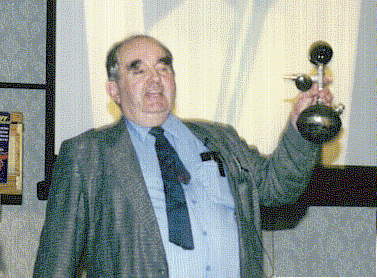
Graphic: Les Case in 1998 from http://www.angelfire.com/scifi2/zpt/case.html

Ten years ago, Case wrote, “I discovered that using certain standard commercial catalysts, one could get this fusion to occur under reproducible, mild conditions. This is the catalyst that I’ve set upon as being about the most effective that I currently have available. This is a standard palladium on activated carbon catalyst. One-half percent by weight of palladium loaded on this activated carbon— this is the key. You change this just a little bit and it doesn’t work— at all! But if you stay within the approved ranges, it works basically all the time.” -Infinite Energy Magazine July 1999

This was the experiment eventually reproduced by a team at SRI International led by Dr. Michael McKubre that also correlated the excess heat with the nuclear product Helium-4.

“Now, people said, ok the reaction is happening on the finely divided palladium,” continues Storms. “but that’s not necessarily true. The reaction could also be happening in the charcoal.”

“The charcoal cracks a lot. Look at it on a scanning electron microscope and you can see the cracks. All the charcoal has to do is allow the hydrogen atoms being generated at the palladium to diffuse across the surface to find a crack where the nuclear reaction occurs.”

This hypothesis is supported by the fact that when the source of charcoal, made from a particular coconut collected from a South Pacific island, was no longer available, Case could not get the reaction to work ever again; no other charcoal would work in his device.

“We have to be very careful in imagining where this nuclear reaction actually occurs. Even in palladium, in the electrolytic experiments, it only occurs very near the surface. And the surface of the cathode is not pure palladium, it’s a very complex alloy, and it’s also complex metalgraphically, so there’s a lot of stuff going on there, that has no relationship whatsoever to how people imagine palladium to look.”

According to Edmund Storms, there is no reason to believe that the nuclear reaction was occurring in the palladium itself, and likewise, the same situation would apply to the nickel-hydrogen reactions.

If Andrea Rossi has found the right mix of elements to catalyze and control the reaction, only time will tell as we wait for confirmation.

Robert Godes on the Cold Fusion Now! podcast

Robert Godes, the President and Chief Technical Officer of Brillouin Energy, is the guest on the Cold Fusion Now! podcast and discusses the latest changes to their signature LENR reactor now in development as a commercial product, the Brillouin Hydrogen Hot Tube.

Listen to Robert Godes, Brillouin Energy on the Cold Fusion Now! Podcast page

Last June 2018 at ICCF-21, Dr. Francis Tanzella of SRI International reported on a year-long test of over thirty Brillouin HHT reactor cores with thermal power outputs of about 1.5x the initial electrical input, and producing under 10 Watts excess.

Watch video of Dr. Francis Tanzella’s ICCF-21 presentation Nanosecond Pulse Stimulation in the Ni-H2 System here.

Download the ICCF-21 presentation file here.

On-and-off control of the reaction has been routine for the Brillouin lab since its inception; they use a proprietary “Q-pulse” electrical stimulation to initiate and regulate the excess thermal power. But swapping out reactor cores and producing the same excess power results demonstrated that the year-long focus on quality materials manufacturing paid off.

Go to the Brillouin Energy website http://brillouinenergy.com/ to download the technical reports issued by SRI International.

By December 2018, a newly-designed Q-pulse board raised the thermal output to about 50 Watts reliable excess heat, all generated by a 2x COP.

“The highest power run then was 53 watts in and 109 Watts out,” wrote Godes. “A typical run looks like this”:

But just since this podcast was recorded, the HHT thermal power output has surged, more than doubling its December values and jumping to 100+ Watts – with more than 2x power output.

In the interview with Ruby, Robert Godes explains the Hydrogen Hot Tube marketing plans. Brillouin Energy Corp. has negotiated and sold licensing rights to several companies along the Pacific rim and there are negotiations with a mid-Eastern company for regional manufacturing rights.

All this may seem pre-mature; there are still engineering challenges ahead. However, with the LENR field advancing quickly, companies are accepting the risk and making the research investment now, fearing the higher costs after breakthrough.

The next phase of Hot Tube development is also open to a select public. One billion “Brillouin units” will available for purchase at a new company website http://bec.ltd/

From the website:

There is an opportunity for up to 299 US investors and up to 1,700 non-US investors to participate in this fund. Access to the fund will be on a first come, first served basis, beginning soon.

The minimum investment in this fund is 24,750 EUR. Register here to get on the waitlist and receive advanced notice when the units in the fund become for sale.

With the fund’s proceeds, BEC Ltd. will purchase from Brillouin Energy Corp. a dedicated class of preferred stock established in its charter, with the following terms.

Brillouin Energy Corp. will distribute 20% of its net profit to BEC Ltd. until the total distributed profit reaches five times the initial fund value, after which

Brillouin Energy Corp. will distribute 10% of its net profit to BEC Ltd. until the total distributed profit reaches ten times the initial fund value, after which

Brillouin Energy Corp. will distribute 5% of its net profit to BEC Ltd. in perpetuity

BEC Ltd. will distribute all revenues received from Brillouin Energy Corp. to unit holders equally on a per unit basis.

“I’m determined to bring the Hot Tube to market,” says Robert Godes. “We’ve got original equipment manufacturers (OEMs) that can design our reactor into highly energy-efficient products and de-carbonize this planet.”

The amount of hydrogen in an average glass of water contains enough energy density, when applied to Brillouin Energy’s unique boiler systems, to power 30,000 homes for a year.

Listen to Brillouin Energy’s President and Chief Technical Officer Robert Godes discuss, science, technology, and LENR theory on the twentieth episode Cold Fusion Now! podcast with Ruby Carat on our podcast page, or, subscribe in iTunes.


Cold Fusion Now! brings the voices of breakthrough energy scientists to the public and we need your financial support to continue. Go to our website at coldfusionnow.org/sponsors/ to be a Cold Fusion Now! SuSteamer or sign-up on Patreon.

Patreon is a platform for financially supporting people like us. You can pledge as little as a dollar per episode and cap your monthly spending. When we deliver, you reward the work!

Visit us on Patreon to sign-up and become a Patron!


Edmund Storms on the Cold Fusion Now! podcast

Nuclear chemist and former Los Alamos National Laboratory rocket scientist Dr. Edmund Storms has been researching cold fusion/LENR since 1989 and talks with Ruby Carat on the Cold Fusion Now! podcast about this new area of science founded by Drs. Martin Fleischmann and Stanley Pons.
Edmund Storms is widely considered one of the foremost researchers in the cold fusion field. In 1989, he and Carol Talcott detected tritium from Fleischmann-Pons cells at Los Alamos National Laboratory. In May 1993, he was invited to testify before a congressional committee about the cold fusion effect. In 1998, Wired magazine honored him, along with Michael McKubre, as one of the 25 people in the U.S. who is making a significant contribution to new ideas.

Read Wired Magazine November 1, 1998 The Wired 25 and
“What is Cold Fusion is Real?”.

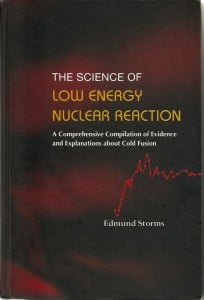
The Science of Low Energy Nuclear ReactionsEdmund Storms has written over a hundred papers and several surveys of the condensed matter nuclear science field, including books The Science of Low Energy Nuclear Reaction, a survey of the experiments and theories of the field through 2007, and, The Explanation of Low Energy Nuclear Reaction, A Comprehensive Compilation of Evidence and Explanations about Cold Fusion, describing the top contenders for a LENR theory, as well as providing a new model of the reaction derived solely from the physical evidence.

Edmund Storms’ website http://lenrexplained.com/ describes this work.

A LENR Research Documentation Project by Thomas Grimshaw of the Energy Institute University of Texas at Austin has compiled Storms’ LENR work through 2015.

Edmund Storms discusses some of the episodes of history, like the Les Case experiment, as well as the progress in LENR theory and the difference between Super Abundant Vacancies SAVs and Nano-spaces as a nuclear active environment.

Listen to the Cold Fusion Now! podcast with Ruby Carat and special guest Dr. Edmund Storms at our Podcast page https://coldfusionnow.org/cfnpodcast/ or subscribe in iTunes.


Cold Fusion Now! brings the voices of breakthrough energy scientists to the public. We need your financial support in order to continue. Go to our website at coldfusionnow.org/sponsors/ to be a Cold Fusion Now! SuSteamer or sign-up on Patreon.

Patreon is a platform for financially supporting the creative . You can pledge as little as a dollar per episode and cap your monthly spending. When we deliver, you reward the work!

Visit us on Patreon to sign-up and become a Patron!


LENR-forum poll and CFN “I’m Hot!” awards

LENR-forum has a poll on the “best LENR science news” of 2018 which you can vote on here.

Cold Fusion Now! voted, and here, we share our perceived top achievements in slightly different distinct categories of science, engineering, and news, for the “2018 I’M HOT!” award. We say “perceived” as the CMNS field is wrought with secrecy as advances are made in labs cluttered with NDAs. Programs have developed around the globe, and there is more LENR activity than ever, but little hard news about results or funding.

We give a nod to those who have published and revealed publicly what they have achieved in 2018 in regards to Science, Engineering and News.

“Science” refers to research focused on determining the basic parameters of a LENR experiment.

“Engineering” refers to developments concentrated on producing excess heat expressly for commercial purposes.

“News” refers to announcements or stories that have the potential to provide science or engineering results in the future.

BEST SCIENCE Clean Planet-Tohoku-et al.

The collaborations between academia and industry in Japan have been producing results that have brought LENR into the mainstream of science through the actual facts of Reproduction. A two-year collaboration between Clean Planet Inc, Technova, and Tohoku University, and a host of other universities on the island, on excess heat experiments using similar cells and the same cathode materials, have produced results with similar output profiles. A willingness to publish these increasingly “hotter” results, and the scope of the cooperation, puts this group of researchers in the top spot for 2018 I’m Hot! Science Award.

BEST ENGINEERING Brillouin Energy Corporation

There are few labs whose sole purpose is to engineer a commercial product, but only one that has followed the prescribed steps of evaluation by a recognized independent lab with public distribution of the technical reports, and that is Brillouin Energy Corporation. The verification of the Brillouin Hot Tube by SRI International was confirmed by two seperate technical reports, the one this year announcing a doubling of the thermal output over the previous report. Their ability to swap out reactor cores and obtain the same outcomes is the result of a focus on engineering cores to specifications that have recently bumped thermal excess to 50 Watts, equating to twice the heat input. Doing the hard work in the full view of their investors, and laying bare the results for the public, puts this group of engineers in the top spot for 2018 I’m Hot! Engineering Award.

BEST NEW STORY GEC-NASA GRC Agreement

This year Global Energy Corporation and NASA Glenn Research Center entered into an agreement to develop a 10kW Genie power generator based on the previously patented hybrid fusion-fission reactor which uses LENR-generated neutrons to activate fissionable material – “a natural abundance uranium deuteride fuel element”, eliminating the need for plutonium. While NASA has dabbled in LENR off-and-on since the 1990s, this agreement for development is a new level of cooperation that brings the US agency together with a private corporation long involved in LENR research. If they are successful, the reactor would provide a cleaner alternative to conventional fission, making another useful application of the LENR reaction. For this announcement, we give GEC-NASA the 2018 I’m Hot! News Award.

2019 will mark 30-years of research in the field that Drs. Martin Fleischmann and Stanley Pons discovered in 1989. As labs build upon hard-won successes incrementally, we are approaching the point where replication is the norm, and results are repeatable.

It’s anyone’s guess when mainstream science will turn attention towards this solution to our energy problems. However, the knowledge and skills built up the CMNS community are indispensable to bringing this science to a technology, and the increasing collaboration between LENR scientists and mainstream institutions shows resources in CMNS being drafted for that experience.

2018 shows how productive that cooperation can be.

Take your vote on the Best of 2018 at the LENR-forum poll here.

Tom Whipple of Falls Church News-Press on Great Transition

Former senior analyst for the Central Intelligence Agency (CIA) Tom Whipple is a writer/editor on energy, Peak Oil, and LENR.

This is a re-post of Tom Whipple’s The Great Transition: Progress on New Sources of Energy published in Falls Church News-Press at https://fcnp.com/2018/12/20/great-transition-progress-new-sources-energy/.

The Great Transition: Progress on New Sources of Energy

by Tom Whipple

Unless humanity replaces fossil fuels in the next couple of decades, it is almost certain that the latter part of the 21st century and beyond is going to be a very unpleasant era in which to live. For the past 200 years, much of the world has prospered greatly from fossil fuels. Most of us have become so accustomed to the benefits of fossil fuels that few are anxious to give up the lifestyles that this energy has provided despite the dire implications for future generations.

After three decades of grappling with climate change, it is becoming apparent that the only solution to slowing and reversing its effects is to develop new sources of energy that are so much cheaper than our fossil fuels and our current alternatives that a rapid transition to non-polluting energy will happen quickly and without too much economic damage. Although considerable progress has been made in improving and reducing the cost of our current, non-carbon emitting energy sources, for a variety of reasons not enough progress is being made in substituting these alternative energy sources to stop catastrophic changes in our climate.

At present, there seem to be only two radically new sources of energy under development that offer hope of replacing fossil fuels soon. As I have discussed several times before in this paper, there are two technologies — Low Energy Nuclear Reactions LENR and hydrogen/hydrino reaction — under development that appear to be nearing commercialization. Both of these technologies have been scientifically controversial for many years, but as their developers make progress, skepticism among those who have insight into the progress to these technologies is starting to wane.

The most prominent developer of the LENR technology, Andrea Rossi, said recently that he is installing a LENR heating system in a factory and that the first phase of this system has been in operation since mid-November. Rossi, however, releases information about his technology in such small bits and pieces that it is difficult to evaluate his technology or its prospects.

In contrast to the secretive Rossi, Randell Mills of Brilliant Light Power is an open book. For years, Mills has posted on his website periodic briefings outlining his progress and plans for the future. In recent years he has been issuing quarterly progress reports which are supplemented by the release of annotated video clips showing steadily improving prototypes of his devices being tested. In contrast to Rossi, some 95 percent of Mills’ technology and progress is available to anyone interested on the Brilliant Light Power website.

Mills has been working on his technology for over 25 years, and his laboratory is adequately financed by investors who believe he is developing a revolutionary technology. Mills produces energy by converting hydrogen atoms into a hitherto unknown form of hydrogen, which he calls hydrinos, which results in the release of unprecedented amounts of energy. His reaction has been working for several years and seems to be well verified by outside scientists. However, a reaction on a laboratory bench is not the same as a device that can replace all types of fossil fuels worldwide. There is still a lot of engineering to do before a plasma glowing on a laboratory bench is ready for mass production.

It has been two years since Mills last demonstrated his hydrogen-to-hydrino reaction and laid out a plan to build and market an energy producing device he calls a SunCell. During this period there have been important changes in Mills’ concept of how a commercial device that will reliably produce heat and electricity will work. Plans to release a device that would convert the energy being produced by a high-temperature plasma into electricity by using photoelectric cells has been put aside in favor of more promising techniques. Mills is now planning to develop two devices, one to produce heat and the other to produce electricity, using a highly efficient technique known as magnetohydrodynamics (MHD).

Before a commercial energy producing device can be built, Mills first has had to develop what he calls an “automated cell” or subsystem in which the energy-producing reaction can take place under computer control. In the early prototypes, Mills’ reaction was started and maintained manually, making it unsuitable for a commercial product. Judging from the videos showing various configurations of the SunCell that have been tested and the quarterly reports that have been released, he seems to be making progress. Successful development of several subsystems for the automated cell has been announced, and the videos show the reaction can now take place inside various types of enclosed spheres.

The two commercial products under development that will incorporate the automated cell are the “Thermal SunCell” which is to deliver 500kW for boilers, hot air or hot water thermal systems. As this device is far less complex than the “Electric SunCell,” it should reach the market first and demonstrate the potential of the technology. Brilliant Light Power plans to market this device initially to industrial firms which use heat in their processes. Although Mills says the SunCell theoretically can be scaled to produce anywhere from 10 kilowatts to 10 megawatts, the first device which incorporates an MHD subsystem is being designed to produce 150kW. By using MHD rather than photovoltaics to produce the electricity, Brilliant Light has lengthened the development time but, in the end, may have a better and far cheaper device.

With the changes taking place in plans for a commercial system, the path to non-polluting cheap energy from the SunCell technology has been lengthened, and BLP is no longer making forecasts of how long it will be before even a commercial-ready prototype can be developed. There was one clue in a recent BLP video of “Shakedown testing of our inverted-pedestal-electrode reactor before our planned demonstration for DOD scientists.” This could be a very significant development for if BLP can convince DOD scientists that they are looking at the energy source of the future, the technology could be in production a lot faster. It was scientists from DoD’s Advanced Research Projects Agency that was instrumental in developing the Internet — and look how that turned out! There may be some hope for the 22nd century yet if Rossi’s or Mills’ devices get into production in time.

From The Great Transition: Progress on New Sources of Energy by Tom Whipple

David French leaves legacy of public service to breakthrough energy

Patent lawyer and Cold Fusion Now! contributor David J. French passed away quietly in his sleep the night of Sunday Dec 2.
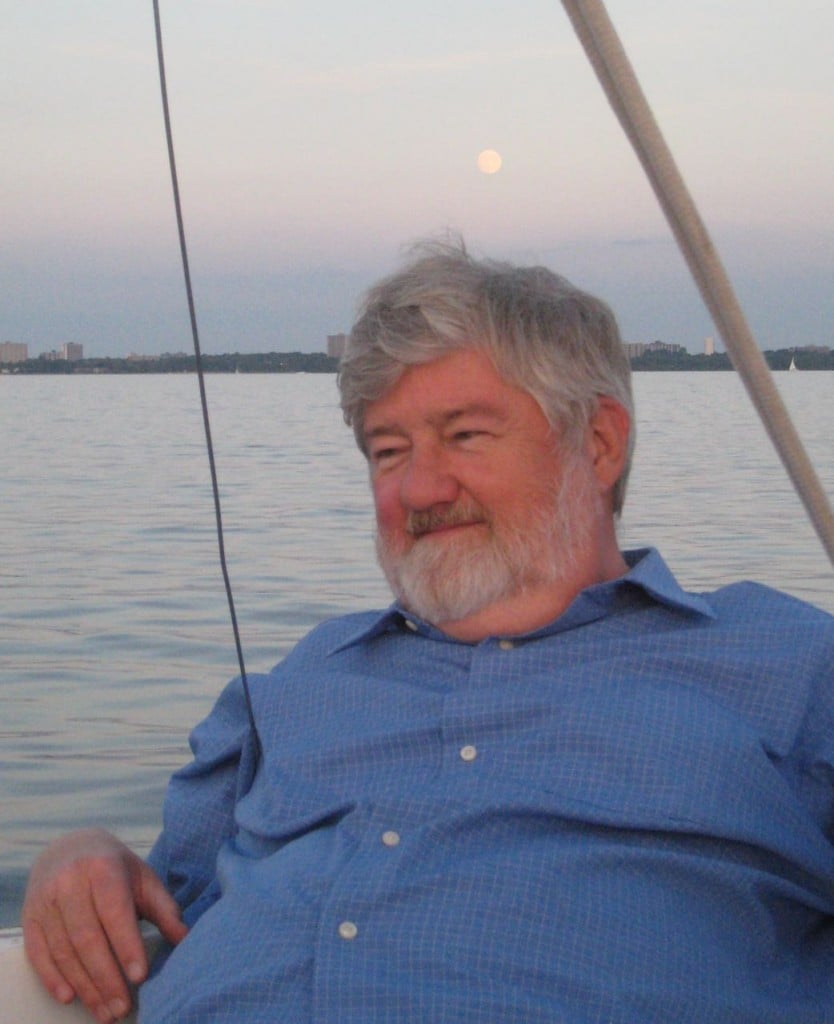
He spent his career at private law firms and also worked with the Canadian government on law reform and international patent issues before retiring to his own law firm Second Counsel in Ottawa, Canada.

He began consulting with scientists in the CMNS field offering patent advice and helping to secure their intellectual property, sharing much of his expertise knowledge pro bono.

David in blue shirt on sailboat with Bernie Sanders! (not shown) August 2011

David J. French wrote his first article for Cold Fusion Now! in August 2011 – Review of Cold Fusion Patents – and continued to write through May 2016, doing an analysis of Andrea Rossi’s patent filings.

See the whole set of David J. French articles for Cold Fusion Now! here: https://coldfusionnow.org/patents/

He also published in the Journal of Condensed Matter Nuclear Science and began speaking publicly at conferences on the issues of patents and cold fusion.

In 2012, he spoke at ICCF-17 on Patents and Cold Fusion, published in the Proceedings [JCMNS V13 .pdf].

In 2013, he presented a poster at ICCF-18 Patenting Cold Fusion Inventions before the US Patent & Trademark Office which this paper is based on.

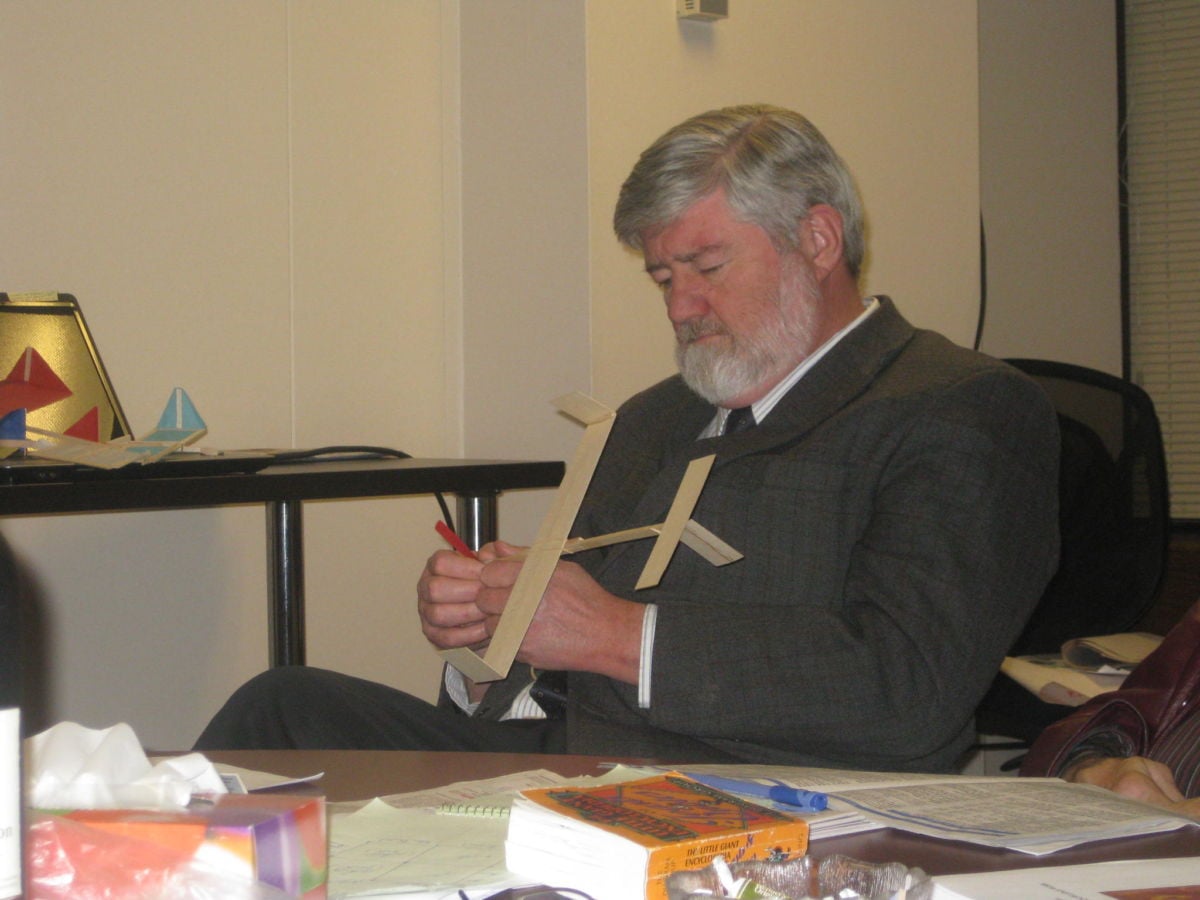
David French examines model airplane December 2009

At the CF/LANR Colloquium at MIT, David J. French spoke March 22 2014 on The role of the Patent Attorney in patenting Cold Fusion inventions seen here on Youtube.

In June 2017, he spoke at the 12th International Workshop on Anomalies in Hydrogen Loaded Metals and published Key Principles for Patenting in the Land of LENR in the Proceedings [JCMNS Vol26 .pdf].

Video of the talk was captured by Société Française de la Science Nucléaire dans la Matière Condensée:

Although he attended ICCF-21 this past June 2018, he did not present formally, but spent hours sharing patent advice with the scientists there. High drama ensued when, on the day of the outing, the tour bus full of scientists forgot David at a Rocky Mountain Park visitor center. He notoriously decided to hitchhike home from 7800 feet (~ 2400 m), getting multiple rides from locals off the mountain. Nuclear scientists searched the upper peak, looking for the missing patent lawyer until learning he was napping back at campus!

Rocky Mountain National Park in Colorado, US.

David French showed generosity and kindness to the CMNS community with his open and steady demeanor. Like his fellow Canadian Marshall McLuhan, David J. French embodied the even-tempered balance of issues, always willing to listen, rejecting emotional judgements in favor of a civil discourse that pursues a common understanding.

His last update for Cold Fusion Now! was in April 2018 when he joined me on the podcast. Personally, David was a voice of inspiration, creativity, and positivity. I hope that some of his creative writings see the light of day – he dabbled in fiction and screenplays, as well as history.

His many friends in the CMNS community will surely miss his understanding and contribution of law, science, and technology, and this friend will too.

Top