Cold Fusion Radio’s James Martinez on Buzzsaw

From TheLipTV Channel on Youtube:

Cold Fusion, nuclear power and the global economy are put under the microscope with guest James Martinez in this full length interview for Buzzsaw with Sean Stone. We take a look at the possibility of free energy revolution–from Andrea Rossi’s game changing technology in cold fusion, to the credit based economy, mind control and more,

GUEST BIO:
James Martinez is a Media Ecologist, Radio Talk Show host and pioneer in radio broadcasting and behavior modification. He was born in San Diego, California and grew up in Brazil, England and Europe. After attending University he began working for a retired Federal Agent and one retired Naval Intelligence officer. He is an accredited member of the press for American Media Distribution and has been a consultant for True TV’s Conspiracy Theory and has consulted for Emmy Award winning actor Eion Bailey for show entitled “Imagine This!” Mr. Martinez can be heard on the Achieve Radio Network and soon the first men’s network Protection For Men.

James Martinez began Cold Fusion Radio with his interviews with scientists and business leaders in the cold fusion research arena.

Cravens demo a puzzle for onlookers

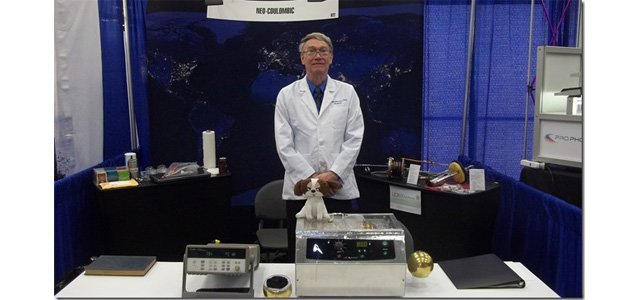
Photo: The Neo-Coulombic booth with Dr. Dennis Cravens at NIWeek 2013.

Last year’s NIWeek 2012 was a pageant of LENR with multiple events bringing condensed matter nuclear scientists from all over the world to the Austin, Texas showcase.

This year, National Instruments chose to focus on conventional energy technologies, with one exception: Dennis Cravens‘ demonstration of anomalous heat generated by … er, well, what could that have been?

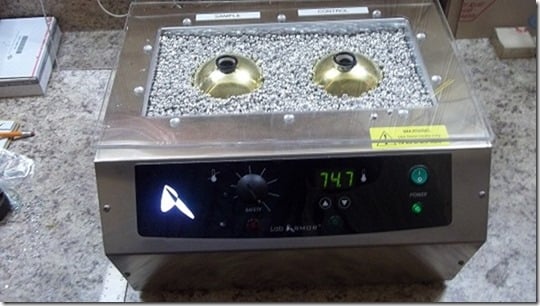
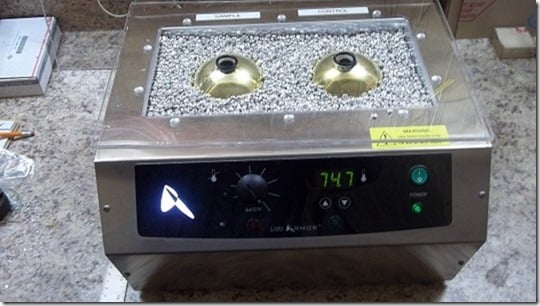
The sample sphere (L) ran about 4 degrees C hotter than the control (R).

The device consisted of “two simple spheres, a control with a little sand (a bead “bath”), and a sample.”

The unusual thing about this was that the sample (L) ran hotter than the surrounding material it was in, or the control (R), by about 4 degrees C.

“Most people that stopped to look at it were software or electrical engineer types, and they seemed to receive it well,” says Cravens. “I would say only 2 out of the hundred+ people had negative statements – at least at the booth. Some may have laughed later, but most were very much interested and had very intelligent questions.”

Oddly, most visitors to the booth did not speculate as to the operation, but focused on a more practical query.

“The most common questions centered on marketing – what would it cost, can you scale it up, and when will it be available?”

What could be making the heat? How can a small ball get hotter than the sand it’s in?

“It was clear that something inside was producing heat. Most people seemed to be satisfied with the D + D to Helium pathway. The most pleasing response was: can you make me a charger for my Tesla?”

Not everyone was satisfied with the display.

“A few software types suggested that a single line of LabVIEW code could have given “fake” heat levels. Thus, we omitted the software and graph the second day. Instead we just read the temperature directly of the Agilent so there could be no question of sneaky behavior.”

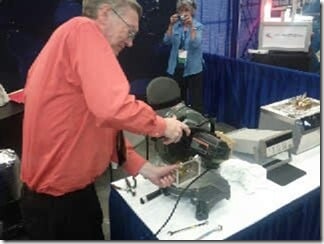
Cutting the sphere open to show nothing inside.
Cutting the sphere open shows nothing inside.
Cravens set-up the device on Sunday, and ran it through the week until Thursday, when he cut the spheres open, and surprised the crowd by showing there was nothing inside.

“I got some applause. Many took pictures. Many came over to exam the material. A few kids wanted some of the gold-looking brass dust from the cutting.”

Cravens describes the experiment by beginning with one of the basic laws of thermodynamics: heat will only flow from a hot object to a cold one.

The small sphere was hotter than its bead bath, so it must necessarily contain a heat-producing source.

At the show, he suggested a mechanism:

You look around the exhibit floor and see hundreds of people but none are touching each other. A physicist would say that deuterium atoms in equilibrium at low temperatures would never interact.

However if some one yells “fire, fire!”, there would be massive interactions at the doors. People would be trampled. Some would be injured. There can be a lot of unexpected interactions when you have a dynamic movement of deuterium.

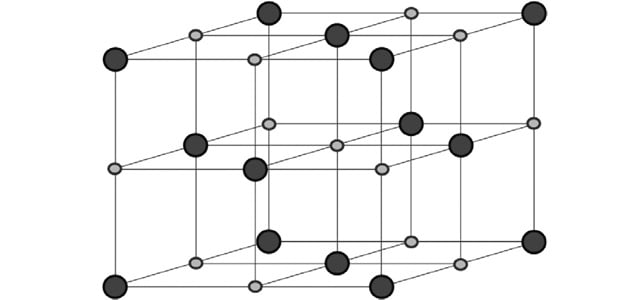
Here we have deuterium trying to move through the vacancies of the metal lattice that are no bigger than an atom. It is not unrealistic to think some will get trampled. Not only that, the carbon that holds the metal lattice has a size just matched to the black body radiation wavelength at the operating temperatures.

In this analogy, it is like people are having to go through a door way that is vibrating.

Hmm, a lesson with a little mystery left to figure out.

“What NI does is take complex problems and reduce them to the size of the team.” says James Truchard, CEO of National Instruments, the company he founded.

Cravens, who’s been both a research scientist and a teacher, agrees.

“My philosophy is to support and recognize those that are doing good and those that are trying to learn more. Kids live for recognition and praise. I disagree with the current trend in education that tries to cookie-cut all the courses.”

“I feel the reason that America is known for innovation is because of the range of teaching and the creative spirit teachers have had.”

Demonstration experiments that engage minds through wonder, and explanations that use common experiences as analogy, can teach both young and old.

Education should go beyond the “marginal improvement of existing development” and Dennis Cravens is using cold fusion to do it.

Related Links

NIWeek 2013 features Dennis Cravens experiment

Cold fusion-powered car engineer has history of discovery

The Doctor Is Very In: Dr. James Truchard’s Quest For Endless Innovation by Lydia Dishman on FastCompany.com

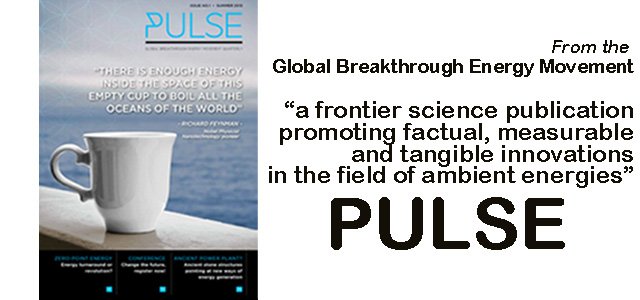
PULSE magazine debuts with first issue as premium

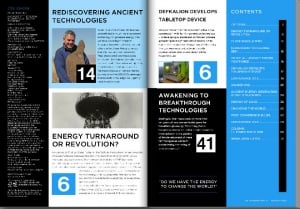
The Global Breakthrough Energy Movement (GlobalBEM) continues to power forward with a new magazine launch.

PULSE provides “an international platform, to publish their ideas about breakthrough energy solutions” gathering pieces by authors well known to the new energy community as well as works by authors new to the field.

Created as “a frontier science publication”, the editors are “promoters of factual, measurable and tangible innovations in the field of ambient energies.”

While magazines have a tough time surviving in the digital age, there are still markets for portable, dense, information and images in the form material atoms. Eugene Mallove was the driving force behind Infinite Energy Magazine, and now, a new generation takes up the mantle of media promotion.

GlobalBEM formed to organize Breakthrough Energy Conference in Hilversum, Holland last November 2012, an event that gathered a who’s who of new-energy icons, including maverick thinkers from the economics and art world. Cold Fusion Radio’s James Martinez also attended, presenting a talk dedicated to the memory of Russell Means.

This year, GlobalBEM is scheduling its three-day symposium October 10-12 at the University of Boulder in Colorado, U.S. Scheduled to present are scientists, technologists, artists, activists, historians, and economists who work to develop revolutionary energy technology. Cold Fusion Now and Cold Fusion Radio will represent with talks by Ruby Carat and James Martinez.

But your help is needed to bring this community together. From GlobalBEM:

“With the help of private Dutch investors we were able to make the 2012 conference happen. This time we want to ask YOU to get involved in crowdfunding our campaign on Indiegogo.”

This campaign’s purpose is to help us raise a total of $30,000. Which will cover the travel and hotel expenses for our panel of speakers and core team. We can’t make this conference happen and bring this wealth of information to the world without your help.

“IT’S BREAKTHROUGH TIME!”

PULSE-1-interiorThis new quarterly publication “contains over 50 editorial pages on all things Breakthrough Energy. We have reports on current developments, background stories and the personal opinions of experts in the field.

Dr Turtur tells us about his findings on zero point energy, Michael Tellinger shares his fascinating research into an ancient civilization and their breakthrough energy. Sterling Allan, Andrew Johnson, Professor Ilija Lakicevic and many others contributed to make PULSE a must-read for everyone.

Take a look at selected portions of Issue #1 here.

Writers are encouraged to submit their work for publication, and your subscription to PULSE will help fund the Breakthrough Energy Movement.

NIWeek 2013 features Dennis Cravens experiment

NIThis year’s National Instruments weeklong event NIWeek 2013 begins today and runs Monday, August 5 through Thursday, August 8 in Austin, Texas, U.S.

Dennis Cravens, a long-time researcher who pioneered laser-induced reactions and has worked on energy cells as diverse as James Patterson‘s Patterson Power Cell, will be conducting a live demonstration experiment from booth #922 under the name Neo-Coulombic.

From the NIWeek 2013 Program [.pdf]:

Neo-Coulombic is a small private research group specializing in “long shot” technology involving methods of thermal energy generation using hydrogen and metals. physicsandbeyond.com

Cravens described his device to E-catworld.com as:

spheres2… the simplest demo I could come up with at NIWeek. It is not intended to prove anything , just to something to make “Joe Six pack” take notice and give him something to about. There will be no input, no flows to measure, no HV to scramble the instruments, no calculations to explain . . . just one brass sphere warmer than the other, and the bath temperature.

I know full well I will get a lot of people that will want added bells and whistles but I hope the target audience (the average engineer type walking by with their family) can understand the system within in 30 seconds at the booth. One sphere is hotter than the other so it must have a power source of some kind inside- what is it? Come back on Thursday and see inside.

It is just two brass spheres in a constant temperature bath (80C Lab Armor aluminum bead bath). One is a sample and one is the control. The sample just stays warmer than the control (for the full 5 days of the expo). Temperatures will be monitored and displayed via a Lab View interface (after all, this is NI) during the expo.

I hope to cut open the sample on the last day to show there are no hidden items.

The theme for the 2013 summit is “Deploying the smart grid—effective deployment techniques for smart grid embedded control and monitoring systems.” and focuses on conventional alternative energies, a switch from last year’s strong focus on breakthrough energy.

NIWeek 2012 put LENR front and center, with opening remarks by National Instruments President and CEO James Truchard indicating his strong interest and support of the topic. Robert Duncan, Vice-Provost for Research at University of Missouri and organizer of the recently held 18th International Conference on Cold Fusion (ICCF-18) also spoke at the event and Francesco Celani, of the Italian National Institute for Nuclear Physics (INFN) performed a live demonstration of his cell. Defkalion Green Technologies, developers of the Hyperion reactor, gave a presentation, as did Akito Takahashi, of Technova, Inc. Numerous new energy researchers attended, and a panel discussion brought many to the stage for an open debate on the future of LENR.

Dennis Cravens is the sole representative from the new energy community scheduled to appear this year, but that doesn’t mean NI support has waned.

Truchard recently gave the Keynote Address at ICCF-18 and currently supports a number of new energy projects to varying degrees, with NI software, equipment, and more.

Deformation of electron outer shells important for Hyperion too, says Tsyganov

Physicist and cold fusion researcher Edward Tsyganov presented his research on low-energy collisions of atoms within a crystal at the Channeling 2012 Conference organized by the Italian National Institute for Nuclear Physics (INFN). A description of this work was summarized in our Q&A A Physicist’s Formula with Tsyganov.

Now, Registration of energy discharge in D + D 4He⁄ reaction in conducting crystals (simulation of experiment) [.pdf] has been published along with the Proceedings of the conference, and Tsyganov had this to say about the results of his research presented in the paper, and in particular, how it relates to Defkalion Green Technologies recent demonstration of the Hyperion R5 reactor:

In the article presented to your attention here, we simulated the proposed experiment to further elucidate the nature of the process of the so-called cold fusion, which is observed in metallic crystals. We are convinced that in the present experimental evidence does not leave any room to doubt the reality of the existence of this phenomenon. Unfortunately, the negative attitude of the nuclear physics community to this new phenomenon, hastily formulated some 20 years ago in a poor repeatability of experiments of the time, remains dominant today.

It should be noted that the only calorimetric measurements, supporting cold fusion, have not been able to bring the experimenters to a correct explanation of this phenomenon. Help came from the accelerator experiments at low energies. It should be noted that the first cycle of these experiments took place in Japan as early as 1996-2000, but remained virtually unnoticed. Below these works are cited.

H Yuki, T Satoh, T Ohtsuki, T Yorita, Y Aoki, H Yamazaki and J Kasagi “D + D reaction in metal at bombarding energies below 5 keV”, J. Phys. G: Nucl. Part. Phys. 23 (1997) 1459-1464

J. Kasagi, H. Yuki, T. Itoh, N. Kasajima, T. Ohtsuki and A. G. Lipson “Anomalously enhanced d (d, p) t reaction in Pd and PdO observed at very low bombarding energies”, the Seventh International Conference on Cold Fusion, 1998, Vancouver, Canada:, ENECO, Inc., Salt Lake City, UT. : P. 180.

H. Yuki, J. Kasagi, A.G. Lipson, T. Ohtsuki, T. Baba, T. Noda, B.F. Lyakhov, N. Asami “Anomalous Enhancement of DD Reaction …”. JETP Letters, December 1998.

J. Kasagi, H. Yuki, T. Baba and T. Noda “Low Energy Nuclear Fusion Reactions in Solids”, 8th International Conference on Cold Fusion, 2000, Lerici (La Spezia), Italy: Italian Physical Society, Bologna, Italy.

A.G. Lipson, G.H. Miley, A.S. Roussetski, A.B. Karabut “Strong enhancement of dd-reaction …” The work was presented at the ICCF 10 in 2003 and is interesting due to recorded soft X-ray radiation.

Already at the conference ICCF 7 April 1998, Prof. Bressani quite clearly laid out the path to an explanation of the process of cold fusion based on this series of experiments. [See Nuclear Physics Aspects of Cold Fusion Experiments Scientific Summary after ICCF-7 by T. Bressani .pdf.]

Unfortunately, the cold fusion community has not followed the Bressani call; each group had its own theory of the process. In 2002-2009, a similar accelerator experiments at Gran Sasso (Rolfs et al) and Berlin (Czerski et al) successfully produced similar results . References to this work are given in our article. However, even after these experiments very few people realize what all of this might mean.

In our analysis, the only hypothesis which provides sufficient explanation of this “cold fusion” phenomenon , which the traditional nuclear physics community has found difficult to accept, is the assumption that the sub-barrier fusion reactions in the nuclear decay rate of the resulting composite intermediate nucleus is slowing down if the excitation energy of the intermediate nucleus is reducing. In this case, at the thermal energy of the reagents intermediate compound nucleus becomes metastable, and the energy transfer process to the electrons of the crystal lattice through the exchange of so-called virtual photons becomes effective.

If we talk about the DD reaction in metallic crystals, for the practical start of the reaction, we need to fill in all the possible deuterium vacancies in the crystal. When these positions are not filled the reaction is practically not observed. This is due to the vacancy and the extended location of the deuterium atoms from one another. This fact was the main reason for poor repeatability of experiments in the past. As the vacancy is filled with deuterium, the double fillings appear where the fusion process becomes much faster due to the deformation of the electron shells of deuterium in metallic crystals.

To conclude, it is especially important to comment on the recent experiments on the Hyperion reactor, under the direction of John Hadjichristos (ICCF 18). Hadjichristos took an interesting comparison of the process of deformation of the outer electron orbits of the reacting atoms with the detail of the legend of the Trojan horse in the capture of Troy. As was noted earlier in our studies, the deformation of the electron orbits can effectively mask the Coulomb barrier in the fusion reaction at very low (thermal) energy.

An extremely interesting (if confirmed) result of the experiments on the Hyperion is the emergence of strong magnetic fields during the cold fusion reactions. This result often immediately shuts down many theoretical constructions which can only explain the released nuclear energy going directly to the thermal vibrations of the crystalline lattice by nothing short of a magical force. For this reason, the closer look at the current experimental data presented here is so essential.
Edward N. Tsyganov

Original text:

Уважаемые коллеги!

В предлагаемой вашему вниманию статье мы провели расчеты предполагаемого эксперимента по дальнейшему выяснению природы процесса так называемого холодного синтеза, наблюдающегося в условиях металлических кристаллов. По нашему убеждению, в настоящее время экспериментальные факты не оставляют места никакому сомнению в реальности существования этого феномена. К сожалению, отрицательное отношение сообщества ядерной физики к этому новому явлению, поспешно сформулированное около 20 лет тому назад в условиях недостаточной повторяемости экспериментов того времени, остается попрежнему доминиружщим.

Нужно отметить, что одни только калориметрические измерения, подтвеждающие холодный синтез, оказались не в состоянии привести экспериментаторов к правильному объяснению этого явления. Помощь пришла со стороны ускорительных экспериментов при низких энергиях. Нужно отметить, что первый цикл этих экспериментов прошел в Японии еще в 1996-2000 гг, но остался практически незамеченным. Ниже приводятся эти работы.

H Yuki, T Satoh, T Ohtsuki, T Yorita, Y Aoki, H Yamazaki and J Kasagi “D+D reaction in metal at bombarding energies below 5 keV”в журнале J. Phys. G: Nucl. Part. Phys. 23 (1997) 1459–1464

J. Kasagi, H. Yuki, T. Itoh, N. Kasajima, T. Ohtsuki and A. G. Lipson “Anomalously enhanced d(d,p)t reaction in Pd and PdO observed at very low bombarding energies”, the Seventh International Conference on Cold Fusion, 1998, Vancouver, Canada:, ENECO, Inc., Salt Lake City, UT. : p. 180.

H. Yuki, J. Kasagi, A.G. Lipson, T. Ohtsuki, T. Baba, T. Noda, B.F. Lyakhov, N. Asami “Anomalous Enhancement of DD Reaction…”. Декабрь 1998 г, письма в ЖЭТФ.

J. Kasagi, H. Yuki, T. Baba and T. Noda “Low Energy Nuclear Fusion Reactions in Solids”, 8th International Conference on Cold Fusion, 2000, Lerici (La Spezia), Italy: Italian Physical Society, Bologna, Italy.

A.G. Lipson, G.H. Miley, A.S. Roussetski, A.B. Karabut “Strong enhancement of dd-reaction…” Работа была доложена на ICCF 10 в 2003 г. Интересна тем, что там регистрировалось мягкое рентгеновское излучение.

Уже на конференции ICCF 7 в апреле 1998 г проф. Брессани достаточно ясно изложил путь к объяснению процесса холодного синтеза, основанный на этой серии экспериментов. К сожалению, сообщество холодного синтеза не последовало призывам Брессани, у каждой группы была своя теория процесса. В 2002-2009 гг успешно прошли аналогичные эксперименты на ускорителях в Гран Сассо (Ролфс и др.) и в Берлине (Черский и др.). Ссылки на эти работы даются в нашей статье. Тем не менее, даже после этого мало кто осознал, что все это может означать.

В нашем рассмотрении единственной гипотезой, которая необходима для объяснения холодного синтеза и с которой традиционным ядерным физикам оказалось трудно согласиться, является предположение о том, что в реакции подбарьерного синтеза скорость распадов образующегося составного промежуточного ядра по ядерным каналам замедляется при уменьшении энергии возбуждения этого ядра. В этом случае при тепловых энергиях реагентов составное промежуточное ядро оказывается метастабильным, и процесс передачи энергии этого ядра электронам кристаллической решетки посредством обмена так называемыми виртуальными фотонами становится эффективным.

Если говорить о реакции DD в металлических кристаллах, то для практического начала реакции нужно заполнить дейтерием все возможные вакансии в кристалле. Пока эти вакансии не заполнены, реакция практически не наблюдается, так как вакансии и, соответственно, атомы дейтерия располагаются достаточно далеко друг от друга. Это обстоятельство являлось главной причиной плохой повторяемости опытов. При дальнейшем заполнении кристалла дейтерием появляются вакансии с двойным заполнением, где процесс синтеза протекает очень быстро из-за деформированности электронных оболочек дейтерия в металлических кристаллах.

Завершая это предисловие, необходимо особенно отметить недавние эксперименты на установке Гиперион под руководством Джона Хаджихристоса (ICCF 18). Хаджихристос приводит интересное сравнение процесса деформации внешних электронных орбит реагирующих атомов внутри кристаллических кристаллов с подробностями легенды о троянском коне при взятии Трои. Как отмечалось в наших первых работах, деформация электронных орбит позволяет эффективно преодолевать кулоновский барьер в реакции синтеза при низких (тепловых) энергиях.

Исключительно интересным результатом (если он подтвердится) экспериментов на установке Гиперион можно назвать возникновение сильных магнитных полей при протекании реакции холодного синтеза. Даже один этот результат Гипериона сразу закрывает многие теоретические построения, в которых выделившаяся ядерная энергия некоторым магическим образом переходит непосредственно в тепловые колебания кристаллической решетки.

С уважением,

Э.Н. Цыганов
Top