Current Science 108 features Special Section: Cold Fusion

Cover of Current Science 108
Current issue of Current Science; forthcoming issue has Special Section: Cold Fusion
CURRENT SCIENCE, VOL. 108, 2015 issued in January features a Special Section: Cold Fusion, publishing papers from a wide group of scientists probing both experimental and theoretical results in the field of condensed matter nuclear science.

Current Science is a science journal based in India and Edited by R. Srinivasan of the Indian Institute of Science. India had a large number of people investigating the Fleischmann-Pons Effect early on, including Mahadeva Srinivasan and the team at Babha Atomic Research Center (BARC). But difficulties in reproducing the effect proved too much. Today, there is no support for research by official agencies in India.

In the online Special Section on Low Energy Nuclear Reaction, uncorrected proofs of featured articles awaiting publication in the next print issue of Current Science are available:

http://www.currentscience.ac.in/cs/php/fcarticles.php

Edmund Storms
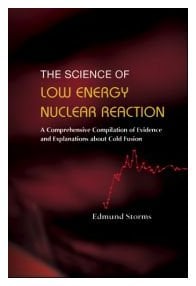
Edmund Storms’ The Science of Low Energy Nuclear Reaction – the source for observational results.
Dr. Michael McKubre, the Director of Energy Research at SRI International in Menlo Park, California, introduces the set of papers with Cold fusion: comments on the state of scientific proof [.pdf], which discredits the quick condemnation of early scientific claims, and demands that critics look at an unprecedented body of work generated over the last two-and-a-half decades that challenges what we know about nuclear reactions.

There is also a lesson for students of cold fusion:

How does one proceed as a thoughtful intelligent person
simply wanting ‘to know the truth (see note 4)’, but
not having years to devote to experimental studies or
literature review? I would suggest beginning with Storms’
books as resources to identify sub-topic areas of personal
interest and pointers to primary sources for further
study. Obviously, I have neither the time, patience nor
space to emulate Storms’ efforts here. I restrict attention
to the conclusions arrived at ‘long ago’ in the deluge of
information achieved hurriedly in the biblical 40 days and
40 nights leading up to the 1 May 1989 APS meeting.
The conclusion and ‘voted consensus’, that Fleischmann
and Pons had made fundamental errors and elementary
mistakes, was itself premature and in error. This leaves
wide open the possibility that our free-space view of
nuclear physics requires extension in potentially interesting
directions.

Professor Peter Hagelstein and Dr. Mitchell Swartz created the IAP MIT short course Cold Fusion 101 which ran Jan. 21-24, 2015 from the campus of Massachusetts Institute of Technology. Jeremy Rys has attended the lectures since they began three years ago, and this year, Livestreamed from his laptop in the front row. Along with Gayle Verner, they contributed Summary report: ‘Introduction to Cold Fusion’ – IAP course at the Massachusetts Institute of Technology, USA [.pdf].

From the Introduction:

WHILE the Massachusetts Institute of Technology (MIT),
USA, officials still reportedly do not recognize cold
fusion or its viability, the fact that it has entered the academic
domain, albeit through the less-structured IAP
agenda, is certainly noteworthy, both for those scientists
working for its public acknowledgement and for the
appearance of a place to go and get an education in
this field. Twenty-five years later, one can now walk into
an MIT classroom, listen to an academic lecture on the
subject, and learn that the phenomenon is real and reproducible.

For an article entitled Condensed matter nuclear reaction products observed in Pd/D co-deposition experiments, authors include P. A. Mosier-Boss, L. P. Forsley, F. E. Gordon, D. Letts, D.Cravens, M. H. Miles, M. Swartz, J. Dash, F. Tanzella, P. Hagelstein, M. McKubre and J. Bao.

Descriptions of the various types of cells used by these veteran experimentalists showed a strong effect from the co-deposition method, first applied to cold fusion by Navy electro-chemist Dr. Stan Szpak, and created one of the more easily reproducible types of cells available.

From the conclusion of the paper:

… several researchers have used Pd/D codeposition
to investigate the phenomenon of condensed
matter nuclear reactions within a Pd lattice. The emphasis
of many of these investigations has been on heat production.
In these particular experiments, excess heat has been
measured using different variations of co-deposition as
well as different kinds of calorimeters, both open and
closed. In addition to heat, other reaction products that
have been observed include new elements, tritium, energetic
particles and neutrons.

Contents of Special Section: Low Energy Nuclear Reactions
(which may be different from the print publication)

Cold fusion: comments on the state of scientific proof
Michael C. H. McKubre

Selective resonant tunnelling – turn the hydrogen-storage material into energetic material
C. L. Liang, Z. M. Dong and X. Z. Li

Highly reproducible LENR experiments using dual laser stimulation
Dennis Letts

Condensed matter nuclear reaction products observed in Pd/D co-deposition experiments
P. A. Mosier-Boss, L. P. Forsley, F. E. Gordon, D. Letts, D. Cravens, M. H. Miles, M. Swartz, J. Dash, F. Tanzella, P. Hagelstein, M. McKubre and J. Bao

Use of CR-39 detectors to determine the branching ratio in Pd/D co-deposition
P. A. Mosier-Boss, L. P. G. Forsley, A. S. Roussetski, A. G. Lipson, F. Tanzella, E. I. Saunin, M. McKubre, B. Earle and D. Zhou

Observation and investigation of anomalous X-ray and thermal effects of cavitation
V. I. Vysotskii, A. A. Kornilova and A. O. Vasilenko

Transmutation reactions induced by deuterium permeation through nano-structured palladium multilayer thin film
Yasuhiro Iwamura, Takehiko Itoh and Shigenori Tsuruga

Biological transmutations
Jean-Paul Biberia

Microbial transmutation of Cs-137 and LENR in growing biological systems
V. I. Vysotskii and A. A. Kornilova

Energy gains from lattice-enabled nuclear reactions
David J. Nagel

Summary report: ‘Introduction to Cold Fusion’ – IAP course at the Massachusetts Institute of Technology, USA
Gayle Verner, Mitchell Swartz1 and Peter Hagelstein
Condensed matter nuclear science research status in China
Z. M. Dong, C. L. Liang and X. Z. Li

Open Power Association Newsletter #17: Roy Virgilio honored; collaboration with Francesco Celani moving forward

The Open Power Association at Hydrobetatron.org has published Newsletter #17. Selected excerpts of interest to readers are google-translated and posted here.

Read the full and complete newsletter in the original Italian here.

*****BEGIN NEWSLETTER*****

2015: if it were a good year?!

Dear Friends,
The reactor ITAbetatron is now ready to support the experiments planned. In the coming weeks we will enter the heart of the work, and we all wish you success in this endeavor!

In this case we will finally have a new source of energy: clean, inexhaustible and economic, that creates the conditions for the welfare and prosperity of the peoples of the Earth, and at the same time to combat global warming, and therefore dangerous climate change in place thus also saving the planet Earth.

All your help will be useful if not decisive. Therefore you renew your subscription to ‘Association Open Power or subscribe for the first time. This is the greatest gift you can give yourself! CLICK HERE and with your association, also receive a nice gift!

*****

THE REACTOR: WORK IN PROGRESS …
in the foreground a particular extension of the reactor ITAbetatron:

Itabetatron-in-assembly

Are you entrepreneur-minded? Then you may want to consider the possibility of investing in our promising research to find a new source of energy: clean, inexhaustible and economic.

Seize this opportunity now!

Send us an e-mail with your proposal to:
contatti@hydrobetatron.org

We will evaluate and if necessary, fix an appointment for you to learn more about our program, and what we can do to collaborate.

*****

The Directors of the Open Power Association resolved unanimously to appoint the Honorary Member in 2015: Roy Virgilio

Roy Virgilio, Honorary Member 2015 Open Power Association

Roy Virgilio, deals with conventional renewable energy, and more exotic for about 10 years.

In September 2002, he founded http://www.progettomeg.it, covering cold fusion experiments and other clean energy, with a focus on biofuels. In 2004 he also founded the Shared Forum on Renewable Energy Sources (http://www.energeticambiente.it) where the threads of all energy sources are collected.

In 2005 he organized the National Conference on Cold Fusion held in Pisa in April, and participated in the foundation of the NPO and Social Promotion “EnergoClub” for the conversion efficiency of the planet.

Since 2004 he has been a speaker at several conferences throughout the country, talking about Free Energy, Cold Fusion and Biofuels.

He also writes articles for magazines of science and environment including “AamTerranuova“. In 2007 he published his first book “Biofuels Yourself”, currently in its second edition.

*****

Hubble-montageSometimes we humans are hypocritical, selfish, evil and even violent.

Nevertheless: Our nature is Divine! Let us help you remember this by connecting to the beauty of the ‘Universe also watching the beautiful images taken by the space telescope: Hubble!

TO VIEW ALL GALLERIES: http://hubblesite.org/gallery/album/entire/

*****


Francesco Celeni
Francesco Celeni
And ‘We are honored to be able to announce that Francesco Celani
(website: francescocelanienergy.org) officially collaborates with “Open Power”!

Francesco Celani, besides being always our friend and esteemed scientist, is an honorary member of “Open Power” from the foundation of the ‘Association itself. Thursday, December 11 (2014), Francesco Celani has visited our new laboratory in Rome where he met amicably with Ugo Abundo, our President and Scientific Director of the ‘Association “Open Power”, for a scientific debate on issues of common interest. On this occasion was made official the relationship of scientific collaboration that will elapse between us.

Interviewed by Luciano Saporito, he had words that fill us with pride about our commitment in the field of new energy.

Francesco Celani also claimed that “the laboratory Open Power is well structured, the enthusiasm of the researchers involved transpires, the search ranges in different directions that complement each other, carried out in specific work islands; the procedures are scientifically confirmable, and equipment built, well-engineered, integrated fields of investigation and promising, and proposals for innovative solutions and optimal desirable to make the maximum effort in running projects designed”.

*****

Celani-cell-of-discoveryA NEW DISCOVERY (June 25 2014) FRANCESCO CELANI!

It is an electrical phenomenon, apparently not due to known phenomena, due to the interaction of Hydrogen gas with long (100cm) fine wire (diameter 100 microns and 200-meter) Constantan (alloy Cu_55%, Ni_44%, Mn_1% with traces of Iron from 0 to 0.5%) having the surface covered by the same Constantan to reduced dimensionality (measured between 50 and 5000 nm with SEM) as methodology developed in LNF also with the help, at various levels of external colleagues. The whole is measured, at a macroscopic level, when such INDIVIDUALS wire, electrically isolated from each other with sheaths made of borosilicate glass, placed inside a reactor having also the hydrogen gas, have an internal temperature of> about 150 ° C and external next environment. In other words, it is as if you were in the presence of a new form / method (apart from the well-known Seebeck effect and / or Thompson) CONVERSION DIRECT from Heat to Electricity. E ‘truly challenging, from the point of view of scientific speculation, the role of Hydrogen understood as mono-atomic and / or even proton. Obviously we’re just starting. New recent (December 15, 15:00) results show that the ignition temperature is not 150 ° C but only (about) 55 ° C. ”

PRECIOUS were some suggestions on the issue of “abnormal current” provided to Francesco Celani also by some researchers and collaborators Open Power.

*****

Published on: francescocelanienergy.org
An interview by Maurizio Melis with Francesco Celani aired on Thursday, December 25, 2014 on Radio 24 under the heading: “Smart city, voices and places of’ innovation ‘directed by Maurizio Melis.
TO LISTEN TO THE ‘INTERVIEW: CLICK HERE

*****

movie-clipPublished in: hydrobetatron.org
a new video in which Ugo Abundo illustrates some details of the ItaBetatron reactor. TO SEE THE FULL MOVIE: CLICK HERE

*****


Alexander Parkhomov has confirmed the Hot Cat experiment.
Russian scientist Alexander Parkhomov
Would successfully replicate the E-Cat Andre Rossi.
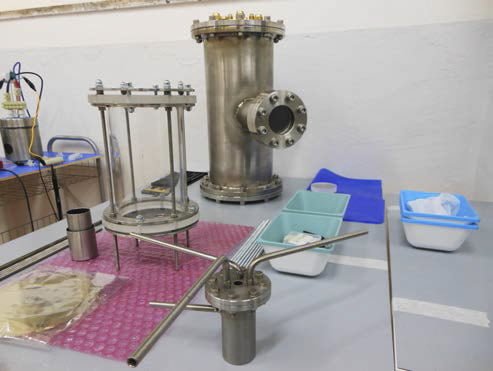
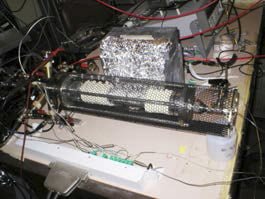
The reactor prepared for the ‘experiment

Fig. 2 Reactor prepared for experiment.

Fig. 4. The reactor in operating time. The covers from a thermal insulation and vessel with the reactor are removed
The reactor operates during the ‘experiment.
Read more HERE

*****


TALKING ABOUT US …
https://coldfusionnow.org/francesco-celani-continues-live-open-science-with-open-power-association/

*****

GOOD READING!
Published in the articles section of hydrobetatron.org, the new article:
“Science, brain and spirituality” by Luciano Saporito
TO READ THE ‘ARTICLE IN PDF CLICK HERE

*****

BOOK: “PILLS OF WISDOM” PILL 013
“A ‘picture sometimes speaks a thousand words”:
Sri Krishna

*****

For the full Open Power Association Newsletter #17, please go to the Archive here: http://www.hydrobetatron.org/archivio-newsletters.html

MIT goes Live with Cold Fusion 101

Cold Fusion 101: Introduction to Excess Power in Fleischmann-Pons Experiments starts tomorrow morning 10:30AM Cambridge-time Tuesday, January 20 on the campus of Massachusetts Institute of Technology and runs through Friday, January 23.

LIVESTREAM ON ColdFusionNow Youtube Channel google+ here!

Led by Dr. Peter Hagelstein of MIT and Dr. Mitchell Swartz of JET Energy, Inc, the course examines the experimental work of Martin Fleischmann and Stanley Pons, and theorizes on an explanation. For more, see Cold Fusion 101 at MIT for 2015

Cold Fusion Now’s MIT Special Correspondant Jeremy Rys will be attending the course to document the lectures – and possibly live-stream from the event.

Go to the Cold Fusion Now Youtube channel tomorrow Tuesday morning January 20 at 10:30AM-2:30PM MIT-time (4:30PM-8:30PM Paris, 12:30AM-4:30AM Tokyo) and see and hear the lecture live.

Watch Cold Fusion 101
10:30AM-2:30PM MIT-time on the
Cold Fusion Now Youtube google+

Cold Fusion Now New Fire by Nixter

Related Links

World Time Buddy

A Russian Experiment: High Temperature, Nickel, Natural Hydrogen by Michael C.H. McKubre

This is a re-post of an article written by Michael C.H. McKubre and published in Infinite Energy Magazine issue #119.

The original article can be found here.

A Russian Experiment: High Temperature, Nickel, Natural Hydrogen
by
Michael C.H. McKubre

[Editor’s Note: Alexander Parkhomov’s E-Cat experiment report was issued on December 25, 2014. We have uploaded the original Russian report by Alexander Parkhomov and his English translation.]

The first thing to record is that the document under consideration is an informal, preliminary research note available to me only in English translation of the Russian original. Despite that it reads well. Alexander Parkhomov is a “known” scientist from a highly reputable Institution, Lomonosov Moscow State University, which I have visited on several occasions. He has published work with friends of mine including Yuri Bazhutov (Chairman of ICCF13 and member of the IAC) and Peter Sturrock (Stanford University). These are both very capable senior scientists so that when this research is prepared for formal publication I am sure we can anticipate a complete and solid report.

In the meantime I will comment briefly on what is presented. Because of the community interest in the topic and the apparently clear and elegant nature of the experiment, Parkhomov’s preliminary report has already received an astonishing amount of discussion on the CMNS news group. What is stated in this preliminary report is encouraging, potentially even interesting, but one is struck by material information that is not made available in this report. Much, most or all of this added detail apparently is available to the author so one must await further elucidation from Parkhomov or a serious engineering effort at replication before final conclusions can be arrived at.

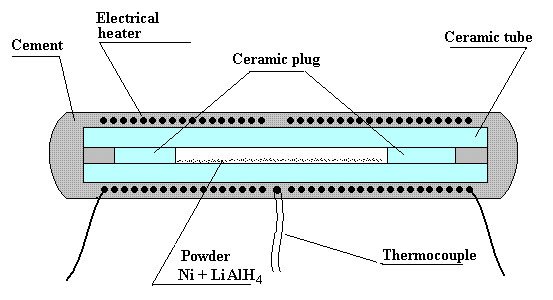
Although clearly motivated by the Rossi “Lugano” experiment it is not correct to call either a replication of the other or of any before. These are new experiments, with new characteristics, and some common features. As shown below the reactor active core consists of nickel powder intermixed with a hydrogen (lithium and aluminum) source, LiAlH4, enclosed in an alumina tube and confined with bonded ceramic plugs. This core is surrounded by a helically wound, coaxial electrical heater extended in length to provide closely uniform heating. The whole is potted in ceramic cement to incorporate a single sense thermocouple.

Fig. 1 Design of the reactor.

To this extent this configuration mirrors the Rossi reactor recently reported from Lugano although we do not know the similarity or differences between the Ni samples used in each.[1] Since LiAlH4 decomposes to liquid and H2 gas at the temperature of operation its source and nature of are presumed not to make much difference although the impurity content (unstated) may. Also different is the nature of the electrical input used for heating. For Parkhomov this is unspecified. The Rossi effort at Lugano employed 3-phase (50 Hz.) power for the calorimetric input and thermal stimulus but also includes an unknown amount of power in unstated form as a trigger. No such trigger apparently was used by Parkhomov.

The two experiments diverge radically in their chosen means of calorimetry. Parkhomov states that the “Rossi reactor technique based on thermovision camera observation is too complex,” with which I tend to agree. The chosen mean of calorimetry on the new report is to employ the latent heat of vaporization of water — the well known amount of heat required to boil water to steam, in this case at ambient pressure. The heater/reactor combination shown above was enclosed with partial insulation inside a rectangular metal box that was contacted on 5 of 6 surfaces by water.

There are some second order effects that might pertain to this boiling water calorimetry but the method is “tried and true.” It has been employed accurately for well over 100 years and in a slightly different form (boiling liquid nitrogen) was the method selected in recent SRI calorimetry.[2] With simple precautions such a calorimeter should be accurate within a few percent over a wide range of powers and reactor temperatures. One must be concerned to interrogate the heat that leaves the calorimeter by means other than as steam escaping at ambient pressure, that water does not leave the vessel in the liquid phase as splattered droplets or mist (fog), and to accurately measure the water mass loss (or its rate to determine output power). Obviously one also needs to accurately and completely measure the electrical input power.

Although this last issue has been recently (and anciently) raised it is very rarely a problem. Measurement of current, voltage and time (power and energy) are some of the measurements most easily and commonly made. Parkhomov does not supply details of the electrical power or its measurement and he is very much encouraged to do this in his formal reporting. I have no reason, however, to doubt the input power statements. Splatter and mist are issues of observation and calibration and heat leaks are a matter of calibration. Much detail is missing here. Full information about the calibration(s) must be provided in any formal report and full resolution of the question “what do the data tell us?” awaits this detail.


Infinite_energy_logo2

Get Infinite Energy now!


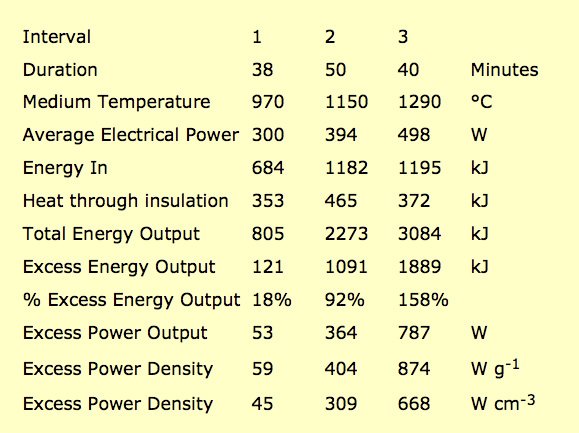
In the meantime what can we learn? Parkhomov states without showing that data that: “The power supplied to the heater stepwise varied from 25 to 500 watts.” The thermocouple in the reactor reached 1000°C approximately 5 hours after initial heating. It would be very nice to have these early-time data together with the data for calibration with which to compare; the greatest weakness of this report is the paucity of data. We are forced basically to rely on three data pairs that I have re-tabulated below from the Parkhomov report with some calculated numbers. Three time intervals are reported of varying duration (Row 2) in which the cell reported an average temperature resulting from the stated average electrical input power, and accumulated the stated Energy In. Parkhomov states from his calibration (not shown) that the heat leak from the system to the ambient is 155 W with the boiler at 100°C. From this heat leak rate we can calculate the energy that leaves in each interval through the insulation and from the mass of water lost we can calculate the heat that leaves as steam by using the known latent heat of vaporization of water (40.657 kJ /Mole or 2258.7 kJ / kg of H2O). The sum of these is the Total Energy Output, the second half of our three data pairs.

Tab-data-MM-analysis

These tabulated data (although few) exhibit an impressive set of characteristics:

  • Excess energies of ~120 to ~1900 kJ in 40-50 minutes.
  • Energy output greater than heat leak rate for the two higher input powers so that even if this loss approaches zero there is still calculated excess energy.
  • Percentage excess energies (and therefore average power) of ~20-160% with increasing input power and temperature.
  • Average excess powers of ~50 to nearly 800 W with a very small “fuel” load (0.9g of Ni).
  • Excess power densities of ~60 to nearly 900 W g-1 of Ni, well within “useful” regimes and consistent with previous CMNS results.
  • Excess power densities for the small reaction volume (~1 cm3) of ~50 to nearly 800 W cm-3.

All of these characteristics are exceptionally favorable. In the “plus column” we can also add that the experiment should be very easy to reproduce and we will hopefully soon have well-engineered replication attempts and conceivably confirmations. The experiment also does not appear to need stimulation[3] other than heat, hydrogen and possibly lithium or the need for solid-nickel/molten-metal interaction. So what are the worries? A very large amount has been said about this experiment in part because of the spectacular character of the tabulated data. Over and above the obvious need for calibration data and complete run-time data (ideally in the form of numbers not just plots) not everybody is happy. Why not?

Although others may have further points to add I would summarize three major concerns expressed[4] with the material that has been presented (rather than what was not):

The unexpected behavior of the Temperature at high power. When excess power (of apparently considerable power density) is being created one would expect to see the temperature of the source to be increasingly elevated. The observed trend is not in the “right” direction.

A plot of the data tabulated by Parkhomov for Reactor Temperature vs. Input Power is a stunningly good fit to a parabola. Because of limits of accuracy and precision experimentalists normally expect such close fits to be the result of calculation, not measurement. The goodness of fit may be explicable by the author or just be a fascinating coincidence.

A temperature arrest of approximately 8 minutes occurred at the end of the experiment after the rapid power and temperature drop following heater failure. This “Heat after Death” episode was preceded by a similar period of apparent temperature fluctuation. Either episode or both might be important signals of the underlying heat generation process or may signal sensor failure. It is difficult to resolve this ambiguity without redundant temperature measurement.

In the absence of relevant calibration data at least, and (better) a finite element model of the complex heat flow from the system as well, one can use only experience and intuition to predict what the reactor thermocouple sensor should register as a consequence of changing input power. The input power to the helical heater has a known (distributed) location. The excess power, however, while (presumably) volumetrically constrained has no defined or necessarily stationary position within the fuel volume. Even the first step of heat flow is therefore complex but an argument has been made qualitatively that, all else being equal, if you add a heat source the temperature should go up. Does it?

Let’s look first at a plot of percent excess power (left vertical axis) and temperature (right vertical axis, °C) as a function of input power (W). Three different colored curves are plotted for three different postulated values of the conductive heat leak from the calorimeter: red (155 W) the heat leak power calibrated by Parkhomov and assumed to be constant throughout the active run; blue (102 W) the value that makes the excess power for the first data point zero, as a conservative internal calibration; green (0 W) no heat leak, the most conservative estimate possible for this term. There is nothing at all surprising about this set of curves, and something quite encouraging. The observed excess power cannot be explained by an error in the conductive heat leak or any changing value of that parameter. The temperature of the reactor rises monotonically and smoothly with increasing excess and total power.

Now let’s look at the same data plotted against the measured reactor temperature below. Here we see some indication of the first concern enumerated above. Although slight, the curvature of this family of curves is up suggesting that as the excess (and total) power measured calorimetrically by the released steam increases, so also does the rate of heat (or temperature) loss from the thermocouple sensor. Although this might indicate a measurement problem (unknowable without calibration data) note that the deviation cause by this curvature is well within the variation bounded by the assumed heat leak to the ambient and might easily be caused by a relatively small change in this calibrated “constant.”

At least two unincluded heat loss term are known that must cause the heat leak constant to change in the direction to cause upward curvature: radiant heat loss from the reactor to the enclosing metal box at higher temperature; increased convective transport from the enclosing metal box to the inner wall of the “steamer” at higher rates of steam bubble evolution. I do not know whether the shape of the curve is a problem or is not. The point that I would like to re-reinforce is that we can only answer such questions definitively and thus gain confidence in the data and therefore knowledge if we have direct access to calibration data in the relevant temperature regime. I would also like to see a good thermal model as the reactor/calorimeter system is nowhere near as simple as it seems having several parallel and series heat transport paths. I realize that such model would be labor intensive and/or expensive to develop so lets start with the calibration. How does the system behave with no possibility of excess power?

As a comment in conclusion, there are gaps and unexplained effects in the data set, notably in the missing calibration data, and the foreground data record is slight. Nevertheless the experiment is clearly specified, easily performed, elegant and sufficiently accurate (with relevant calibration). I would recommend that the experiment be attempted by anyone curious and with the facilities to do so safely, exactly as described. Anything else or more runs the risk of teaching us nothing. I await further word from Parkhomov and reports from further replication teams.

Footnotes:
[1] Parkhomov has stated that the NI used to charge his reactor had an initial grain size of ~10µ and specific area ~1000 cm2/g.
[2] SRI DTRA report and ICCF17 proceedings.
[3] Note that the lack of need for stimulation is very good for demonstration but undesirable for control and thus technology.
[4] The first two points were elaborated initially by Ed Storms, who may make them more strongly than I do here.

About the Author: Dr. Michael McKubre is Director of the Energy Research Center of the Materials Research Laboratory at SRI International. He received B.Sc., M.Sc. and Ph.D. in chemistry and physics at Victoria University (Wellington, New Zealand). He was a Postdoctoral Research Fellow at Southampton University, England. Dr. McKubre joined SRI as an electrochemist in 1978. He is an internationally recognized expert in the study of electrochemical kinetics and was one of the original pioneers in the use of ac impedance methods for the evaluation of electrode kinetic processes. Dr. McKubre has been studying various aspects of hydrogen and deuterium in metals since he joined SRI in 1978, the last 25 years with a close focus on heat measurements. He was recognized by Wired magazine as one of the 25 most innovative people in the world. Dr. McKubre has conducted research in CMNS since 1989.

***********************************END RE-POST

Related Links

Russian scientist replicates Hot Cat test: “produces more energy than it consumes”

Interview with Yuri Bazhutov by Peter Gluck

Infinite Energy Magazine

Interview with Yuri Bazhutov by Peter Gluck

This is a re-post of an article written by Dr. Peter Gluck of Ego Out in Cluj, Romania.

The original article can be found here.

SHORT INTERVIEW WITH YU. N. BAZHUTOV by Peter Gluck

I had the privilege to ask a few preliminary questions from the leader of Russian LENR researchers Yuri Nikolaevich Bazhutov. They call the field Cold Nuclear Transmutation and I think this name is more realist than Cold Fusion.

Yuri Bazhutov is an ’89-er cold fusionist (excuse me) a well known member or our community, a reputed author, with 15 papers 1982 to 2014 in the LENR-CANR Library, an organizer and participant at our meetings, CNT strategist, a personality..

Q
It is encouraging to see and easy to observe how closely and seriously are followed, discussed and theorized the developments in CNT/LENR in Russia. What is the strategic thinking beyond this and the main targets?

A
After more, than 25 years of theoretical, experimental pilot studies in Cold Nuclear Transmutation in Russia we have arrived to a stage when we think about patents, demonstration devices, search for investors for realization of industrial devices. We are at a different, higher level now.

Q
Your very personal opinion: how do you see the scientific aspects; how these new developments, can they be explained theoretically and what do you and your collaborators intend to do for the experimental part?

In essence is it new science or new application (s) of already known science?

A
As co-author of the Model of the Erzion Catalysis (MEC), I believe that it explains the nature of CNT. All my experiments made in 25 years confirm this model.

MEC is built on orthodox representations of the Physics of Elementary Particles including as the main part, Quantum Chronodynamics (QCD) and, therefore it is also the new Section of Nuclear Physics

Q
The Lugano experiment despite its over-complicated thermometric calorimetry is a harbinger of a really wonderful/powerful energy source, MWhours from grams. Unfortunately, the Testers were shocked by the analytical results.
What do you think about those unexpected isotopic shifts and the dynamic processes that make these possible

A
Starting with the first experiments made by Rossi and Focardi up to the very Hot Cat tested in Lugano, MEC gives generally fine explanations and I have published about this in RCCNT&BL Proc., and in the Russian Inventing magazines (No. 1, 2012) and ISCMNS J. (No. 13, 2014). However I believe that our option of Russian E-cat on the basis of Plasma Electrolysis gives a much better perspective- heat generator at close realization still having a very high output specific power (MWhours from grams common water).

Q
On December 25, 2014 at a CNT seminary-Alexander Parkhomov and you have presented an experiment confirming the Lugano experiment using a realistic-cut-the Gordian knot simple calorimetry inspired from your experience. A very positive event.

However, after more than 50 years in and around research i have learned the cruel 1=0 rule-1 single experiment can’t generate absolute certainty. Nor Lugano, neither Parkhomov; so I ask-was the experiment repeated in house and when will the new report be published?

A
Parkhomov now works on lengthening of time of continuous work of a cell then to do atom spectroscopic and mass spectroscopic analyses of change of chemical structure and of the isotopic composition of fuel.

Peter Gluck – This was just a first discussion, I hope to continue. Bazhutov added: see and read more– and I have translated the paper.

http://vpk.name/forum/s188.html
The revolution in energetics was accomplished! The place of organic fuels was taken by the Cold nuclear Transmutation.
By A.A. Rukhadze, Yu.N. Bazhutov, A.B. Karabut, V.G. Koltashov

The era of oil burning has arrived to its end. The revolution in CNT (Cold Nuclear Transmutation) opens the way toward a new economic transformation, to the triumph of robotics, to cheaper production and the transition of the world’s economy in which Russia should not be disadvantaged.

On October 8, 2014 in the prestigious Los Alamos electronic publication Arxiv.org it was published the report of an independent group regarding the testing of the heat generator- Hot Cat created by Andrea Rossi. Six well known scientists from Italy and Sweden have tested for 32 days the functioning of the generator that allows obtaining cheap energy on the basis of a new scientific principle.

In the absence of the author of the invention (A. Rossi) there were measured all the possible parameters of the “energetic cat” After that, for an half year the scientists have processed the results in order to get comprehension. And their verdict was univocal: the Rossi generator works and produces an incredible amount of energy- the energy density is millions times greater as by burning the same quantity of any kind of organic fuel and is 3.7 times greater than the input electric energy. In the same time it is changed the isotopic composition of the fuel materials.

No nuclear radiations from the reactor could be observed during the test.
The first demonstration of working of an E-cat prototype was performed already at January 14, 2011 in Bologna, at the Physics Dept. of the University. During this demo the scientists and the journalists have seen a functioning reactor with the power of 12.5 kW at output. This works on the principle of cold nuclear transmutation as have related the authors, Andrea Rossi and Sergio Focardi.

Sergio Focardi, professor at the Bologna University – has performed even 20 years earlier the mechanism of hydrogen-nickel interaction in cooperation with the professor of the Siena University, Francesco Piantelli. These studies were done in the frame of a new physical phenomenon, cold fusion discovered by Martin Fleischmann and Stanley Pons in the year 1989.

At October 28, 2011 Andrea Rossi has already shown his first 1 Megawatt reactor sold to his first customer. Engineers and scientist were present, verifying how it works. Due to some imperfections, the reactor has produced 470 kWatts working for 5.5 hours in self-sustaining mode. There were used 100 reactor modules each with 3 branches- the whole complex of 300 reaction chambers.

The orthodox physicist overall have again ignored Rossi. According to all the canons of physics, something like this- nuclear boiler on the table- cannot exist! Amplification of energy almost 10 times is pure non-sense! And only few “heretics” of science, working for cold fusion (CF) have supported him.

Rossi had an unpredictable behavior but not so that he could be called a rogue and a charlatan as the orthodox have accused him. He has not asked money from anybody, on the contrary he has sold his house to be able to start this research. He has not chased popularity in the press; he refused interviews and has worked more with businessmen than journalists.

Rossi also has not tried to open a dialogue with the scientists – the luminaries of the nuclear physics: “The best proof of my truth will be the commercial device on the market”- he says.

The attitude toward this inventor has gradually changed- when after a dozen conferences nobody could show he cheats, secretly brings electricity to the device.

After that NASA took Rossi under its protection. Rossi could not refuse. It is clear he is safer in the US than in Italy. But NASA is only the visible part of the wall built by USA around Rossi and his invention.

It can be confirmed that the US tries to obtain complete control of the new sources of energy, the one who owns it, will be the far leader in technology.

Signals at the APEC Summit Show Big Changes Ahead
http://ireport.cnn.com/docs/DOC-1187686?ref=feeds%2Flatest
and gets rid of the oil gas dependence.

The US hopes not only to manage the flow of finance but also, on the basis of new technologies, having almost free, clean, limitless energy to perform export-oriented industrialization.

Other countries will remain behind if they will not also try to change. For this reason, in India after the ATEC summit where this issue was discussed ( see the CNN link) governmental actions were initiated to finance the development of new energy see please: http://www.e-catworld.com/2014/11/17/indian-government-urged-to-revive-cold-fusion-research-program/

It is for sure to say that Rossi’s invention cannot be kept under lock for long. In dozens of laboratories worldwide, the scientists are trying to guess the secret of the “silent Italian”, to find out his catalyst, to develop a theory of the process. In meantime, preparations are made for bringing the generators on the market. If the transition in industry, trade and transport rising humankind to a new level of automation- needs hundreds of thousands “Cold Cats” (actually they are warm or hot, N.T.) the start of these new industries will bring the oil industry in the abyss by thousands of ways – very bad for the economies that depend on hydrocarbons. It will become obvious the futility of investing in oil and its long term purchase.

In the near future we can expect a rapid development of the Cold Nuclear Transmutation (a new and more correct name than Cold Nuclear Fusion) both regarding theory and experiment, great investments will lead to breakthroughs in the related fields of science and technology. U.S. already relies on the revolution in the energy sector and may soon get its winnings. Civilization is near to a new era and we know in advance that it will be grandiose.

Russia is still among the leaders in research in Cold Nuclear Transmutation even in the absence of targeted funding, due to the still strong post-Soviet educational, theoretical and experimental research basis of its enthusiasts. The country has a Coordinating Council on the issue of Cold Nuclear Transmutation, held annual conferences and monthly seminars, in spite of the strong resistance of its orthodox-minded opponents. The Russian researchers in Cold Nuclear Transmutations have presented copyrighted theoretical models for CNT, more than 500 publications at the 25th anniversary of the discovery of CNF by Fleischmann and Pons. Based on the principles of CNT there had been created dozens of patents for the creation of new energy. A part of the researchers had been able to get small funding, others, unfortunately were forced to work abroad.

The “war of sanctions” from 2014 has shown that the US sees Russia as a threat to its dominance in Europe and world hegemony. Rossi’s success gives them a chance to retain the role of the global financial and industrial center, undermining the position of the other strong players. But the long-term decline in prices in the oil market will not necessarily mean a catastrophe for the Russian economy. With a favorable state’s attitude toward science, we will be able to recover the leading position as it was in the ‘50-‘60 years of the twentieth century. We will be able to participate in the new industrial revolution, going forward to terminate the humiliating position on the raw materials periphery of the world.

A.A. Rukhadze
Chairman of the Coordination Council of the SFA on the problem of Cold Nuclear Transmutation,
Academy of Natural Sciences and the National Academy of Sciences of the Republic of Georgia, Honored Scientist of Russia, Doctor of Science, prof., Institute of General Physics “AM Prokhorov”

Yu. N. Bazhutov member of the International Executive Committee on the issue of Cold Nuclear Transmutation, organizer of (1-21) Russian Conferences on Cold Nuclear Transmutation and the problem of the 13th International Conference on Cold Nuclear Transmutation (Dagomis 2007), Deputy. President of the Cold Nuclear Transmutation Committee (RFO), PhD, MN, IZMIRAN

A. B. Karabut AB, winner of the International Award Cold Nuclear Transmutation them. “Giuliano Preparata”for 2007.,
Laureate of the State Prize of the USSR for 1982. Member of COP Cold Nuclear Transmutation (RFO), PhD, MN, SNA “Luch”

V. G. Koltashov, head of the Center for Economic Research Institute of Globalization and Social Movements, Ph.D.

Translated by Peter Gluck, Jan 13, 2015

END RE-POST

Related Links


Russian scientist replicates Hot Cat test: “produces more energy than it consumes”

Q&A with Jack Cole on new Hot Cat replication, experiment completion

A new replication attempt of the Andrea Rossi E-Cat technology has been announced by Jack Cole on http://www.lenr-coldfusion.com/2015/01/13/hot-cat-replication-attempt/.

The Universal LENR Reactor was designed by Dale Basgall and Jack Cole and they have been posting updates since September 2012.

Nikita Alexandrov, President, Permanetix Corporation has contacted the lab and generated these details about the experiment.

 
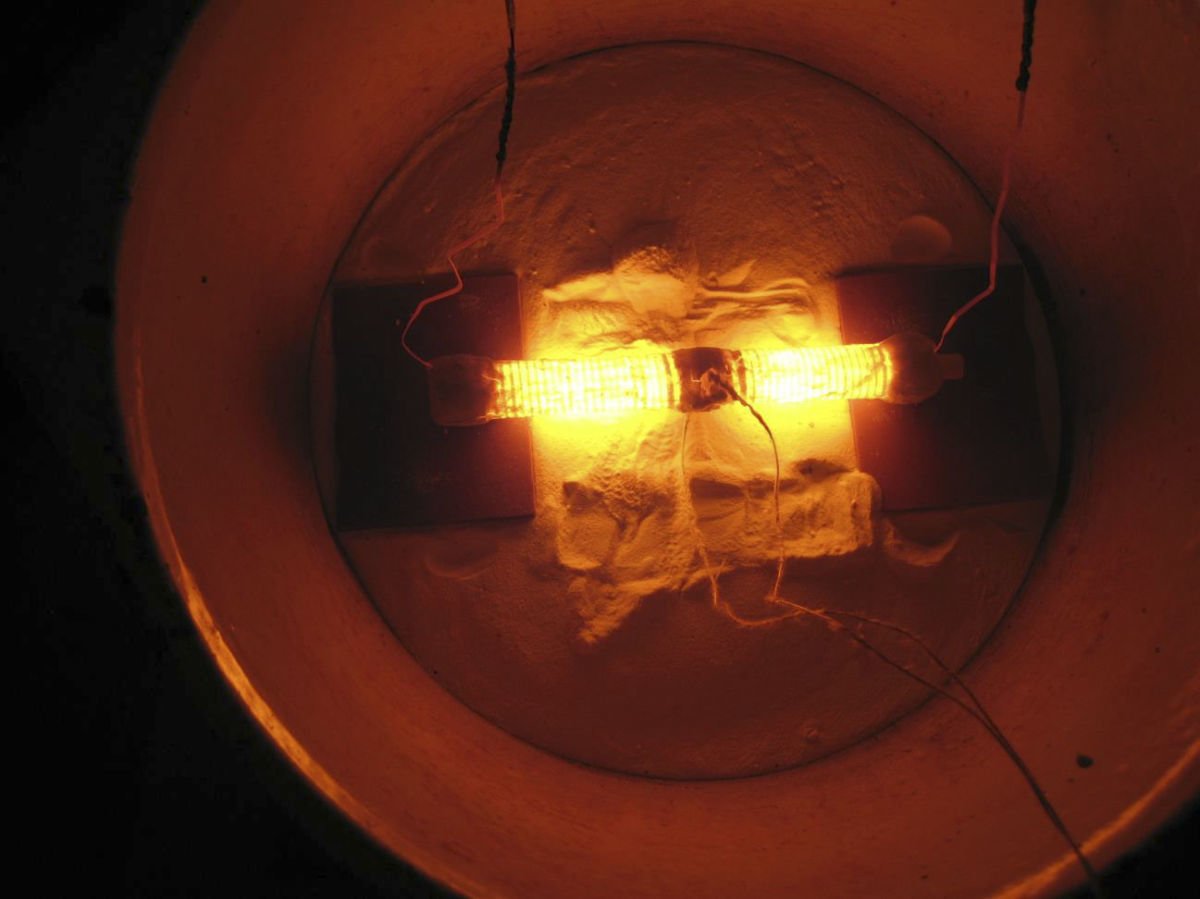
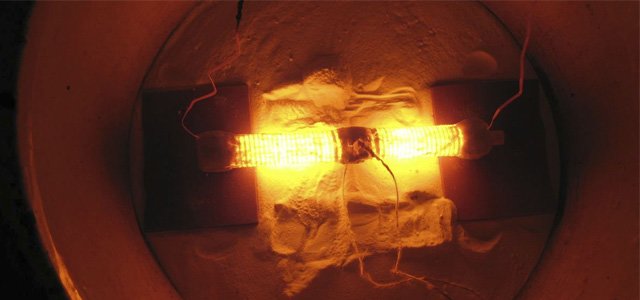
Photo: Reaction chamber in operation. Note that the true light color was orange. Courtesy Jack Cole.
 

Q&A with Jack Cole and Nikita Alexandrov

Q A replication of the Rossi type Ni-H LENR system was posted to your website. Were you the one who performed this experiment or was it someone else?

A Yes, I was the one who performed the experiment.

Q Can you go into detail regarding the nickel powder ie: grain size, composition, purity, source, batch number, etc?

A INCO Type 255 Nickel Powder (2.2 to 2.8 um particle size). Purchased on Ebay. I also use Fe2O3 added to the nickel.

Q Can you explain which type thermocouple/DAQ system you were using?

A I’m using a type K thermocouple of the type frequently used in kilns. I use a USB thermocouple adapter that has it’s own software (http://www.pcsensor.com/index.php?_a=product&product_id=49). The power data is acquired directly from the programmable DC power supply using a Visual Basic .NET program that I wrote. The VB program samples and adjusts power levels every 5 seconds to compensate for changing resistance to maintain a constant power output.

Q Can you explain which sources you ordered your alumina materials from?

A I purchased a 12″ alumina tube from Amazon and cut it into 3″ sections. It is 3/8″ OD and 1/4″ ID. The experiment was conducted with a 3″ tube.

Q Can you explain the geometry of your reactor and heating coils as well as method of sealing?

A The heating element is simply coiled Kanthal. The seal is not hermetic (it leaks hydrogen). I tested with a dangerous gas detector and it was leaking up to the last power step. After that point, I detected no more hydrogen. It was either sealed at that point or no more hydrogen was being produced. Based on the description of how Rossi sealed his reactor in the Lugano report, I find it unlikely his seal was hermetic (unless he found a very clever method of sealing the tube).

Q Can you explain which hydrogen carrier you used? In the report it was implied it was not LiAlH4, was it magnesium based – if you do not want to go into detail can you just confirm it was not a gas or which elements were present?

A I used lithium hydroxide and aluminum powder. The advantage with this method is that it does not start producing significant amounts of hydrogen until the LiOH melts at 480C. Earlier experiments were performed with KOH and aluminum powder. It starts producing hydrogen after 100C (presumably when the water absorbed in the KOH is liberated as steam). I haven’t seen any research discussing these facts as most research looks at combining water with these elements at room temperature to produce hydrogen. I don’t add any water (not really needed since these compounds absorb water from the air). The hydrogen production can be quite vigorous as I found out in an earlier copper tube experiment where the end cap was shot across the room into the basement wall.

Q Can you tell me if you made a blank, sealed reactor for the calibration?

A The calibration (control run) was performed with the same cell with one end sealed. The lack of seal on one end is a potential limitation. What bolsters the results is that the apparent excess heat has been decreasing (makes it less likely that the lack of seal on one end gave a bad calibration). Additionally, the Delta T at the first two power steps was almost identical between the control and experimental run. Hydrogen production started at the third power step.

Q Can you tell me how many trials you performed with this system before you saw xP?

A I performed many experiments with different types of tubes before this (brass, copper, and stainless steel). The trouble with all those is the melting temperatures and difficulty sealing. Copper is easy to seal, but you have to keep it below 150C to keep the solder from melting. You can get hydrogen with KOH and aluminum at that level (which produces chemical heat). I had promising results with alumina on my first run (but I used it as it’s own calibration comparing the lower temperature curve to the higher temperature curve–certainly not ideal). Part of the difficulty has been finding the right heating element diameter to match with my DC supply to be able to produced the needed heating levels. I have done probably 15 experiments with alumina tubes, but I had the best configuration for making measurements on the last one that I reported on.

Q Would you be interested in having a sample of your spent nickel material analyzed for elemental transmutations?

A I’ll keep it after I’m done with it in case this could be done in the future. Right now, I need to work on calorimetry to verify this in a more rigorous way.

Q Would you feel comfortable having me post your answers publicly, online and not just to the private mailing list?

A You can use it in whatever way you like. Keep in mind that I am not yet convinced by these results and there is more work to be done. I might yet discover that there is a simple conventional explanation that is not LENR. The results have to convince me, and I’m not to that point yet.

Q Thanks so much, this will really help educate the general community.

Top