“Dr. Steven Chu, Secretary of Energy is looking at Lattice-assisted Nuclear Reactions (LANR) Cold Fusion as a part of implementing President Obama’s ambitious agenda to invest in clean energy, reduce our dependence on foreign oil, address the global climate crisis, and create millions of new jobs.”
“This weekend at (MIT) Massachusetts Institute of Technology, Cambridge, MA, a global group of scientist and entrepreneurs met to discuss the latest advancements in LANR and CF.”
“On target with Dr. Chu vision to devote his recent scientific career to the search for new solutions to our energy challenges and stopping global climate change – a mission he continues with even greater urgency as Secretary of Energy. The event held at MIT brings together key players in the Cold Fusion LANR and other types of Nuclear Reactions.”
— from Steven Chu looks at Lattice-assisted Nuclear Reactions Cold Fusionhttp://the-explorer.com/steven-chu-looks-at-lattice-assisted-nuclear-reactions-cold-fusion/2011/3429583.html/
We sent Secretary Chu a few Cold Fusion Now stickers last fall with our letter signed with 30 signatures collected over a rainy energy outreach event. Check his bumpers!
We also sent a wad of stickers to Dr. Arun Majumdar, the Director of ARPA-E. I wonder where he slapped his?
It’s hard to understand the article. Did Secretary Chu actually attend the MIT conference?
This would be big news: LANR/Cold Fusion in the Secretary of Energy’s sight, and admitting it in public! This is just about as official as you can get. Can funding be far behind?
Let’s hope recent progress isn’t derailed, at the least.
According to the Congressional Research Service (using NEI data), there were 62,683 metric tons (138,192,360 lbs) of commercial nuclear spent fuel accumulated in the United States as of the end of 2009.
Of that total, 48,818 metric tons – or about 78 percent – were in pools.
13,856 metric tons – or about 22 percent – were stored in dry casks.
The total increases by 2,000 to 2,400 tons annually.
Before vacating the Cold Fusion Now HQ in beautiful Eureka, California and taking the show on the road, we squeezed in a visit to our local Pacific Gas & Electric Humboldt Bay Power Plant HBPP. A geologist friend of mine Bob MacPherson and I had made an appointment to see the Plant Manager Paul Roller to tour the facility.
Currently, providing 163 MW of power for Humboldt County, California from 10 brand new Wärtsilä natural gas engines, the HBPP is dismantling Units 1 and 2 of the original heavy fuel oil reactors from the late 50s which had then moved to natural gas in the 60s.
In addition, the facility is decommissioning a Unit 3 nuclear reactor built next to the old natural gas units, and underground 66 feet below sea level, in 1963 and which had been shut-down since 1976. (See HBPP timeline here.)
I wanted to see how the spent fuel assemblies were going to be stored on-site. Though the Unit 3 nuclear reactor had been closed for the past 35 years, the radioactive fuel rods had been stored at the plant in a pool of water 40 feet below the surface.
Spent fuel pools are steadily filling up in the US.
Most spent fuel in the US is stored in pools of water, but a geologically active region like the Pacific coast of the United States is challenged by both earthquakes and tsunami presenting added difficulty to safely storing this high-level radioactive waste, and this facility sits on the Cascadia Subduction Zone and Little King Salmon faults along the Ring of Fire.
In 1988, the HBPP was granted “site-specific permission” from the Nuclear Regulatory Commission to construct an Independent Spent Fuel Storage Installation (ISFSI), in what is called SAFSTOR. This meant that the plant operators could take the radioactive fuel assemblies out of the waterpools, and put them in more secure dry containers for interim storage. (See the NRC page on HBPP here.)
Mr. Roller is in charge of the decommissioning and first brought us up to his office to talk about the layout of the facility and how it changed over the decades. He mapped out what the power plant would look like after decommissioning. Then he showed us the method of SAFSTOR that they were implementing using models. It took about an hour as he was patient and careful about answering all of our questions.
Today’s conventional nuclear power poses a high contamination risk from mining the radioactive fuel through it’s eventual form of weapons or waste, and I was upfront about not wanting to invest scarce resources in any more of these types of power plants. However, I told him truthfully that I was glad to hear about their new design for storage of the fuel assemblies that could better prevent tragedy occurring on our coast, and I was grateful for his time and openness about the process.
Models of the inner and outer casks for storage of radioactive spent fuel assemblies. The stainless-steel inner cask on the right holds the fuel assemblies. The carbon-steel outer cask is on the left.
Mr. Roller described an inner cask made of 40 tons of stainless steel is big enough to take 80 used radioactive fuel assemblies – with the surrounding water. After setting down inside, the water is drained through a small hole near the bottom of the canister, and a 10,000 kilogram (22,000 pound) lid is robotically welded shut.
Again through the small hole, the container is evacuated and filled with helium gas. Then, the small hole is welded shut. The inner container is then put into a carbon steel canister with 54 bolts sealing the top and similarly filled with helium.
This is a model of the inner cask with its 10,000 kilogram lid welded shut.
The steel vaults stand 12 feet high and are partially buried so the top of the cask is at 44-feet elevation. This height accounts for a 40-foot tsunami wave hitting the low-elevation coastline. The nearby natural gas reactors stand at 12-feet elevation.
The casks are designed to maintain integrity and withstand 1.3 horizontal g-forces and 1.6 vertical g-forces. According to Mr. Roller, “At Fukushima, the vertical g’s recorded were 0.52. The only thing built to withstand these forces in Humboldt County are these storage facilities.”
After the Fukushima disaster, the HBPP issued a press release that was published in our local weekly, the Arcata Eye [1] outlining the strength of the facility:
“The Independent Spent Fuel Storage Installation (ISFSI) project was completed in 2008 and the facilities have been designed to withstand an 8.8 magnitude Cascadia subduction zone earth quake and a tsunami surge between 28 to 43 feet above sea level. The underground vault affords greater seismic stability, greater protection from tsunamis, reduced maintenance, enhanced aesthetics, and uses conductive cooling, making it completely passive, meaning that the facility is able to perform its job without requiring any actions to be taken by plant workers.”
We took a quick walk around the property. This is a view of the hill where the five vaults, which can hold a total 390 fuel assemblies, are located partially underground. Work is ongoing so it’s currently surrounded by those cement blocks and I took the photo through a chain link fence. Interestingly, being the highest elevation in the area, the nearby coastal town of King Salmon goes to this same hill during tsunami alerts.
Storage containers are being partially buried underground on the hill.
A rendering of the final landscaping shows the storage casks partially emerging from the top of the hill in the upper left. Just to the left you can see the edge of King Salmon.
The little spot on the top of the hill shows the top of the storage casks.
This site is only interim. There is no clear national policy in the US on long-term storage or recycling of toxic nuclear wastes. The 104 licensed commercial nuclear plants operating in the US are generally responsible for storing their own used fuel assemblies.
Because of another appointment, Mr. Roller wasn’t able to give us the full plant tour, but he showed us a few labs staffed by engineers who were also local residents and concerned about the safety of Humboldt Bay. I got the impression there was an excellent team running the facility.
Yes, that was some cold fusion materials in the Plant Managers office. Mr. Roller was very interested to learn of the recent developments in clean energy reactors and excited to receive some recent issues of Infinite-Energy magazine, as well as a copy of Nuclear Transmutation: The Reality of Cold Fusion by Dr. Tadahiko Mizuno.[4] Genuinely interested in hearing about cold fusion, Mr. Roller was bewildered at why, if this was so promising for clean energy, weren’t more people working on this, and indicated that he would investigate himself. I gave him a couple of complimentary Cold Fusion Now stickers to enjoy after his surely imminent conversion.
The Humboldt Bay Power Power plant generates 163 MW of electrical power using 10 natural gas reactors that can be dialed down below baseline to accommodate new power sources. I’ll be following up with Mr. Roller soon to see if he is ready to dial down a few Wärtsilä’s and purchase a some ultra-clean E-Cat modules as replacements.
How about making an appointment with your local power plant for a tour? Be friendly, and you’ll learn how your local power is generated. Have a conversation and communicate with those who maintain and operate your local power station and see the level of commitment the staff has.
Bring some information about LENR with you, and tell them where they can order an ultra-clean replacement for those rods.
But yo yo yo – the left coast here is Ruby’s sales territory!
Related links
Arcata Eye PG&E Statement On The Humboldt Bay Power Plant – March 21, 2011
Nuclear Energy Institute, Key Issues from an industry-funded association.
Nuclear Regulatory Commission HBPP public webpage here.
Pacific Gas & Electric’s Humboldt Bay Power Plant public webpage here.
Times-Standard Officials say Humboldt Bay Power Plant fears unwarranted March 26, 2011.
Tokyo Electric Power Company presented Integrity Inspection of Dry Storage Casks and Spent Fuels at Fukushima Daichi Nuclear Power Station 6-1_powerpoint November 16, 2010 at ISSF 2010.
A Special Report Renewable Energy Resources and Climate Change Mitigation SRREN by the Working Group III of the Intergovernmental Panel on Climate Change IPCC “presents an assessment of the literature on the scientific, technological, environmental, economic and social aspects of the contribution of six renewable energy resources to the mitigation of climate change. It concentrates “on the role that the deployment of RE technologies can play within such a portfolio of mitigation options.”
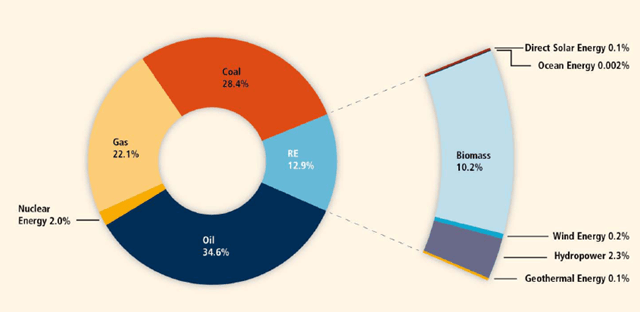
The assessment produces a best case scenario projection of 77% of of global primary energy from renewable sources by 2050. The Summary for Policymakers presented the numbers of current Renewable Energy RE sources. A graphic shows the total global primary energy supply of 492 Exajoules for 2008 and its distribution of energy by source.
Figure SPM.2: Global Primary Energy Distribution 2008
Biomass contributes the largest share of the RE contribution, but 60% of that comes from “traditional” biomass.
“Traditional” biomass generally means the burning of wood is the primary source of energy for billions of people and contributes to deforestation, loss of wildlife habitat, and poor air quality.
On a global basis, it is estimated that RE accounted for 12.9% of the total 492 Exajoules (EJ) [5] of primary energy supply in 2008 (Box SPM.2) (Figure SPM.2).
The largest RE contributor was biomass (10.2%), with the majority (roughly 60%) being traditional biomass used in cooking and heating applications in developing countries but with rapidly increasing use of modern biomass as well.[6]
Hydropower represented 2.3%, whereas other RE sources accounted for 0.4%. [1.1.5]
In 2008, RE contributed approximately 19% of global electricity supply (16% hydropower, 3% other RE) and biofuels contributed 2% of global road transport fuel supply.
Traditional biomass (17%), modern biomass (8%), solar thermal and geothermal energy (2%) together fuelled 27% of the total global demand for heat. — SRREN
Assuming bio-fuel crops like corn, sugar, and palms are within the other portion of the biomass contribution to energy, then doubling the contribution of this renewable source could generate possibly 8% of total primary energy demand.
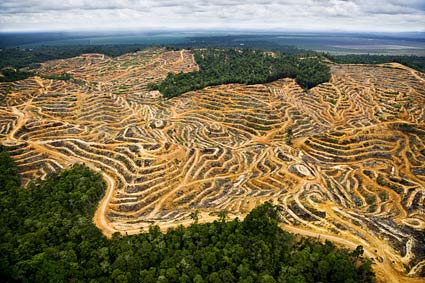
Palm Oil plantation removes virgin forest in Sarawak. Photo: Mattias Klum.However, doubling the amount of sugar and palm plantations will take virgin forest, home to the last great wild mammals, themselves near extinction, and clear-cut habitat to plant monoculture crops. Cropland re-directed to supply bio-fuels can take farmland from food, causing shortages and higher prices. Recently advanced chemically synthesized bio-fuels like algae require lots of water for growing.
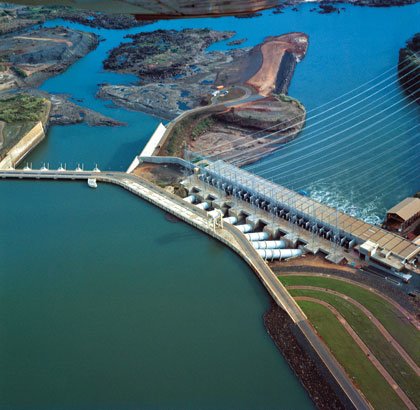
Hydropower takes second largest share of RE contribution to primary energy supply.
Hydroelectric power generates 2% of the global primary energy. Suppose that doubling the number of dams globally doubled the hydropower contribution to the total primary energy supply to a 4% share. What effects would this have?
Brazil gets 85% of its electricity from hydropower, and shares the largest hydroelectric dam in the world with Paraguay.
A five-dam project in Chile recently approved will change the Patagonian wilderness landscape by carving roads through wilderness to construct power lines, “drown 14,000 acres, require carving clear-cuts through forests, and eliminate white-water rapids and waterfalls that attract ecotourism.” Here in Northern California, efforts continue to succeed to un-dam the Klamath River, which has decimated salmon populations, though the recent victory by Native peoples, environmentalists, fisherman, and miners has yet to see a timetable for actual de-construction.
A greater percent of RE contributed to electricity alone, with 16% generated by hydropower.
Direct solar energy generated 0.1% of total global primary supply in 2008.
Doubling the contribution of solar energy would produce a 0.2% share, still a miniscule amount of the total. “The technical potential for solar energy is the highest among the resources,” the report stated. Then,
“Factors such as sustainability concerns [9.3], public acceptance [9.5], system integration and infrastructure constraints [8.2], or economic factors [10.3] may also limit deployment of renewable energy technologies.”
All of these choices viable for small scale use. But these traditional RE technologies will need to deeply expand into a finite and sensitive environment disrupting ecosystems and economies with negative effects if they are to provide a primary energy supply.
Renewable energy continues to grow with relatively small gains in total primary energy supply.
Interestingly, nearly half of the new electricity capacity generated from 2008 to 2009 was generated by renewable energies, but it hasn’t made much of a difference in an overall cleaner energy consumption. Primary energy supply is dominated by fossil fuels, and peak oil has changed production and consumption of fossil fuels at all levels.
Renewable energy accounts for just under 13% primary energy supply.
Although, according to the SRREN report, RE capacity continued to grow rapidly in 2009 compared to the cumulative installed capacity from the previous year distributed as:
wind power (32% increase, 38 Gigawatts (GW) added),
hydropower (3%, 31 GW added),
grid-connected photovoltaics (53%, 7.5 GW added),
geothermal power (4%, 0.4 GW added), and
solar hot water/heating (21%, 31 GWth added).
Biofuels accounted for 2% of global road transport fuel demand in 2008 and nearly 3% in 2009.
The annual production of ethanol increased to 1.6 EJ (76 billion litres) by the end of 2009 and biodiesel to 0.6 EJ (17 billion litres) [1.1.5, 2.4, 3.4, 4.4, 5.4, 7.4].
Of the approximate 300 GW of new electricity generating capacity added globally over the two year period from 2008 to 2009, 140 GW came from RE additions.
Bio-fuels increased 50% in one year, but producing this bio-fuel has taken farmland away from food possibly contributing to higher food prices. Yet it’s still only a mere 3% of global transport fuels.
The report states that wind energy, which in 2008 provided 0.2% of total global primary energy, increased capacity globally by 38 Gigawatts, a 32% gain in 2009. Solar power increased by 53%. But when the share is still less than 1% of total power generated, the gains are not so effective overall.
The SRREN summarizes the various scenarios for RE growth.
“A significant increase in the deployment of RE by 2030, 2050 and beyond is indicated in the majority of the 164 scenarios reviewed in this Special Report[11].
In 2008, total RE production was roughly 64 EJ/yr (12.9% of total primary energy supply) with more than 30 EJ/yr of this being traditional biomass.
More than 50% of the scenarios project levels of RE deployment in 2050 of more than 173 EJ/yr reaching up to over 400 EJ/yr in some cases (Figure SPM.9).
Given that traditional biomass use decreases in most scenarios, a corresponding increase in the production level of RE (excluding traditional biomass) anywhere from roughly three-fold to more than ten-fold is projected. The global primary energy supply share of RE differs substantially among the scenarios.
More than half of the scenarios show a contribution from RE in excess of a 17% share of primary energy supply in 2030 rising to more than 27% in 2050. The scenarios with the highest RE shares reach approximately 43% in 2030 and 77% in 2050. [10.2, 10.3]”
We will have to double the power generated by a mix of RE sources many times over to reach the highest projection of 77% of our energy supply from RE, or, drastically reduce what we are currently using. And 27% of primary energy supply coming from RE is too little too late. Scaling up the supply of RE technologies such as biomass, hydro and solar have broad impacts that will inhibit this ability to grow.
Nevertheless, assuming there is no “technical barrier”, then it’s possible to continue to make these gains. Given these gains though, the ease of integrating renewable energy resources into existing systems of fossil fuels “varies” and is generally site specific “depending on region, characteristics specific to the sector and the technology.”
“As infrastructure and energy systems develop, in spite of the complexities, there are few, if any, fundamental technological limits to integrating a portfolio of RE technologies to meet a majority share of total energy demand in locations where suitable RE resources exist or can be supplied. However, the actual rate of integration and the resulting shares of RE will be influenced by factors, such as costs, policies, environmental issues and social aspects. [8.2, 8.3, 9.3, 9.4, 10.2, 10.5]“, the report states.
“Costs associated with RE are expected to go down” according to the report. But it appears that costs given do not take into account several factors.
“The levelized cost of energy represents the cost of an energy generating system over its lifetime; it is calculated as the per-unit price at which energy must be generated from a specific source over its lifetime to break even. It usually includes all private costs that accrue upstream in the value chain, but does not include the downstream cost of delivery to the final customer; the cost of integration; or external environmental or other costs. Subsidies and tax credits are also not included.”
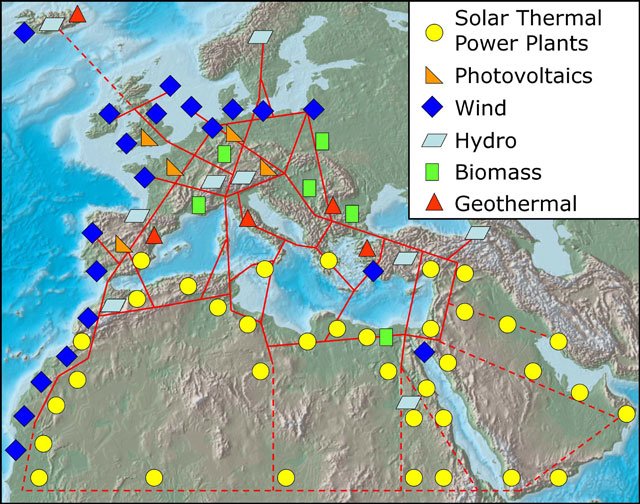
One of those costs is associated with transporting energy throughout a grid as in the transmission of centrally-generated electrical energy. European "Smart" Grids
New RE sources require investment in next-generation grid.
Our current infrastructure of power delivery was built by a previous era for a specific technology of hydrocarbons burned at a central location in great quantity to generate electricity that is then carried over long distances to power cities, suburbs, and industrial parks. Neglect, coupled with the patchwork nature of joining technologies together from previous centuries, have left the US electrical grid failing in its attempt to provide over-capacity production.
In “Northwest power surplus may halt wind energy“, the Associated Press’ Tim Fought reports that surging rivers from record rain in the Northwest US have hydroelectric dams at maximum production of electricity that they effectively can’t stop without flooding regions upstream, and apparently cannot sell.
The Bonneville Power Administration has announced “its intentions to curtail wind power until the grid has more capacity, in a move likely to cost the industry millions of dollars.” They have “run out of capability to sell the surplus electricity, store the water or shut down gas, oil, and nuclear plants – leaving wind farms the unfortunate victims.”
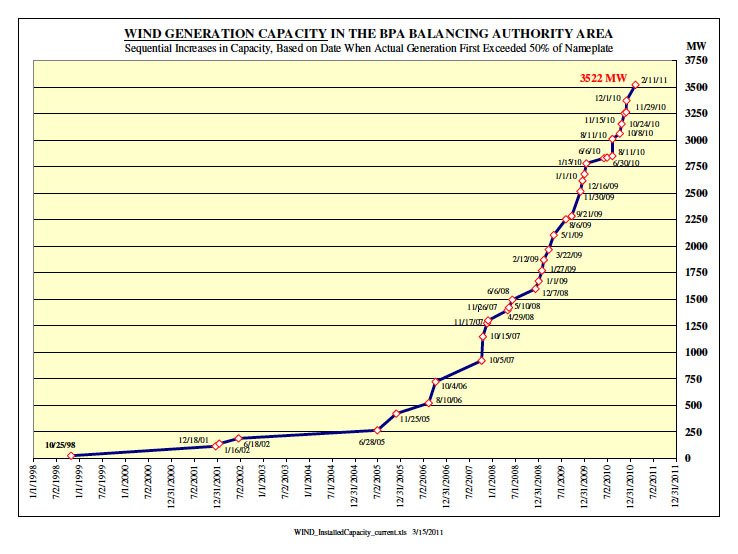
Growth of wind power in the US Northwest is exponential.
Clash of technologies from previous eras impedes deployment of new RE sources.
Many of the wind farms in the Northwest US were built using programs that provide tax credits – only if the operation is producing electricity. Not operating over a three-month period could cost wind farms “as much as $50 million.” If forced, these utilities that use wind farm energy will litigate over “antitrust and market manipulation laws”, the AP report continued. “The action reflects difficulty in integrating the young wind industry into a power grid that dates to the Northwest dam-building campaign that began in the Depression and kicked into high gear after World War II.”
This decision follows a Northwest Power and Conservation Council study that estimates wind power could more than double by 2025, according to another AP report “Northwest wind power could double, cause grid problems“. The council is charged by the President with “developing long-term power plans that balance the region’s energy and environmental needs”.
Wind power in the Pacific Northwest can currently “generate a peak output of about 6,000 Megawatts, or the equivalent of 15 good-size natural gas-fired power plants …… most added in the past five years” and could add “another 5000 to 10,000 Megawatts of wind capacity by 2025.”
I want to believe that renewable energy can be a primary energy source, but rapidly deteriorating world affairs have not yet swayed the biggest consumers to forsake hydrocarbons and adopt renewable energy. Nor has it stopped the developing hardware infrastructure under construction elsewhere. Fossil fuels have a century of history and built a colossal reality of cement and steel. The numbers for RE contributions are low and successive doublings of output from RE seems unlikely.
There is a viable alternative to traditional renewable energy.
Breakthroughs in low-energy nuclear reaction LENR science have achieved a major advance in power generation technology. Clean, energy-dense commercial devices based on LENR are set to enter the market, perhaps within the year.
LENR energy reactors create power using small amounts of hydrogen and metals like nickel, palladium, and others, both plentiful on Earth to create large amounts of energy, much more than burning hydrocarbons. One of the main components in H2O or water, there is enough hydrogen in the oceans to provide global energy for tens of millions of years. Metals are also abundant over the planet. Nickel is the fifth most common element on Earth, including the Earth’s core of iron and nickel.
New LENR technology can be adopted quickly throughout the planet, empowering local communities to better control their own energy source.
This ultra-clean technology could replace radioactive nuclear fission assemblies one-for-one generating power at a centralized location and delivering at a distance, but a new 1 MW LENR reactor called the Energy Catalyzer “is relatively small, being only 3 x 3 x 2 meters” making the big attraction to LENR reactors the ability to be off-grid, allowing both communities and individuals an independent, sustainable lifestyle with greater local control over their own energy supply.
Currently, there is a non-0% contribution from LENR reactors to global primary energy supply, for somewhere in the world, there are purportedly 97 Energy Catalyzers steaming forth, and there are many more labs around the globe testing LENR reactors of their own.
In the space of twenty years, a digital revolution occurred across the planet. We believe, whenever the first commercial devices are available, that the energy revolution has the potential to transform our world with clean energy in less than half that time, and most certainly well before 2050.
“…SPIEGEL ONLINE has obtained information from German government sources knowledgeable of the situation in Athens indicating that Papandreou’s government is considering abandoning the euro and reintroducing its own currency.” [4]
—Christian ReiermannAthens Mulls Plans for New Currency, Greece Considers Exit from Euro ZoneDer Spiegel Online
By indirections find directions out. — Shakespeare
There is a category of inventions called disruptive technology. Funding streams allotted to this sector award designers who innovate based on radical departures from incremental change. A cursory search of disruptive technology will yield many examples, most of which are IT-oriented, such as breakthroughs in social networking, cloud computing, and cyber security.
You will find little to no mention of the most disruptive technology of all, cold fusion, even as the first commercial device is poised to be installed later this year. Defkalion Green Technologies based in Athens, Greece holds the world rights, excepting the Americas, for Andrea A. Rossi‘s Energy Catalyzer, or ECat, a new energy reactor based on cold fusion technology, which Mr. Rossi prefers to be called low-energy nuclear reactions. A factory located in Xanthi, Greece plans to use an array of smaller models of the publicly demonstrated 12 Kw ECat, linked together, to generate 1MW power for the purpose of manufacturing more ECats.
Steven B. Krivit of New Energy Times published on his blog the possible board of directors for Defkalion as:
– Sortikos George, businessman, born 1942, President
– George Xanthoulis, student, son of Alexandros Xanthoulis, born 1987, Vice President
– Aurel Christian David, Managing Director, born 1969
– Christos Stremmenos, University Professor, born 1932
– PRAXEN L.T.D., Company based in Cyprous, will be represented by Alexandros Xanthoulis, born 1954
– John Chadjichristos, business consultant, member of the board, born 1958
– Andreas Meidanis, industrialist, member of the board, born 1953
– Muafak Sauachni, medical doctor, (Israeli), member, born 1961
– Andreas Drugas, business consultant, born 1945
Member Christos Stremmenos is a University of Bologna professor who was interviewed recently on Radio Città del Capo in Bologna, Italy about the ECat technology. Portions of the interview have been translated from Italian by Alex Passi in a piece on the website 22passi.blogspot.com entitled Stremmenos: “cold fusion will solve many problems of humanity”. [1]
In the interview, Professor Stremmenos mentions “his mediation with the Greek government to make an industrial plant possible. For this purpose, Defkalion Green Technology was formed, a business venture of which he is vice-chairman — on “honorary terms”, he says.
When asked about the role of the Greek government in the formation of Defkalion and the initiation of the factory in Greece, Professor Stremmenos replied with some background:
“When I retired, I wanted to set up my own lab and quietly continue my research. But I did inform George Papandreou, the current Prime Minister, who at the time was President of PASOK. In the Convention which elected him, there were these commissions working on various aspects of the Greek economy. These were supposed to lay down the most favoured Party’s platform for government. So I told him, “George, look” — I explained — “I’m still working on this”. So at the Convention he says: “You know, I believe in this thing too, but who knows when it will come about” “I don’t know”, I said, “ truth and fate we haven’t got, but we must support and pursue this line.”
When the recent breakthrough in energy production came with Mr. Rossi’s catalyst, Professor Stremmenos says he wrote to Mr. Rossi “I’d like to follow this thing up in Greece too, because right now there are serious economic problems in my country”. Later, he states,
“In short, considering the climate, the mindset of the present government in Greece …let me tell you, even the opposition has now asked to be informed on this issue, too. Therefore in Greece this matter is treated without prejudice, no one is uncommitted. Here, Rossi is right, there is not much one can do about it…”
Whatever the veracity of the report by Der Speigel Online that Greece would like to “exit’ from the Euro Zone, if a factory in Greece has the rights to manufacture the biggest breakthrough energy technology since the burning of wood, and the government has confidence that it’s ready to be commercialized, these events would influence any decision to leave the Euro behind, and speculate on perhaps creating their own currency backed by profits of ECat manufacturing and licensing, estimated in the hundreds of trillions of dollars? [5]
Separated from the European Central Bank, the people of Greece could be able to keep this wealth derived from energy, close to its shores. Where over two-thousand years ago, the roots of modern science, math, and democracy first emerged, we may now see a next-generation energy technology that will extend globally, for the first time in history, the opportunity for all humans to be equally self-sufficient.
The reality is that once the technology is spread, the opportunity for a change in living arrangements will be immediate, and a boon to the entire planet. New and better devices will be developed with applications we cannot think of today; an entirely new service environment with new roles for humans to play.
In a Wall Street Journal update after the secret meeting held last night in Luxembourg, Finance Minister George Papaconstantinou has refuted the notion that Greece will leave the Euro Zone, and there are other points to factor in. But as Greece roils from a year of financial crises that continues to bring its people into the streets protesting, the European Union won’t let Greece go easily, as revealed in the dire predictions for its economy should Greece ever depart.
It may look like an old bathroom pipe, but this invention defines disruptive technology. Photo: Mats Lewan NY Teknik
As this technology emerges into the public awareness, “there will be a stampede” for cheap, clean, energy generated by the hydrogen in water. Our current global industries of oil, gas, and coal will be obsolesced by a small, portable, self-contained energy reactor that can supply all personal energy needs for about a quarter to a third of current prices, and eventually, even cheaper.
The dollar, once “as good as gold”, became a petro-dollar linked with the currency of oil and as cold fusion technology permeates society, the dollar will not retain its status as the world’s reserve currency. Corporations, and all levels of government that exist for these non-entities, will see profits landslide. Cold fusion, and all new energy technologies, challenge the power that existing networks of money and hydrocarbons have, and after reigning for a hundred years, it won’t go down easy.
The public must be prepared to defend this ultra-clean energy technology. Be prepared for the assault by the diehards on this the most disruptive of technologies.
Challenge energy policies that do not include cold fusion relentlessly.
Support young, independent new-energy companies designing next-generation technologies.
Defend your right to clean energy.
And begin transitioning to the next phase in human existence.
“Cold fusion is no longer a maybe-possibly-probably not-junk- science. It is now real and it is emerging into the marketplace and we will see the first 1 MW power plant coming in mid-October of this year which will be producing 300,000 units per year. And that’s just starting. And so this is a great opportunity for people to get involved in a technology that can completely revolutionize the planet energy wise and get us off our dependence on fossil fuels.” –Sterling Allan
James Martinez Live had a surprise guest on last Tuesday, April 26 on his Cash-Flow show, when Sterling Allan swooped in for a visit. He is the man behind Pure Energy Systems, the yellow pages of new energy researchers. Allan has also formed the New Energy Congress, whose purpose is “to provide quorum review of leading technology claims, to assess viability and prioritize; then facilitate advancement”. His PESWiki allows for contribution by members of the new energy community.
Pure Energy Systems has a “Top Five Exotic Free Energy Technologies” listing of breakthrough technologies that got the attention of Gerald Celente, and made it into the Trends Journal 2011. Andrea A. Rossi’s Cold Fusion Generator is number one.
In the effort to move minds into action, and instigate the public to demand cold fusion, James Martinez began by stating flatly “It’s really up to you, the public to…vote for your children’s future … and liberate yourself.” This is aligned with Sterling Allan’s plea to “hound your representatives and tell them there are solutions. Stop saying they are not [any]!” Their hour-long conversation exposed what solutions to our energy crisis look like.
Listen to the full hour and download .mp3 on our Audio page.
A few highlights are transcribed below. In one exchange, James asked Sterling about the nature of implementing new technology into the current paradigm, and he lamented the bureaucracy that gets in the way of both scientists and students who want to study cold fusion. Sterling responded:
“It really is amazing to see how the role of politics in science can really stifle the development of science. Scientists, we would like to think, are really open-minded; something new comes along, they’re going to embrace it, they’re going to be excited about it, but in practice , the old Not-Invented-Here syndrome gets really really tight. If the scientist didn’t come up with it, if it wasn’t first published in some scientific journal, gone through the rigamaroll that they’d like it to go through, boy …. and that’s what we specialize in: when something makes the professor’s eyebrows raise, that’s when we start getting interested.”
He also recited a proverb posted on his website:
“He who is one-step ahead is a genius.
He who is two-steps ahead is a crackpot.”
When Sterling presented that to an audience in Estonia, somebody in the audience quipped, “He who is one-step behind, is the government.”
Then he added academia to the that same equation with “academia is so bureaucratic now, they are as bad as the government in stifling innovation.”
Listeners to the archive will enjoy the strange protracted silence, right before James comes back and relates his experience with a high school student who wanted to be a cold fusion scientist and James was setting up a cold fusion scientist to go and visit him at school. However, the young man’s school thwarted the effort. James then reminded us, “Learning institutions are supposed to be open-forums for discussion.”
Two years ago, prompted by the Navy’s research which was “basically saying cold fusion was real”, Sterling started a collection of positive reports on cold fusion that were printed in mainstream news and scientific journals around the world, “all basically announcing that cold fusion should be taken seriously.” [See this bit of presentation here on Youtube.]
“You think that would mark the turning point in the scientific world, that now we would start taking cold fusion seriously. But no, that wasn’t the case.
To this day, even with this Rossi cold fusion happening, if you go to academia and you say cold fusion with a straight face, you’ll be laughed at as a crackpot; it’s still junk science, because of politics, not science.”
James responded with some practical advice for young people in these lean financial times. “Forget the schools. Learn it yourself.”
The conversation inevitably touched on the lack of funding in cold fusion research. Sterling Allan responded:
“I learned a long time ago to not even glance at the government for any kind of leadership when it comes to this stuff. I go to the private sector. It’s the private sector that you get the receptive ears and you get the people that are excited. You get a phone call from somebody from NASA every once in a while that’s interested. You’ll get a cloaked email from somebody from some academic institution that’s kind of contacting you on the side, or on the sly so to speak.
But there are a lot of people that are supportive of these technologies and they are moving forward. The momentum is on our side.
We are moving into a state where we will lose our dependence on a central authority and we will gain our independence energy-wise, so that each house will have its own power device, each vehicle will have it’s own power generator so you won’t have to stop for fuel, it’s pulling energy from the inexhaustible sources all around us.”
James remarked that this technology of the gentle green giant nuclear power from water will “liberate humanity from the dependency on these oil companies and BP spilling hundreds of millions of gallons and getting away with…it’s an end to that.”
Later, Sterling echoed the responsibility of the current energy corporations in the current lack of vision in our energy technology:
“We need to shame the energy industry in the United States, and probably elsewhere in the world, not as bad in Europe as it is in the United States. The United States is almost the worst case scenario when it comes to energy. They are supporting the wrong horse and suppressing the right horses.
If you look at industry in general, the amount of money industry spends from their budget on research and development is 3.1%.
On the other hand, industries like communications, they spend 26% on research and development, software spends 15%, pharmaceuticals is like 14%.”
He then turned the tables and asked James if he knew what percentage of their budget the energy industry spends on research and development. A tiny 0.3% was the answer!
The entire energy industry in the US spends 0.3% of their budget on research and development — a shockingly low number.
“An order of magnitude lower than the industry average! Energy is so important…..we have to start spending our research and development money on new ideas. There are plenty of places to put that money, I promise you that,” Sterling said.
At the start of the second half of the show, James announced he had spoken with Andrea Rossi earlier in the day about an interview, but Mr. Rossi declined at this time, and all the way through October. He’s too busy working on his Energy Catalyzer (E-Cat) with his company Defkalion Green Technologies.
“They will be building 300 smaller, officially-rated 2.5 Kw reactors”. The reactor chamber is 50 cubic centimeters — 3.2 cubic inches. Then he characterized Andrea Rossi’s discovery as finding the catalyst to the nickel-hydrogen reaction, or the additive to the nickel powder. (In subsequent correspondence, Sterling (via his associate Hank Mills) added that: Andrea Rossi replaced the nickel rods or wires used in other Ni-H Cold Fusion experiments with nano-nickel powder, which greatly enhanced the surface area of the nickel. More surface area resulted in more sites at which the hydrogen could react. By combining this nano-nickel powder with two undisclosed elements (which he calls the catalyst) the fusion reaction was further enhanced.)
Addressing the cost issue for the average home user, Sterling noted that “a 2.5 Kw solar system would cover both roofs”. And Rossi’s device might cost “somewhere in the low thousands.”
“But an easier number people can relate to is cents per kilowatt-hour. Where I live [in Utah, US] we probably have the cheapest at 4 cents a Kwh wholesale”, he said. “Rossi cold fusion will deliver for 1 cent per Kw, one-quarter of the price“. He did add that the first applications would be in creating heating systems, and a turbine added to make the electricity would initially add to the cost.
He reminded listeners that though cold fusion is a nuclear process, there is no radioactive materials used, and there is no radioactive waste to get rid of. Mr. Sterling continued the good news throughout the interview.
“The coming year is going to be phenomenal in terms of the emergence of breakthrough energy technologies, clean energy technologies, affordable, portable…there’s a lot of stuff breaking out, this is one of them. This (cold fusion) is number one in our top five on our homepage of http://freeenergynews.com. This is our top one, but it is not the only one that’s to emerge this year. Some are expected to emerge even before this one.
This technology, from what I understand, is really quite simple to implement. It is something that could be licensed by a large number of manufacturers around the world and deployed very rapidly to create jobs and infrastructure that goes along with those jobs and all the various iterations of this. There’s going to be a lot of research and development that will need to go into making this stable for transportation, for example.
When we talk about nuclear, we think of Fukushima and we think of disaster, and we think ‘Oh my gosh, I don’t want that in my yard, let alone my garage’, but this is very different even though this is a nuclear reaction, if this was suddenly … a catastrophe happened, let’s say you were hit by a meteorite in your garage, and it smashed right into your cold fusion reactor, nothing would happen.
You don’t have radioactive elements leaking into the environment, you don’t have some big explosion taking place, it doesn’t runaway, it just stops. That’s all…
…Alternative energy can be our savior economically if we get on this fast enough, and the sooner we get on this, the more of a remedy it will be … and Gerald Celente actually predicted in his 2011 Trends Journal in January that 2011 would see the emergence, and he specifically mentioned Rossi’s cold fusion technology, that there’s going to be a breakthrough energy technology to come along that will be as big as the invention of the wheel or the discovery of fire in terms of its transformation capability for the human race.
Think of it this way. When people are able to do what they’re good at and what they want to do, they are 7 times more productive than when they’re working for somebody else doing something they hate, especially if they are slaves to a system, and they’re on fluoride, and they’re not thinking straight. When they become independent and they think for themselves and they’re doing something they love, they are 7 times more productive.
So when people are given power, a device that can power their house in the garage, and they’re no longer dependent on a central authority, and they’re able to pursue their dreams, we’re going to see prosperity like never before. We will see an end to war. We will see an end to poverty. We will see an end to so many of the problems that plague this planet. And that’s why these bastards don’t want to see free energy emerge because it empowers the individual. It’s power to the people…
….It’s an act of revolution to support free energy, and today’s generation that does so will be the heroes of the coming generation.”