James Martinez continued the Cold Fusion Radio series by hosting the creator’s of the new cold fusion documentary “The Believers” on his Achieve Radio Ca$h Flow show this past week.
Monica Long Ross and Clayton Brown of 137Films have spent three years on the film, interviewing some of the heavyweights in the field. A recent test screening was held February 11 in Chicago, Illinois.
James began by asking when we’d be able to see the film.
Clayton: Our film is technically unreleased, and so anytime we show it, we have to label it as a test screening, or a screening that’s a work-in-progress until it has its official premiere, which we don’t know yet where that’s going to be. We’re hoping that will be at a major film festival and we’re waiting in the next few days, the next few weeks, we’ll hear where that’s going to premiere and then we can release it to other film festivals.
As far as when it will come to a local theater near you, we have no idea yet, and that’s to a large degree out of our hands. It depends if we can sell this film to a distributor who thinks that it might have a chance at making some money in the theater, or maybe it will go on TV – maybe it will be on PBS, we just don’t know yet.
This particular screening happened because there’s a local science group called the Chicago Council on Science and Technology that took an interest in what we do, which is make films about stories that we find in the world of science, and they thought hey we’d like to have these guys show their film and have a winter session. It was a real nice event, kind of a win-win situation for both organizations.
James: How many people did you interview for this particular project?
Clayton: We interviewed probably 20-30 people for the film, and there were several people that we reached out to who for one reason or another were not interested, so we spread a really wide net – we probably contacted close to 50 people.
Some of them were supporters of cold fusion, some of them were cold fusion skeptics. As we discussed with you, we believed it was really important to maintain a neutral stance about cold fusion, so the film is neither a cold fusion promotional film, nor a cold fusion detractor film.
We hear from both sides of the argument which as you know is pretty vehement sometimes.
There’s alot of people who absolutely believe its true, and alot of people who absolutely believe its not true, and we wanted to hear from everybody so we could tell what we think is a fair and balanced story about the history of what happened and where it is today.
James: After you interviewed everybody, what’s your own individual consensus?
Clayton: We’re not scientists, and before we started making the film we really hadn’t heard much about cold fusion, so we didn’t have an opinion one way or the other.
We found it really interesting. When we were sitting down with someone like Ed Storms, we really came away thinking wow this is very compelling, I think something is going on here.
But then you sit down with someone like Bob Park, or one of the physicists who’s a real skeptic, and it’s easy to come away from that conversation thinking, now I’m not so sure. If I’m to believe this person, maybe it’s not very likely.
We walked that line for about three years, and we hope the film also walks that line. The film neither confirms or denies cold fusion, and to be honest, I think we both are not quite sure either.
We’re watching what’s happening in Italy, and things are interesting over there. On different days, we think different things. Sometimes we feel yeah I think there is something going on here, and other times we think, I’m not so sure. It’s such an interesting an multi-layered story, it’s easy to not be sure what you think.
Monica: I’d only add that we both came away with the idea that there’s certainly is room in science for the maverick, for the person who believes something and works very hard to continue even when other people in mainstream science are telling them to stop and so we were extremely appreciative of those scientists who wouldn’t give up.
I think that’s part of the story. The story is not just about cold fusion but its about science itself, who owns science, and what role does the person have who has a belief that is swimming against the stream. Clayton and I both came away extraordinarily impressed by these scientists who are keeping up this work and not giving up.
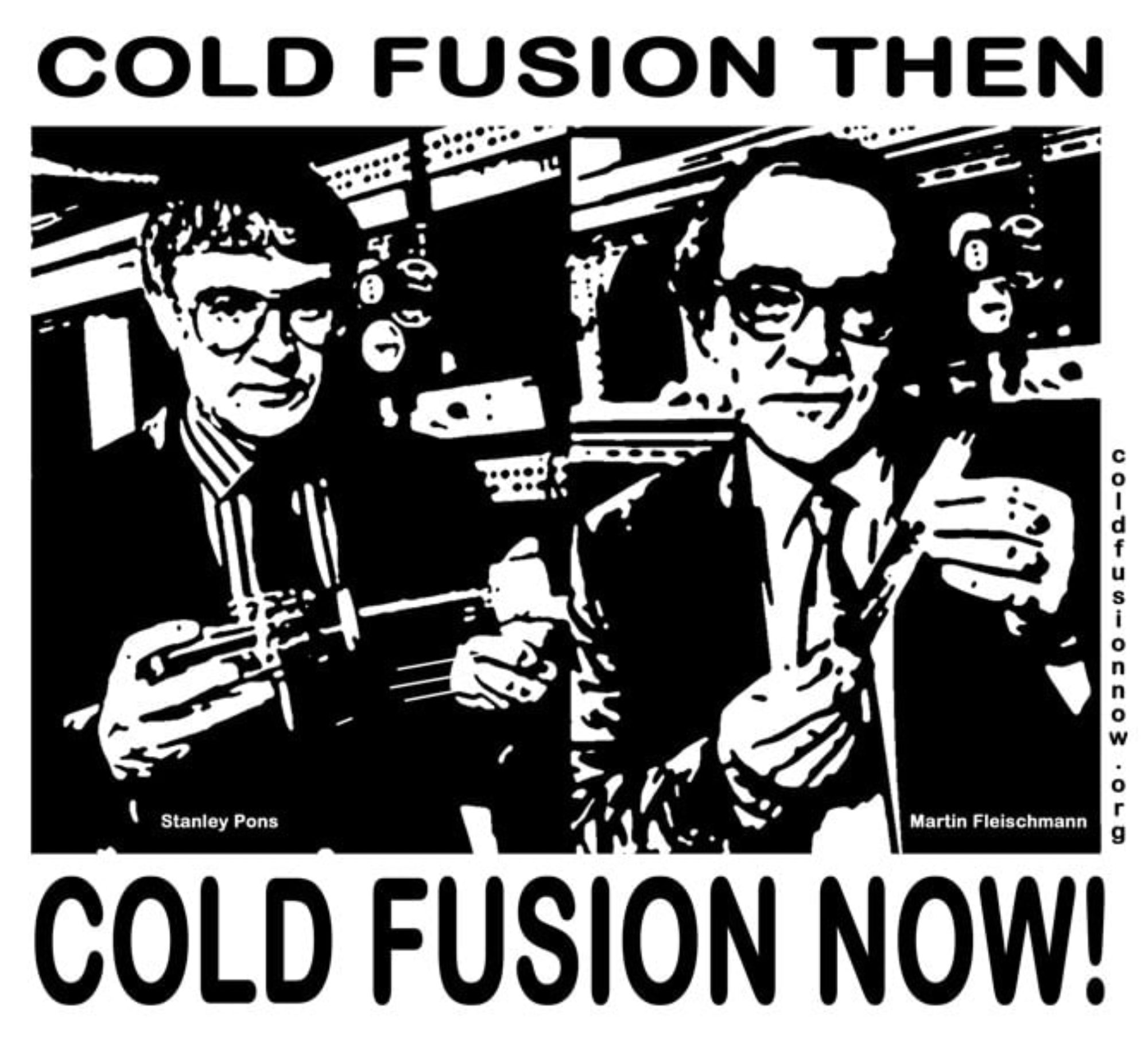
James: Anybody who has any pioneering vision, that is willing to think beyond the normal parameters – it can be a dangerous thing to do that. It can ruin your career, it can stick you in box forever, it can even get you killed as well. After you both had spent time with everybody, is it clearly evident still that from the very beginning when Pons and Fleischmann started this that you can still see doubt layered deeply in the scientific community from the threat of the actuality of cold fusion, or egos?
Monica: I think what we found was that there are scientists who are committed to one side and scientists who are committed to the other side. I think there’s certainly room for conversation and there’s room for opening up areas of research that may be against the mainstream.
I don’t think that we found…, …we did find people who were worried about the idea that there was some kind of organized program against cold fusion or an organized way of stopping people.
One of the primary ways of course is in funding. If someone has an idea that is not accepted by the mainstream science, it’s difficult to get grants, it’s difficult to get the money to do your work, and that kind of censoring of programs we could definitely see.
I don’t think that the skeptics or mainstream science had in any way – of course, we didn’t interview the oil companies, or other groups that you talked about when we interviewed you, so I don’t know that we have a concrete idea of whether there is some organized way against cold fusion.
But I do think that the funding issue is something that we looked into,
and many of these scientists cannot find the money in order to do their work, and how to equalize that and spread that money around, that’s part of the story too, of how does science get done.
I don’t know that in our interviews we found any concerted effort to stop cold fusion, but I do think we found bias within the funding community against cold fusion.
Clayton: One of the things that we heard Ed Storms and some others say was that it’s not necessarily an organized attempt to quash cold fusion, but one thing that we found really compelling that Dr. Storms said was, at the time, Pons and Fleischmann claimed some things that even cold fusion supporters and researchers now recognize was not possible, and so some of the early work that they did, even though it was honestly done, was later seen to be problematic for one reason or another.
The frustration that the modern researchers like Ed Storms, Peter Hagelstein and others have found is with the initial reaction of mainstream science community. There is a frustration with those who are working currently in the field with the idea that they have new information, they have new results and have clarified some of the earlier claims that had since been understood to be problematic.
But those original mainstream scientists will not look at the current work, they just reject it out of hand.
And so one of the frustration that current researchers have is that they can’t get any traction in mainstream science because of the stigma that was attached to the discovery from very early on.
James: That makes it very difficult from the very beginning.
One of the people you interviewed was the high school kid. How’d that go?
Clayton: It went great. In fact we had a correspondence with him. We contacted him and talked with him on the phone quite a bit before we went to his home. We talked about our film and about our methods and practice, and we gained his trust and told him about what we did and how we did it.
And he told us that he was about to receive a cold fusion kit in the mail that he was going to start working on and we said, well great, we’d like to come and film you setting up the experiment, and interview you. And so we did. He and his father were really terrific.
You know, we showed the film a couple of times at colleges getting feedback from different science classes, and at the end of one of the screenings, I asked the crowd, who did you trust most in the story?
Some in the audience said ‘we trusted this high school student the most in this story’.
It’s interesting because he really approaches this as a true scientist and upholds the scientific method. And he get some results that he’s not sure about, and he says ‘their inconclusive’, ‘I believe in the work I’m doing’, ‘I haven’t proven anything yet, but I’m a determined scientist.’
He just had a lot of integrity and we were really impressed with him and what he’s been doing.
James: Originally I had arranged to have one of the top guys out to go do a talk at his school – and that was shut down so fast! Did he ever say anything about that?
Clayton: We didn’t really go there. We knew that had happened in talking to you, and we talked to him informally, off the record about that. What he does say in the film is that he had wanted to do the experiment in school, but the teachers just didn’t know what he was talking about, they didn’t know anything about cold fusion, and so he was unable to do it at the school.
We didn’t go down that road of whether or not the principal shut the thing down having a guest speaker there. He wasn’t real comfortable talking about that and we understood, you know, that’s his school, and he didn’t want to film talking about that kind of thing. So we just let him talk about what he was comfortable talking about.
He ended up doing the experiment in his basement because his teachers at school just didn’t know what cold fusion was. They weren’t familiar with it, and just didn’t want to host the experiment there. I think it ended up being better because his father, who is an engineer, was able to help him and encourage him in a way that probably wouldn’t have been possible at school. So I think it turned out to be a great learning experience for him.
James: What are his plans? Does he plan on having a career in this field?
Clayton: We addressed that and he said ‘you know right now this is a hobby, but I want to continue to do this work and do this research.’
It’s interesting, we asked this same question of Ed Storms and Peter Hagelstein and they were both very hesitant to recommend that a young person go into the field because, as you know, it’s very complicated.
Peter Hagelstein said there’s been a lot of carnage in this field and they would feel very conflicted about recommending a person study this because A) there aren’t very many professors who would teach this and B) as Ed Storms said, if a young person becomes an expert in cold fusion in school, then goes out in the job market and say ‘I’m an expert in cold fusion’ – there are really no job opportunities.
James: Right, it is a complicated thing … The man of the hour is Dr. Andrea Rossi did you interview him post his experiments? At what point did you meet with him?
Clayton: Well, actually we did not interview Dr. Rossi. A lot of those developments happened when we were getting close to finishing this production, and unfortunately, we just didn’t have the budget to go back over to Italy.
So Dr. Rossi and all that work in Italy is emerging in the story. It gets talked about by you, it gets talked about by Eric, and Dr. Storms. We show a couple of clips from their news conference and its referred to in some text, but we didn’t actually talk to Dr. Rossi.
In a way it kind of ends the film saying that this is happening, and it’s a potential new development. Then some people feel like oh, look, it’s just a repeat of what happened with Drs. Pons and Fleischmann, so we don’t know really know where that’s going to go, but we’re keeping our eye on it. In a way, we hope that a viewer emerges from the film aware of this now, saying oh, I’m going to see what happens over there in Italy.
James: Does it just conclude that people just have to decide for themselves? Is there a way that the film says this just happened, or is it just a blank slate at the end?
Clayton: At the end there are some text things and one of them referring to that, and because text is a very easy thing to change, and since we’re not exactly sure when the film will be released, that’s something we can keep updated, you know ‘on such and such a date, Dr. Rossi said this’ or this happened. We’ll give as late an update as we can before the film goes to press. That’s why were watching what’s happening over there.
Hopefully our film will be finished and out the door before October which is when, the latest we’ve heard, he is saying his heaters will be available.
So probably it will be ‘Dr. Rossi claims he will be selling his heaters in October’, so a viewer will know what the current situation is and keep track of the story and see what’s happening.
Ca$h Flow halftime break! @30:00
James: What was the kind of initial feedback that you got from people as they watched this at the recent screening?
Clayton: For this particular audience, since it was organized by a scientific group there were a fair amount of physicists and engineers in the audience, and the discussion for a while centered around the science, and a lot of people asked questions about what they had claimed and what their process was.
But the film talks about the larger picture, there were some patent issues, issues with the media and celebrity, and all kinds of thing, and we think kind of a touching personal story that happened with Pons and Fleischmann who as you know, really suffered because of this. And so at some point the comments and questions shifted to the personal story, what happened to these guys, how did they end up where they are, and what are people doing now.
If there’s a scientific audience, there’s a lot of discussion that happens about the claims and whether or not they’re possible. If its more of a mixed audience, the conversation tends to be as much about the characters and the human arc of the story.
James: Have you shown it to any groups of non-scientists? What was the feedback there?
Clayton: So far, we’ve always had some scientists in the audience just because those are the groups that have been organizing the screenings.
With the non-scientists, you see a split, sometimes people say ‘wow I think these guys were clearly delusional’, or ‘I can’t believe they thought this’, and then you get other people say ‘wow I can’t believe we don’t have more of this going on’, ‘I feel they were railroaded’, and then you get people in the middle who are just not sure.
So I think we’ve hit the right mixture, where conversations and debates and discussions happen where people, depending on what they bring to the film, leave with something different. Or maybe they’re not sure what they think, thinking about it or doing some more research.
What our hope is that people come away asking a lot of questions. Our intention is to raise a lot of questions rather than provide a lot of answers.
There’s so many layers to the story, our hope is that it functions outside the question of whether the science is. If you’re a believer, or if you’re not a believer, there’s a lot of layers at work about what science is, and what happens when science collides with the media, and what happens when science collides with people who want to patent something, and what happens when people believe they’ve got an answer for the world, and what happens when people feel their voices are not being listened to. There’s a lot of bigger pictures that we hope emerge from the story.
James: It’s strange what I’m noticing on the Internet and from what people tell me. You can put as much evidence in the green, or the go, or the yes quadrant, that can be shot down instantaneously by a blog or some scientists who has an ax to grind. For as much evidence that you put forth, somebody can kill that in a moment in a few keystrokes. It creates unusual circumstances for somebody who are trying to say hey, I’ve got something to show the world and I think it should be talked about.
What you’ve done should trigger a big discussion. Was that your primary aim when you first started this, is to create a discussion?
Clayton: Yeah, you know, this is our second film. Our first film was called The Atom Smashers and it told a story about Fermilab which is the local particle accelerator. They were in a race to make this important discovery before a larger lab opened up in Europe and that’s kind of the thread of the story.
But the bigger issues that arise from that are should we fund the type of science that can not just make your cellphone better, but can help explain how the universe works, and what happens when those scientists run up against tax cuts, and what happens when a scientist in the middle of a career wants to have a kid. There are lots of bigger layers that happen and so our goal as an organization is to tell the types of stories that are yes, there’s a story line going on and a plot, but we hope to raise a lot of questions by exploring some bigger issues that lay on top of that story.
This film, we believe, has so many layers and other parts of the story that we got hooked on it right away so yeah, that is our intention – is to cause these discussions and create these conversations – get people to start thinking about who gets to decide what science is, and by the way, what is science and what role does that play in my life?
James: Are there some interviews that you did that you scrapped? Did you get any official words or sit down with people from the Department of Energy or Senators or Congressmen, or did you just keep away from that?
Clayton: There have been several story lines that we started to go down and then decided either it was a dead-end or it was headed where we weren’t really interested in.
In 2004, there was an attempt to get the Department of Energy to recognize cold fusion, which they ultimately didn’t, and we at one point pursued that story line. So we were calling some of the Senators and officials that were on that panel, they weren’t really willing to talk to us, so that storyline kind of petered out.
I think it wouldn’t have made it in the film anyway.
I was a little surprised. They weren’t sure why someone in 2010 or 2012 would be wanting to talk about back then in 2004 or 1989 or 1991! So there were a few people who just had no interest in talking about it and whether or not that was because they were worried about their career or just didn’t have any interest, we’re not really sure.
And then there were a few scientists that we talked to, and as you might know as an interviewer, sometimes you want to talk to somebody and then you find out that they’re not the greatest person to get on the air for one reason or another, and there are quite a few people we talked to that informed us of their information, but were maybe not the greatest on camera.
What you shoot compared to what ends up in the final film is an enormous difference. We probably got 120 hours of footage that we cut down to 84 minutes.
James: When you are going through the final cuts, how long did the edit take to do this?
Clayton: We started editing piecemeal while we were still shooting. That’s kind of a non-traditional way to do it. A lot of times people will shoot everything, be done with it, and then go into two months of editing. But we started building the piece almost right away so we built some of the edit, and then scrapped it, and kept parts of it, and honed it and worked on it probably for the last year-and-a-half of our shooting. We started shooting in January of 09, so the full edit took probably a year-and-a-half – two years, but part of that time we were actually still shooting, so that’s not quite accurate.
James: Well I think your film will get a lot more publicity than you think. Especially now, I can tell you one thing right now, because of what Dr. Rossi’s done, everybody’s ears have pricked up, the media’s paying attention. I know big Hollywood people have approached me, quietly behind the scenes….so I think your going to get a lot of people to take notice of this. And I hope it’s received well. Which film festivals are you going to be putting it in first?
Clayton: Unfortunately, that’s out of our control. We’re submitting to all of the major film festivals, and its really just up to them on whether or not they’ll accept the film, and so its a frustrating period.
We’re just kind of in the dark on what will happen next for the film. As soon as we get notification that we’ve been accepted to one of those bigger festivals we can get into high gear and start getting the word out there. Until that happens we just have to sit on our hands and wait, which is frustrating.
James: Now, there’s a lot more people behind this that are taking a stand publicly than most of the mainstream media has yet to hear about, but I know about it already because I’m involved with it and I know you’re going to get a lot of support all over the place.
You may be surprised at whats gonna show up at that film festival.
Now that you’ve completed the film and going to shop it, do you feel because of the all the new developments that happened that you might have to do a sequel to this?
Clayton: I don’t think we’d do a sequel. At some point, you just have to decide – OK, we’re done with the film. And it can be really frustrating if some results happened that would really add to the story.
But luckily nowadays with social media with web presence, we can give the film a longer life, by having almost a virtual ending that can be updated on the Internet. We can keep track of things that are going on, so if someone sees the film somewhere, and they think ‘oh there’s been some recent developments’ they can log on to our website and maybe we’ve got a little 3-minute video that sums up the latest on what’s happening.
In order to keep our sanity, I think that’s probably how we’re going to have to approach that.
James: I know you’re going to be focusing on this for a while, and I know you deal with science, but is there an area that you want to go now as filmmakers?
Monica: Our next film is going to be about the new space race. We’re going to follow Virgin Galactic and Richard Branson‘s attempt to get a whole new tourism area started. He’s built the Spaceport America outside of Truth or Consequences, New Mexico and we’re interested in going down there and seeing that part of the story of the space race.
We’re also interested in looking at all the new rockets that are being developed to put commercialized satellites into space and what’s happening right now in the new race to be the first in space.
We’re going to look at the United States side of it. So we’re excited, we’re going to be talking to everyday people…
James: That’s going to be a great topic.
Hey, I want to thank you for doing this film. I’m a big supporter of what you’ve done. For some people, this will be the first time that this subject matter will have been put before them. A lot of people just don’t have a clue about this.
And I’m glad that I got to participate in it too, and I look forward in the future perhaps bringing the publicity that this deserves.
The Department of Energy DoE released their FY2012 Congressional Budget Request Budget Highlights. download .pdf
“The Department’s Fiscal Year (FY) 2012 budget request is $29.5 billion, an 11.8 percent or $3.1 billion increase from FY 2010 current appropriation levels.”
“The central theme of this year’s budget in SC [Office of Science] is research in new technologies for a clean energy future that address competing demands on our environment,” the document states.
In FY 2012, the [SC] Department requests $5.4 billion, an increase of 9.1 percent over the FY 2010 current appropriation, to invest in basic research. The FY 2012 request supports the President’s Strategy for American Innovation, and is consistent with the goal of doubling funding at key basic research agencies, including the Office of Science. The FY 2012 Office of Science budget request supports the following objectives from the Strategy, including: — Unleash a clean energy revolution
— Strengthen and broaden American leadership in fundamental research
— Develop an advanced information technology ecosystem
— Educate the next generation with 21st century skills and create a world-class workforce.
Program Office Highlights DoE FY2012 Budget Request page 7
The Office of Energy Efficiency and Renewable Energy (EERE) is one of many DoE offices that claim to be “Investing in Breakthrough Technology and a Clean Energy Future.” Their FY 2012 budget request for $3.2 billion is “aimed at accelerating innovation and change in the Nation’s energy economy.” This includes programs that with meet with the President’s goals of “investing in the next generation of clean energy technologies“, among other things.
But the bulk of these requested monies will fund traditional alternative energies that have been in development, and funded, for decades:
The FY 2012 budget request continues to work to transform the Nation’s energy infrastructure by investing over $1,164.9 million in a variety of renewable programs including solar ($457.0 million), wind ($126.9 million), water ($38.5 million), hydrogen ($100.5 million), biomass ($340.5 million), and geothermal ($101.5 million). Research, development, and deployment of these technologies will reduce the production of greenhouse gas emissions and revitalize an economy built on the next generation of domestic production.
Program Office Highlights DoE FY2012 Budget Request page 8
The DoE office “devoted exclusively to funding specific highrisk, high payoff, game-changing research and development projects to meet the nation’s long-term energy challenges” will get <more than half-a-billion dollars.
Specifically, ARPA-E‘s budget request, ‘detailed’ on page 23 of the document, totals $650 billion. Advanced Research Projects Agency – Energy: Transformational Research and Development
The FY 2012 budget request includes $550 million for the Advanced Research Projects Agency – Energy (ARPA-E), a program launched in FY 2009 that sponsors specific high-risk and high-payoff transformational research and development projects that overcome the long-term technological barriers in the development of energy technologies to meet the Nation’s energy challenges, but that industry will not support at such an early stage.
An additional $100 million in mandatory funding is also proposed from the Wireless Innovation Fund for developing cutting-edge wireless technologies. An essential component of ARPA-E’s culture is an overarching focus on accelerating science to market.
Beyond simply funding transformational research creating revolutionary technologies, ARPA-E is dedicated to the market adoption of those new technologies that will fuel the economy, create new jobs, reduce energy imports, improve energy efficiency, reduce energy-related emissions, and ensure that the U.S. maintains a technological lead in developing and deploying advanced energy technologies.
Nowhere in the budget is found the words low-energy nuclear reactionsLENR, lattice-assisted nuclear reactionsLANR, chemically-assisted nuclear reactionsCANR, condensed matter nuclear scienceCMNS, nickel-hydrogen exothermic reactionNi-H, or cold fusion, despite meeting each of the Department of Energy’s Objectives.
DoE Objective – Unleash a clean energy revolution
The revolutionary energy from cold fusion comes from the Fleischmann-Pons “Excess Heat” Effect FPE.
When hydrogen, or its isotope deuterium, is absorbed by a metal like nickel or palladium, large amounts of heat can be generated. This heat can make useful steam, hot, clean water and eventually, electricity.
Hydrogen is an element abundant in water. Access to water means access to fuel, empowering local communities with their own energy sources.
Metals like nickel are plentiful on the Earth, as well as the moon and asteroids. Costs for these and other metals will be low. And this energy is powerful enough to make ecological mining practices economically viable and standard.
Large energy returns of 25 have been published, and energy returns of 400 and higher have been demonstrated. A planned commercial steam generator is the size of a cigarette pack and expected to generate 10 kilowatts of power.
DoE Objective – Strengthen and broaden American leadership in fundamental research
Internal view of an experimental cold fusion cell.
New technologies using the FPE have been developed largely by trial and error, without the benefit of a guiding theory. Basic research is sorely needed to define what the parameters for successful, and maximal, output of energy are.
Experiments have yielded multiple effects other than excess heat like transmutation, even in biological organisms, where current research may lead to ridding the world of the stockpile of radioactive waste.
The research possibilities are endless.
DoE Objective – Develop an advanced information technology ecosystem
Few could imagine the way personal computers developed in the 1980s would literally change the way we live as they did. New jobs and new businesses can thrive in a service environment for clean cold fusion energy.
As a decentralized power source, cold fusion energy devices do not need a grid delivery system. Units can be designed stand-alone and portable.
Scalable power sources could be built into even the smallest hand-held devices, providing power for the life of the device, with no need to recharge.
DoE Objective – Educate the next generation with 21st century skills and create a world-class workforce.
A cold fusion economy means opportunities for training in new energy. Basic research means jobs for young scientists, with the meaningful and exciting work of building a future based on clean and plentiful energy.
Cold fusion meets the objectives, and then some.
What kind of funding would make a difference?
In an earlier interview with James Martinez, longtime researcher based in Washington D.C. David J. Nagel described a 5-year program starting at $20 million a year, ramping up to $40 million annually, an average $30 million a year for five years to bring this research to the next phase, and more importantly, as Dr. Nagel describes, bring a young group of scientists into this field of research to continue to innovate and drive the next-generation energy for our planet.
$150 million for cold fusion, half-of-one percent of DoE requested budget for 2012.
The document is filled with phrases like “energy security” and “American leadership in innovation”, visual-space divisions that are relevant no more to an alliance of peoples across this planet who live in an invisible spacetime of digital-satellite-wireless electromagnetic resonance, and who realize the need for a new arrangement for living on Earth.
Creating a new economy cannot be done by the US, or any one nation, alone. There is a new world to create, one that requires participation and cooperation from people united on every continent.
How will this move forward?
Within the context of maplines, this scenario was posited by Kiva Labs cold fusion researcher Dr. Edmund Storms, way back in 2010:
“Sooner or later scientists in some country will discover how to make cold fusion work on a commercial scale. When this happens, the countries that develop this technology will rapidly become richer and more powerful. The cost of energy for manufacturing will go down and processes that are not yet practical under most conditions, such as obtaining fresh water from the sea, will become widely used.
These benefits will cause a rapid expansion in the power and influence of the countries using this inexpensive energy source. What about the countries that do not know how to make the effect work?
Their scientists will attempt to reverse engineer the power generator, but in this field, such efforts will be difficult without an understanding of how the process works, an understanding that will not be shared by the discovers.
Also, highly developed countries will have difficulty removing their present energy infrastructure and substituting this much simpler source. So, the race is on and the potential winners are not obvious.
Nevertheless, it is obvious the winner will not be a country that ignores and rejects the reality of cold fusion.” Edmund Storms Why is cold fusion rejected?
Perusing the DoE budget request is like forensics on a phantom limb, gone but not forgotten: there will be no federal funding for this field of new energy anytime soon.
But thank you Mr. Sidney Kimmel!
News like “Billionaire helps fund MU energy research” from the Columbia Daily Tribune is welcome, and desperately needed.
The House Committee on Space, Science, and Technology’s Subcommittee on Investigations and Oversight held a hearing on January 24, 2012 to review the efforts of the Advanced Research Projects Agency – Energy (ARPA-E), a Department of Energy (DOE) agency tasked with ‘funding cutting-edge energy research “in areas that industry by itself is not likely to undertake because of technical and financial uncertainty.”’
According to the Subcommittee press release, the Government Accountability Office (GAO) and the Department of Energy Inspector General’s (IG) office both issued reports that found ARPA-E funding practices and procedures appearing to veer from this mission.
In particular, the GAO’s Advanced Research Projects Agency-Energy Could Benefit from Information on Applicants’ Prior Funding reported that
12 of the 18 companies it identified as having received private sector funding prior to their ARPA-E award planned to use ARPA-E funding to either advance or accelerate prior-funded work. Further, Chairman Broun noted, “Similarly, a review of GAO work papers and publicly available information indicates numerous instances of overlap and duplication between ARPA-E and both public and private sector funding.”
In addition, DOE’s Office of the Inspector General (IG) released its own audit in August 2011 that focused on “whether ARPA-E implemented safeguards necessary to achieve its goals and objectives and to effectively deploy associated Recovery Act resources.”
Two of the three awards examined in detail by the IG had questionable costs of $280,387. Included among these costs were “meetings with bankers to raise capital” and a “fee to appear on a local television show.” Despite concerns regarding these uses of taxpayer dollars, the DOE IG noted in its report that such activities were cited as an allowable cost by ARPA-E under its Technology Transfer and Outreach policy.
ARPA-E, DOE IG, and GAO each testified.
Testifying were Dr. Arun Majumdar, Director, Advanced Research Projects Agency – Energy, U.S., Gregory Friedman, Inspector General, U.S. Department of Energy and Mr. Frank Rusco, Director, Energy and Science Issues, U.S. Government Accountability Office.
Roscoe BartlettDana Rohrabacher
This particular Sub-committee has members such as Representatives Roscoe Bartlett, who has championed the Peak Oil issue in the House for years, though to deaf ears, and Dana Rohrabacher, who spoke out in support of Drs. Fleischmann and Ponstwenty-three years ago.
The Chairman of the Subcommittee, Paul Broun said in his statement that
“while it is clear many ARPA-E projects are pursuing high-quality, potentially transformative research that is too risky for private investment, reviews of GAO work papers and publicly available information reveal many exceptions to this practice, and raise questions regarding ARPA-E’s commitment to ‘carefully structure its projects to avoid any overlap with public and private sources of funding.’”
Specifically, the reports detail information showing that:
Numerous awardees indicated to GAO they would use ARPA-E funding to accelerate work they were already pursuing.
Numerous awardees’ proposals overlap and even duplicate efforts supported elsewhere in DOE and other Federal agencies.
The Administration touted ARPA-E awardees that received private sector funding after their ARPA-E award as proof that ARPA-E is working and successful; however, ten of these eleven recipients had also received significant private sector funding prior to receiving their award, raising questions regarding the degree to which the ARPA-E award itself was the driver of the follow-on funding.
Of the 44 identified small- and medium-size companies that received ARPA-E awards, a review of USASpending.gov shows that 26, or 59 percent, of these companies received other funding from the Federal government.
Over 60 percent of proposals funded by ARPA-E sought to advance technology to Technology Readiness Level (TRL) 6 and beyond—the late stage technology demonstration and system commissioning and operation that is regularly supported by the private sector.
ARPA-E’s response, included in the GAO report, rationalized the actions.
The full Staff Report to Chairman Broun’s statement HERE
The GAO’s Advanced Research Projects Agency-Energy Could Benefit from Information on Applicants’ Prior Funding report is available HERE
The DOE IG’s Audit report is available HERE
The IG report states “The goals of ARPA-E are to enhance domestic economic security through the development of energy technologies and to ensure that the United States maintains a technological lead in developing and deploying advanced energy technologies.”
The small amount of federal funding for cold fusion research has come largely from Department of Defense agencies. Civilian funding would come from the Department of Energy’s ARPA-E office, but so far they have refused to even acknowledge the two-decades long body of science, violating their stated mission.
At this point, it appears private sector funding will carry the development of this revolutionary new energy technology into the future – only after the first steps in commercial products begin appear on the market. Till then, the small, self-funded companies will continue to struggle in their effort to bring forth the answer to many of our energy problems in the form of real, usable generators.
And at that point, the DOE will realize they’ve been playing in Bonanzaland instead of the Space Age.
Cold Fusion Now!
Related Links
Members Question Oversight and Administration of ARPA-E House Science, Space and Technology Subcommittee on Investigations and Oversight Press Release January 24, 2012
Letter to ARPA-E by Ruby Carat August 17, 2010 – one of our earliest efforts at contacting DOE!
“Suburbia lives imaginatively in Bonanza-land.” — Marshall McLuhan The Man, His Message CBC Archives
Contact the Committee on Science, Space and Technology Sub-Committee on Investigations and Oversight
Thank them for supporting new energy research
— and to put LENR funding at a priority.
System crashing, nuclear threat,
riots in streets, fiat paper debt,
mass extinctions, despot measures-
I’m changing the channel for TV pleasures.
I am not familiar with most current TV offerings – and this is old news for you hipsters – but while visiting family, I learned about The Big Bang Theory, one of the biggest shows on TV. It’s about a couple of super-smart science geeks, and the limitations they have as whole people.
One particular episode, Season 4 Episode 2 The Cruciferous Vegetable Amplification, aired on November 30, 2010 and had a guest appearance by Apple computer legend Steve Wozniak AND a mention of cold fusion.
 Monica Long Ross and Clayton Brown of 137Films have spent three years on the film, interviewing some of the heavyweights in the field. A recent test screening was held February 11 in Chicago, Illinois.
 When hydrogen, or its isotope deuterium, is absorbed by a metal like nickel or palladium, large amounts of heat can be generated. This heat can make useful steam, hot, clean water and eventually, electricity.
 A cold fusion economy means opportunities for training in new energy. Basic research means jobs for young scientists, with the meaningful and exciting work of building a future based on clean and plentiful energy.
 The document is filled with phrases like “energy security” and “American leadership in innovation”, visual-space divisions that are relevant no more to an alliance of peoples across this planet who live in an invisible spacetime of digital-satellite-wireless electromagnetic resonance, and who realize the need for a new arrangement for living on Earth.


 One particular episode, Season 4 Episode 2 The Cruciferous Vegetable Amplification, aired on November 30, 2010 and had a guest appearance by Apple computer legend Steve Wozniak AND a mention of cold fusion.