Defined by Wikipedia: “Technocracy is a form of government in which engineers, scientists, health professionals and other technical experts are in control of decision making in their respective fields. The term technocracy derives from the Greek words tekhne meaning skill and kratos meaning power, as in government, or rule. Thus the term technocracy denotes a system of government where those who have knowledge, expertise or skills compose the governing body. In a technocracy decision makers would be selected based upon how highly knowledgeable they are, rather than how much political capital they hold.”
Ron Miller is a retired engineer who now educates about technocracy conducting workshops for kids at schools and colleges. One of his students described technocracy as “a cross between Star Trek and Nova”, which may be as accurate as Wikipedia.
James, whose show looks at issues of money and society, asked about the support shown for a “no money society” from technocracy.org poll participants. Mr. Miller responded:
“What the organization proposed was that the amount of energy that is required to produce every single thing that society needs should be accounted for, and everyone would be given their share, simply by dividing between the population, of the amount of energy over a given budgeting period.
An then when you go into a store, that amount of energy would be deducted so that we could keep track of what’s going where, and so on and so forth. You still have to have a feedback mechanism, for instance, so that the warehouses know that their beginning to run out of a particular product and the warehouse can tell the manufacturer they need more and the reason we chose energy is because energy is the most fundamental constituent of anything physical.
In the universe, there is really only two things, matter and energy, and without energy there is no motion and no movement. It requires energy to dig materials out of the ground, it requires energy to turn them into products, and so forth. Most of the time we don’t measure it, but we certainly could.
One of the real problems, too, that you have when we talk about money, and this is one of the things that I make sure to explain to kids in the classroom, is that money is not wealth. Money is not wealth at all.
Wealth is the chairs they’re sitting in, the buildings they’re sitting in, the houses they go home to, the cars they drive in. That’s wealth. Money is just a pile of paper.”
James asked Mr. Miller what would life look like with this different type of living arrangement, and how would a country operate under this system?
“There would be numbers of things that simply wouldn’t change much,” Mr. Miller said. “People still have to have homes, some place to live, they still have to eat, and so on and so forth, and go about their business.”
“But when you no longer have a price system, there’s a whole bunch of things that you don’t need anymore. You don’t need Wall Street. In fact it becomes worthless, pointless, it can’t exist. Neither can corporations exist. The banking systems becomes obviously non-existent, just an empty building. Most of the financial structure that we have now essentially would disappear.
We certainly wouldn’t need the advertising that we have anymore. There’s going to be huge numbers of things connected with the financial system that we are not going need.
A great deal of what is left can and should be automated, very quickly in some cases. Immediately, what the organization proposed was that a person should start work about the age of 25 and retire by the age of 45. I think that even with a framework of only 20 years of working, I think you’d have trouble finding work for alot of people.
Now, that having been said, we’re going to have to completely rebuild our infra-structure. It’s at a minimum inadequate, if not downright dangerous. It needs to be drastically converted into something that uses far less energy.”
Mr. Miller offers solutions like transportation systems like high-speed magnetically levitated trains, which would replace polluting airplanes. People would work only 4 hours a day, 4 days a week, leaving more time for them to engage in creative pursuits. He describes “an explosion” in the arts and sciences “because people will want something to do with their time and lives of value.”
He believes the transformed society would have personal transports that are diesel-driven, which means there is a huge hole in this model, but he does say overpopulation is the biggest issue that must be dealt with whether or not a technocracy was established.
M. King Hubbert was an original Technocrat. We recently wrote about Mr. King’s interest in nuclear power and his time at the Nuclear Regulatory Commission, then the Atomic Energy Commission. Those who claim Carbon Currency is an outgrowth of the Technocracy, Inc are missing the point by limiting credit to carbon, though perhaps it is not surprising that this is so in a world where governments are indistinguishable from fossil fuel corporations.
A free-energy society operating on energy credits may sound radical, but low-energy nuclear reactionsLENR technology is poised to drop on world culture within the next couple of years, and questions such as how our economy can and should be shaped will be important to stabilizing the effects.
It was Marshall McLuhan whose theories of communication expressed the importance of understanding our technology so that we do not become slaves to it. Laws of Media, written with his son Eric McLuhan, models a system that allows an inventory of effects when new technologies are introduced in society, in order to better mitigate the inevitable disservices.
In the discussion of how to create a new living arrangement on a planet-wide scale using cold fusion technology, one model is proposed by Technocracy, but you decide. In a no-money society, how would we operate with free-energy credits?
[latexpage]
This article organizes information about radiation in three sections.
1 Difference between radioactive materials and radiation. 2 Types of radiation emitted by nuclear processes. 3 No dangerous radiation in cold fusion.
1 Difference between radioactive materials and radiation.
Today’s nuclear fission reactors are more than a poor choice for a primary energy source because of the growing risk of contamination by radioactive materials, which can emit harmful radiation. Humans are not ready to take the responsibility for disaster that could last for geological time, when the amount, and type, of radioactive fuel used in these reactors has the potential to create dead zones for hundreds, if not tens-of-thousands of years.
Why go down this path when there exists an alternative ultra-clean nuclear power? Low-energy nuclear reactions LENR, or cold fusion, is nuclear power from hydrogen, the most common element in the universe, with oceans of it here on Earth. Cold fusion does not use radioactive fuel. Cold fusion does not create harmful radioactive waste. The nuclear reaction occurs inside a tiny piece of metal, like palladium or nickel, in a small device that sits on your tabletop.
Radiation is all around us, everyday, and some radiation of certain kinds can be good and healthy, while other radiation, or too much of the good kind, is bad. For instance, too much solar radiation can cause burns that lead to skin cancers later in life, while too little causes a vitamin D deficiency.
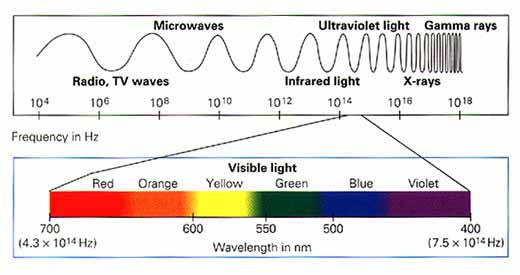
And all radiation is not alike. Of the sunlight reaching Earth’s surface, the ultra-violet portion can burn the skin while the radio-wave portion appears to have left life at the surface unaffected. Both sunlight and X-rays are forms of radiation that are created by nuclear and atomic reactions. But some materials spontaneously and naturally emit radiation, and they are called radioactive. Here is a nice chart about the radiation around us and dosage.
Radioactive materials contain particles of atomic elements that are unstable, and decay, emitting electromagnetic radiation, or photons, as well as other particles, which may themselves also be radioactive.
Radiation describes the particles and photons emitted by a radioactive material.
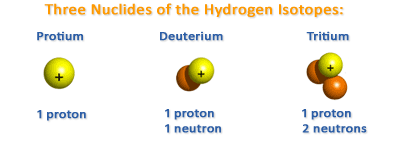
Hydrogen and its IsotopesAn example of a radioactive material and the radiation emitted from it is given by the simplest element hydrogen. The element hydrogen H is composed of one proton and one electron. Hydrogen has two isotopes, deuterium $^{2}H$ and tritium $^{3}H$. Isotopes are atoms that have extra neutrons in their nucleus. Deuterium has have one extra neutron, making a total of two nucleons, while tritium has two extra neutrons, making a total of three nucleons.
While hydrogen $^{1}H$ and deuterium $^{2}H$ both are found naturally on Earth in abundance, tritium is not, for tritium is unstable, and decays with a half-life of about 12 years, meaning there is only half as much material left as there was 12 years earlier. This decay characterizes radioactivity.
Tritium is an example of a radioactive particle. During radioactive decay for tritium, the nucleus of the tritium atom, called a triton, which has one proton and two neutrons, turns into a Helium-3 atom $^{3}He$, an electron, and another tiny energetic particle called a neutrino, all releasing 18.6 keV of energy.[1]
A triton has one proton and two neutrons. The nucleus of the $^{3}He$ has two protons and one neutron. During radioactive decay of the tritium atom, one of the original neutrons in the triton turned into a proton, along with creating an electron and a neutrino in a process called Beta decay, written β−.
Beta decayBeta decay describes when an electron, called a beta particle, and a neutrino fly out of a neutron, leaving a proton in its place. The radioactive material is the tritium, and the radiation is the electron and neutrino. Many elements that have an abundance of neutrons are radioactive this way, and sometimes decay splitting into two smaller atoms, naturally fissioning.
Electrons are usually thought of as carrying electrical current to power our appliances. But a large charge of current can be deadly. A beta particle (electron) will fly out with a varying kinetic energy averaging 5.7 keV. [1] This particle is incapable of penetrating the skin. External sources of beta decay from tritium will not harm the body.
But if a radioactive particle is inhaled or ingested, then beta-decay can cause damage to the cells of the body. The radioactive particle will eventually decay and emit a Beta particle that can then collide with internal tissue, perhaps ionizing the atoms in cells. If the Beta particle hits a DNA molecule, lasting genetic consequences can ensue.
Tritium and beta decay is used to light red Exit signs and glow-in-the-dark watch hands.As long as you don’t breathe it in, or eat it, tritium decay poses little threat to humans and tritium is used in devices such as betalights, which use the electrons emitted by tritium just like electrons that provide electrical current, to provide power to stand-alone illuminated night signs, as well as provide illumination for watches.
There is little naturally occurring tritium here on Earth because most of it has decayed away. Tritium is manufactured for commercial use and for use in hot fusion reactors selling for \$30,000US a gram.[1]
Tritium is not used in cold fusion research. Cold fusion cells use hydrogen $^{1}H$ and deuterium $^{2}H$, both cheap, plentiful, and evenly distributed around the earth in sea-water. No radioactive fuel is used in the cold fusion process.
2 Types of radiation emitted by nuclear processes.
In the conventional nuclear reactions of fission and hot fusion, the main types of radiation seen are particles like alpha particles, beta particles, and electromagnetic radiation such as gamma rays or x-rays. The three main types of radiation are named in the order that they were discovered and after the first three letters of the Greek alphabet. Conventional nuclear fission which relies on a chain-reaction, also produces neutrons.
Alpha particles are helium nuclei. That is to say that alpha particles are the nucleus of helium atoms, consisting of two protons and two neutrons $^{4}He$. Alpha particles are emitted by the natural radioactivity of the heavier elements and their isotopes. Alpha particles are larger clusters of nucleons and generally have low energy that a piece of paper will shield against alpha particles.
Beta particles β−, are electrons that are emitted during beta decay. Beta-emitting isotopes can have a half-life as long as $10^{16}$ years or as short as milliseconds. Beta particles can also be positively- charged positrons denoted β+. Beta particles can be stopped by ”a few millimeters of aluminum”.[2]
Gamma radiation is made up of light, or high-energy photons, that have an extremely small wavelength. They are similar to x-rays, with gamma rays carrying more energy. ”X-rays result when electrons return to a lower energy by emitting electromagnetic radiation and gamma radiation result when particles in the nucleus return to a lower energy.” [1,153]
The light we see is radiation; radio waves are radiation; the whole electromagnetic spectrum is radiation -- of photons.
Both gamma radiation and x-rays will penetrate the body easily and they can be harmful to living tissue. Only shielding made of lead will stop gamma radiation.
Some nuclear reactions can also create neutrons. Neutrons can be dangerous as they can penetrate the body, ionizing cells and creating genetic damage.
3 No dangerous radiation in cold fusion.
While no source of energy is 100% clean, cold fusion ranks cleaner over oil, gas, coal, today’s nuclear fission, hot fusion, solar and wind. Solar and wind are renewable sources, but the materials and manufacturing of solar panels and wind turbines given their energy density don’t compare to cold fusion.
First of all, LENR is a process of that does not involve today’s nuclear fission power designs, so there is no chain-reaction. A cold fusion cell will not ”runaway” like critical masses and fission bombs. Cold fusion energy devices will turn on and off when you want them to.
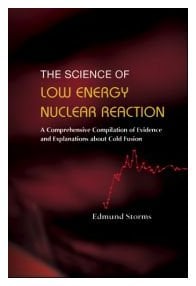
Edmund Storms, a nuclear scientist who has researched cold fusion for over two decades wrote a survey of the field called The Science of Low Energy Nuclear Reaction. Published in 2007, it is a technical summary of results for a scientific reader. In it, there are clear statements about the lack of radiation from cold fusion cells.
This table from Storms’ Science provides the general experimental results regarding radiation from LENR experiments.
Table 14 Expected but missing behavior. [1,176]
1. Gamma emission is rare.
2. Neutron emission is rare.
3. Alpha emission rate is not consistent with accumulated helium.
4. X-rays expected when a significant alpha flux is absorbed are missing.
5. The second nuclear product resulting from transformation is frequently missing.
A listing of the reported studies showing radiation detected in LENR experiments can be found in Table 11 of Storms’ Science[1]. Each entry is listed with radiation type and strength, along with the kind of cell that produced it. He writes:
”Fortunately none of this radiation is a health hazard nor is it easy to detect outside of the apparatus, which makes the process sate to study and safe as an eventual source of energy.” [1,105]
Quite simply, the type and quantity of radiation seen in today’s nuclear power does not show up LENR.
Cold fusion cells do not behave at all like conventional theories of nuclear reactions dictate. The fact that dangerous levels are missing from this reaction was in part responsible for many scientists dismissal of this as a nuclear effect. To quote Nobel laureate Julian Schwinger ”The circumstances of cold fusion are not those of hot fusion.”
Infinite Energy magazine published an FAQ containing this question: Why doesn’t cold fusion produce dangerous ionizing radiation and neutrons?
“Nobody knows for certain why the primary signature of cold fusion is excess heat, not deadly radiation. Nevertheless, many LENR theorists have put forth very intriguing proposals for the mechanism of these reactions. There are, in fact, many dozens of competing theories smaller number of which are very well fleshed out. The exact nature of the LENR reactions is one of the many unsolved scientific mysteries surrounding them. Some scientists think that because the effect does not produce intense radiation, it cannot be a nuclear process. Others say the energy is produced, but then somehow absorbed by the metal lattice either as high frequency vibrations, or through coherent processes in which many delocalized vibrations are involved.” [7]
LENR devices do not have any appreciable radiation from alpha particles, beta particles, high- energy neutrons, and there is no danger of a runaway chain reaction. What about the x-rays and gamma radiation, those high-energy photons that could pose a risk to biological life? Storms writes:
”Most X-radiation will be absorbed by the apparatus, thereby making its detection unlikely.”[1,153]
Andrea Rossi’s LENR-powered hot-water boiler, the Energy CatalyzerECat, is expected to be the first commercial application of this new energy science and uses micro-sized nickel particles infused with hydrogen gas to initiate power production. The ECat is currently being tested and evaluated at the University of Bologna in Bologna, Italy. This device will be commercially implemented in a factory in Athens, Greece, where it will undergo further tests on its safety in an industrial setting.[3]
Andrea Rossi's E-Cat prototype. Photo: Daniele Passerini
For wide-spread use of cold fusion technology, these devices must be safe for the public. This was noted by Jed Rothwell in his Cold Fusion and the Future.
“Some people fear there may be a hidden, long term threat to the health of people who work in close proximity to cold fusion reactors. So far, nobody has detected dangerous levels of x-rays or other emissions from a cold fusion cell. The autoradiographs prove that cold fusion does produce low levels of radioactivity, but the levels are so low that scientists have difficulty detecting them with sensitive instruments. Compared to the radiation from televisions and the natural background of radiation from space, radon and other sources, cold fusion radiation seems likely to remain so low as to be nearly undetectable. Still, cold fusion might conceivably produce some unknown form of radiation or some other deleterious effect. We will have to make sure this is not the case, by exposing rats and other laboratory animals to unshielded cold fusion reactors, and by carefully monitoring the health of the first group of people who work with the reactors every day.“[4]
On Rossi’s device, ”about 50 kilograms of lead shielding, about 2 centimeters thick, protects against any gamma radiation.”[6] During an open Q&A after the NyTeknik interview, the question of gamma radiation from the ECat was posed to inventor Rossi by a member of the public, Goran Ericsson. ”If no gammas are observed, what is the reason to believe nuclear reactions are involved?”
“Andrea Rossi: We observed gammas under the 300 keV range. We did not find, so far, the couple at 180 degrees at 511 keV, and the research we are continuing with the University of Bologna is aimed also to better probe the specter of the gamma produced. It will take some month of research, after which we will able to better understand the theory at the root of the thermal effect.
We have to calculate also the recoil energy, integrated with the kinetic energy we produce. We want to correlate the thermal effect with the gamma specter we will define. We also are continuing to analyze the atomic and isotopical transmutation, to correlate it to the gamma and to the thermal effect. I want to know if Cu-59, 60, 61, 62 decay by electron capture, instead of beta plus emission; if so a very interesting consideration can be derived.
This a very difficult research we are investing on (my money). And, at last, if we will not find high energy gamma and 511 keV couples, well, we will have to think about a new rule. It would not be the first time: they have digged a big hole, there in Geneva, to understand things, and they are finding things by the classic physics could not happen, particle that by the classic physics could not exist. But those things, evidently, are not good Physics students, so they insist to exist. Just read the ”Nuclear Models” of Greiner Maruhn to get a taste of this.“[5]
Speculating on what could happen if Rossi’s device broke, Hank Mills of Pure Energy Systems news wrote:
“There could potentially be a very brief spike of radioactivity for a moment if the vessel cracked or failed, but the venting of the hydrogen gas would immediately end the nuclear reactions taking place and any production of radioactivity.” [4]
An additional batch of questions from Ny Teknik’s readers was answered by Mr. Rossi, some of which addressed the question of radiation from beta decay and radioactivity.
“Peter Ekstrm: In the fusion of a proton with Ni-58 a substantial activity of Cu-59 is formed. Cu-59 decays with a half-life of 82 seconds by beta+ decay. In the Focardi and Rossi article it is stated that: ”No radioactivity has been found also in the Nickel residual from the process”. Considering the very high activity of Cu-59 that is produced, it is surprising that no activity is detected. Even ten half-lives after the end of a run the activity should be of the order of 1013 Bq, which is not only easily measurable (with a detector far away from the source) but also deadly for everybody present in the room! (Could you explain?)
Rossi: No radioactivity has been found in the residual metals, it is true, but the day after the stop of the operation. In any case you are right, if 59-Cu is formed from 58-Ni we should have the couples of 511 keV at 180 and we never found them, while we found keV in the range of 100-300 keV. I think no 59Cu is produced, I suppose only stable Cu is produced from the transmutation of the isotopes 62Ni and 64Ni. I desume this from what we find after the operations. Your observation is correct.”
Cold fusion technology is just beginning to emerge from a science into a technology. Much is still unknown about the science, and further testing will be taken over the next several years to ensure the safety of this technology. To date, cold fusion devices have not produced any appreciable dangerous radiation like that of today’s nuclear fission reactors. Scientists who have worked in this field for the past two decades are healthy and safe.
More importantly, LENR reactions produce energy that is cleaner than any source of power used today. Whether it’s hydrocarbons like oil, gas, or coal, or renewable technologies such a solar and wind, the power of cold fusion lies in its incredible energy density, a nuclear power from hydrogen and greener than today’s nuclear fission power plants.
If you have taken a philosophy course, you probably have heard the story of Socrates, who as an old man was convinced of impiety and corrupting the youth in Athens in 399 BC, and was sentenced to drink the poison hemlock. Instead of fleeing Athens to points unknown, Socrates abided by the decision of his homeland and refused attempts to smuggle him out of the country. He argued that as a loyal citizen of Athens, he should abide by her judgment, just as he had obeyed her laws all his life. By doing so, he made himself into a martyr and eventually, the same courts that had persecuted him; persecuted his accusers.
Socrates, armed with his quest to find someone wiser than himself, may have been the gadfly, irritating his fellow citizens and sometimes making them look like fools. However, he also comes across in Plato as the only truly loyal son of Athens, who with the irritation he caused woke up his fellow citizens, allowed them to see the errors in their thinking and correct those errors if they so desired. Socrates, being portrayed as the loyal son of Athens on the one hand, and the quintessential philosopher on the other, is the patron “saint” of philosophy, for he secured the position of philosophy in Athens and thus ultimately, in the world.
But why did philosophy need to be saved? Truth is; that since its beginning, philosophy was not too popular. Think of it, you are the citizen of an average Greek city, happy with the way things are done, which is the same way they have been done for the past thousand years, and here comes some new upstart, criticizing Tradition and Custom, advocating phusis or Nature, talking about the arche (overarching principle) of things. You may not be the high man on the totem pole, but you understand your place in the cosmos and are anxious about whether everything that makes sense is being overturned. You do not understand much of what this new-fangled philosopher is saying, but you do understand that he is not talking about the traditional gods or rather, the gods as they are traditionally understood. The whole entire city; with its political and cultural system are based on that traditional understanding. “Impiety” is a crime against the city.
So while you do not know exactly what the philosopher is saying, you do know that it is bad news and should be nipped off at the bud. Instead of putting up with the impiety and having the whole political and cultural system undermined, it easier to kill or exile or just chase offending fools out of town. That is what they often did, in Athens and elsewhere in the Greek world. Socrates’ treatment, far from being an exception to the normal treatment of philosophers, is merely the most prominent example of what often happened, the persecution of the philosopher.
On the death of Alexander, Aristotle fled Athens, “lest Athens sin against philosophy twice.” Of course, in saying “twice,” Aristotle was not counting the persecutions by Athens of Anaxagoras, Damon, Protagoras and Diagoras. Anaxagoras of Clazomenae was a friend of the Athenian leader Pericles, and was imprisoned and later, expelled from Athens. Damon the sophist, a friend and associate of Pericles and Socrates, was ostracized. Protagoras of Abdera, the sophist, was expelled from Athens and his books were burned in the agora. Diagoras, an atheist, was condemned to death and fled Athens. A talent of silver (26 kg) was offered as a reward to whoever killed him.
Xenophanes of Colophon was exiled. Zeno of Elea died defying a tyrant. Pythagoras, in some accounts, was killed by a mob. He also had left his home city of Samos, moved to Kroton and then moved again to Metapontum. We do not know how urgent these moves were, but they probably were not entirely voluntary. His followers, the Pythagoreans, were persecuted in Sicily, and there were two general uprisings against the Pythagoreans in Magna Graecia. In fact, what happened to Socrates was very much like what had happened to Pythagoreans or Sophists elsewhere before.
There was a general pattern, a philosopher would make himself unwelcome in a town and would either be chased out or thrown out. In many ways, it was easier for the philosopher to leave and perhaps start up somewhere else, than it would be for him to stay and fight the charges. The problem though is that while running, for example, a Pythagorean cell out of town, took care of that particular cell, it did not solve the issue of the underlying conflict between tradition on the one hand, and philosophers and sophists on the other. This kind of scene was repeated over and over again, throughout Greece until the trial of Socrates basically embarrassed people for the conviction of an old man who always had been loyal to his city, even though that loyalty was expressed in rather idiosyncratic ways.
In philosophy’s early days (c. 585-399), philosophers were often persecuted, but also philosophers persecuted other philosophers. Xenophanes and Heraclitus were highly critical of Pythagoras and his followers, while the Pythagoreans expelled and persecuted renegade members such as Hippasus. Plato was told that he should not bother burning Democritus’ books because there were too many to get them all. Plato also avoids any allusions to Democritus and the atomists in his dialogues. While Plato defines and co-opts other philosophers and sophists who preceded him, he wants to annihilate the memory of Democritus. He is not much better for Parmenides of Elea. A character in Plato’s Sophist (241d-242a), the Eleatic Stranger, talks about (theoretically) having to murder his father, Parmenides, in order to make way for a new critique. To the Greeks, patricide was the worst crime.
Of course, for “golden” Plato, all his sins are still nullified today by the quality and character of his writing. But, it is not only a matter of us overlooking the crimes of a man who through his art delights us. Plato’s “crimes” were done in wartime when philosophy was besieged, and in the end Plato’s work legitimatizes philosophy, establishes it and saves it from persecution. Plato’s work saves philosophy, but it also transforms it and in the process it loses something. Philosophy after Plato is not the same kind of beast that it was before Plato came along. Just in the last 150 years have we really started to realize that, showing how complete Plato’s vision is for us, even today.
But what does this have to do with cold fusion? Maybe just this: No matter how frustrating it is, trying to get cold fusion taken seriously as far as funding and publicity is concerned, it could be worse and it has been worse and also, we have gotten through that. The lesson of the persecution of philosophers in ancient Archaic and Classical Greece is that a thing which is an anathema one moment can become accepted and embraced the next. In fact, not only can that thing become embraced, the very existence that there ever was a conflict can become glossed over. Because of that habit of humanity to gloss over past events, we have been here much more often than one might guess. Because of this habit, one should not confuse the “map” (or formal history) of a thing, with the “territory” of the actual phenomena. By “territory,” here I mean cold fusion as a phenomena which has social and eventually, historical significances in addition to its scientific/technological significances.
That is not to say that scientifically cold fusion is “right,” and that it needs to be (socially) accepted as such. That is an issue ultimately for physicists and engineers to settle, as physicists and engineers, not as gatekeepers who protect the scientific status quo because they are strongly invested in it. At the same time, anyone who is curious about cold fusion should use their God given intelligence, and judge the matter for themselves of whether there is potential there and whether it is worth us as a society pursuing. If they decide there is, then welcome. If not, then I thank them for looking and I will trust that they have considered it in good faith. To me there is enough there to amaze about what has been found so far, and to wonder about what more might be possible.
This article benefits from Peter J Ahrensdorf mentioning of persecuted philosophers in his The Death of Socrates and the Life of Philosophy, (State U. of NY Press, Albany). His book is a close reading of Plato’s Phaedo in the light of the persecution.
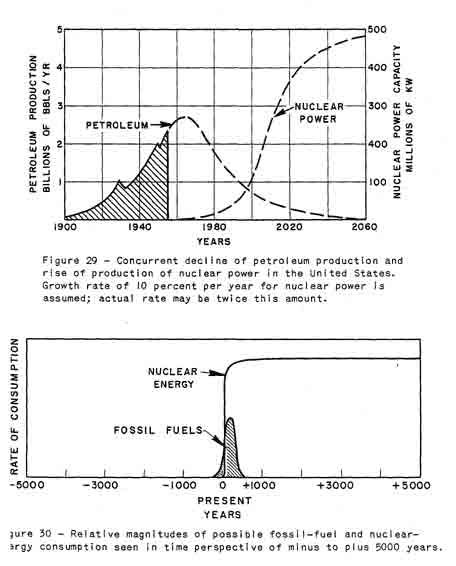
Nuclear Energy and the Fossil Fuels was written by the eminent geophysicist Dr. M. King Hubbert in 1956 and contains the seeds of his Peak Oil theory. Notable as well is his obvious interest in nuclear power as a source of energy for the future.
This was earlier in his career, and he had only recently learned about nuclear energy – many of the details were still top secret. He teased out information, did his own computations, and became excited about nuclear power for its super-high energy density. Here’s a graphic that ends the paper:
In 1955, he had become a member of the Nuclear Regulatory Commission Advisory Committee on Land Disposal of Nuclear Wastes. In Session V of the Oral History Transcript, Mr. Hubbert speaks about his time with the then-named Atomic Energy Commission.
“We probably ought to bring this session to a close fairly soon. There are just a few more questions I wanted to ask you about work in Shell and concurrent research. It was 1953 that you became on the NRC Advisory Committee on Land Disposal of Nuclear Wastes.
Hubbert:
In 1955, I think it was.
Doel:
We can check. Around that time. The Advisory Committee to the Atomic Energy Commission.
Hubbert:
I think it was ’55.
Doel:
We’ll check on that.
Hubbert:
They just broke up that summer, this Conference on Peaceful Uses of Atomic Energy. That was in Vienna. That was the point when they began to open up. Everything was under tight wraps prior to that time. That was the first time they began to take it out of Top Secret.
Doel:
Had you been aware of many of those issues before they became declassified?
Hubbert:
Well, I was an outsider, and not only that, but I’d studied very little nuclear physics. I had studied radioactivity and related things in the physics department at Chicago. There was an elementary course in this. I was familiar with that, but I just had very little knowledge, other than that I knew the geological occurrences roughly of uranium and thorium, and something about the radioactive disintegration theories and the amount of heat energy that were released. But I knew that for example, in granitic rocks that uranium was only so many parts per million, 12 or so, as I recall, and thorium was a little different. I forget now what, just what it was. But these things were very rare elements. For that reason I was very skeptical that uranium could ever amount to anything as a source of power. Atom bombs, yes, they had enough atom bombs to blow us off the earth. But it was not very promising for power. It wasn’t until I was on this committee that I began to get information that enabled me to determine that that scarcity or rarity of uranium was offset by the enormous amount of energy you could gain. A little bit of uranium still had a hell of a lot of energy.
Doel:
What was your role on the committee?
Hubbert:
Just a member.
Doel:
Do you remember any particular discussions of issues?
Hubbert:
Well, the committee was set up — I don’t remember quite the details. There was a tie-up with Johns Hopkins Department of Sanitary Engineering. They had an extending contractual relation with the AEC. That was under Abel Wolman who was the chairman of the department. I don’t remember the date of our first meeting but I think it was the spring, or maybe early summer, of I think 1955. I do know that we met in one of those little temporary buildings that were over on the Mall. And we were just about everything but fingerprinted to get in the place. I had a badge on me — we all wore badges — that said that we had to be accompanied by somebody. I got arrested for trying to go to the gents room without an escort.
Doel:
Is that so?
Hubbert:
The whole thing was silly. So here we were, gathered in this room, and there were about a dozen of us outsiders. All the rest were the AEC people and Abel Wolman’s people, kind of giving us an orientation as to the nature of the problems. Well, they were reeling off facts and figures — they had their chemist from Oak Ridge and various other technical people from here, there and the other place. They were reeling off these things that were familiar to them but totally unfamiliar to people like me. So you just got this was this isotope, that isotope and the other one, and so on, and these wastes. They had a tape machine running taping everything that everybody said, in case they inadvertently let out a secret you could erase. This thing went on from morning, 9 o’clock or so in the morning, a break for lunch, and into the afternoon. It finally came to a slowdown. He said, “All right now, what we want you to do is tell us what to do with this stuff.”
Doel:
You had no preparations before that?
Hubbert:
No. I don’t think we had. I think that was the first meeting. I said to the chairman, “I’ve sat here all morning and up until now and I’ve been trying to get an answer to a couple of questions that it seems to me we need to know. Maybe you’ve told us but if so I missed it. Approximately how much of this stuff per year are you producing? And approximately what are its physical properties?” He kind of looked around. Oh, that was classified and they couldn’t tell us. The whole thing was ridiculous. Here was the very information we had to have, and that was secret. Well, I was sufficiently annoyed by that — I don’t remember whether it was just after or before, but we had had a meeting with the Hopkins people. Out of this we had got the information that on the average one fission produced so and so much heat on the average, and that was one of the very few basic facts that we had. Well, as I say, I was just especially annoyed over that performance. The next big meeting we had was a two day conference at Princeton. I now don’t remember the dates of these things, but this was either the same year or the next year. We’d invited in quite a spectrum of outsiders, mining engineers, ground water people, and so on, that hadn’t been present in these earlier meetings. Well, I determined, OK, this can’t be all that mysterious. I did a little work with a handbook of physics and chemistry. All right, how many atoms of uranium would there be in a kilogram, say, of uranium? And whether the ratio of U-235 to U-238, etc. And then if we held so much energy released per fission, and that was put in oh, some unorthodox units. I forget what they were, but anyhow, you can convert from one physical unit to another. We had things like electron volts. I guess that was it, so many electron volts. And you could convert that.
Doel:
From volts back into calories?
Hubbert:
To heat, say, and so, I did a little work with this. I put a handbook of physics and chemistry and a slide rule in my bag on the way over to that meeting. I did a little bit theoretical work and a little bit of computation, and one of the questions that I was asking was, suppose we produced all the electric power in the United States as of that date from uranium? From then to the year 2000, how much uranium would that take, or how much U-235 would that take? Actual tonnage of it. I made the calculation, and came out with a certain figure. I wasn’t sure of myself, I was just feeling my way along, an outsider. I wasn’t at all sure what I was doing was correct. But I came up with a certain answer. It was a very useful figure. I don’t remember what it was now. But I was determined, when we got to the meeting and they pulled this secrecy on us, I was going to put it on the blackboard.
Doel:
At this Princeton meeting?
Hubbert:
Yes, this forthcoming meeting. I was just loaded for bear, so to speak. Well, when we got there, and after some preliminaries, we finally broke meeting into two sections. One dealt with surface disposal of waste, on the near-surface. The other was deep disposals and deep wells. And so on. Well, I wound up as chairman of the second meeting. I had in my group Floyd Cutter, who was the chief chemist of Oak Ridge. We worked our way around to where this question was needed. We were putting this thing down, say, a well. Well, how much volume of sand would be occupied? And so on. I posed this question and sent Floyd Cutter to the board to work it out. He got the same answer I did. Then I got a letter from him a week or two after that meeting, very much relieved. They’d just made a terrific bugaboo out of this thing. They were relieved to discover that the magnitudes they were looking at were not as awful as they thought they were.
Doel:
Really? This is one of the first times that they had begun to seriously look at waste volumes?
Hubbert:
His letter was expressing a relief to discover that this bugaboo was not as bad as they had thought it was. Well, one of the things that came out of these meetings and this earlier review was what they were doing in various of these locations. One of them was at Hanford. They had dug a well down this loose sand, clay things where the plant is located right up on the border of the Columbia River. This stuff was all worked over by the Columbia River, and so they had dug what amounted to a mine shaft. They’d lined it with wood and cribbing like a mine shaft, to hold the loose material back. They were running this stuff down that hole, it was disappearing and they didn’t have the remotest idea where it was going. It just disappeared. They expressed considerable misgivings about that practice.
Doel:
I can imagine.
Hubbert:
Supposing that they’d just got rid of it. They hadn’t got rid of it, it would be coming out somewhere, including the Columbia River, which it was right close to. Then in Oak Ridge, why, they’d bored out a dirt tank in the local clay area, shale outcrop, and were running all waste into these big tanks.
Doel:
Just plain dirt floor tanks?
Hubbert:
Hoping that they wouldn’t leak. We said to them, they damn well would leak. Then, following that, later on we went out and spent time at Oak Ridge, Savannah River, and these various places, Idaho, and Hanford. We made stops of a day or two in each one with the staff at each one of these places. We saw on the ground what they were doing, and got a notion of what the situation was in each of these places. Savannah River not immediately; that came about later. But we had Oak Ridge, we had Idaho, and we had Hanford, among the places we visited the first summer, I think it was. Gradually, well, we wrote up a report about so thick on this conference at Princeton, the summer results. One thing that came out there was this. They always wanted, for every one of these things right from the beginning, to dispose of these things at the site where they were produced. And we said, “Gentlemen, these sites weren’t selected with regard to waste disposal, they were selected for totally different purposes. It doesn’t follow that because you’re producing wastes here, it’s a suitable location for their disposal.”
Doel:
Right. They were worried about transport of materials?
Hubbert:
Yes. Of course. Well, what about putting it in hard rock mines? There were mines up and down the piedmont, New Jersey, Pennsylvania and so on. We said, “Well, have you ever been down in one of those mines? If it’s an operating mine, you’ll find water coming in through all the chinks and cracks and crevices, and the pumps are running. If they don’t, the mine will fill up with water. If it’s an abandoned mine, it’s full of water. And if you don’t keep the pumps running, the working mines would flood. So we suggest that you go out and go down one of these mines and take a look at it, and then consider whether you want to put wastes down there or not. We don’t regard that as a practical solution right now.” And as in this dirt tank thing at Oak Ridge, over and over again they wanted disposal sites where they were producing the wastes. All we could come up with at that conference was really two possibilities. One was deep wells in a basin like the Illinois Salt Basin, in deep sand, which is now full of, say, salt water brine. There you would pump the brine, dilute the wastes very considerably, and pump them down into this sand and displace the existing brines down there. Put them at a density high enough that they would stay down on the basis that they were of a higher density than any displaced water. The other thing was you had to account for the heat problem. You had to have enough dilution so that your heat wasn’t too concentrated. That was one possibility. But the practical problems of drilling the wells and handling these wastes down the hole and so on, presented enough practical difficulty that alternatives were to be considered. One of them was a proposal of a member of the committee, that would be Heroy [unclear], of rock salt, and I was very skeptical about that.
Doel:
What made you skeptical at first?
Hubbert:
Well, bedded salt in particular. Salt domes. I’d been in salt domes, I knew they were tight. Bedded salts would be salts of a few feet or a few meters thick, and overlaid by water filled sediments. To me, I anticipated that they would be pretty leaky. Well, Heroy insisted that the salt mines even under Detroit were bone dry. He also did a considerable amount of looking into the various salt mine areas of the country, including out in central Kansas. So we finally made a trip out to Kansas, to see these abandoned salt mines out there. It turned out that at a depth of around eight hundred feet or so, there was an old abandoned mine that had been mined out about 1920 or so. There was not a drop of water in the place. At least, maybe a little suture occasionally and a little bit of moisture along the lines or so.
Doel:
Right, but very different from a hard rock mine.
Hubbert:
Yes. And this was quite impressive. So we recommended they clean up part of this old mine where the roof had caved in and so on, and use it as a place to do experimental work on properties of salt including using simulated wastes which had the same chemicals, but with the heat supplied laterally. Putting things in salt cavities and observing the effects on the mechanical properties of the salt. Well, what we didn’t know was that right next door almost, there was a solution salt mine in operation. Nobody knows the outer boundaries of a solution mine. So we wound up after the preliminaries recommending this salt disposal, but not in a slurry or liquid form but in solid chroamics tubs so big around, maybe ten feet around, put into a honeycomb series of rows in the salt, widely enough spaced so you could keep the temperature controlled. We made such a recommendation. As far as locality is concerned, I don’t know if we expressly said so, but we had the understanding that this whole abandoned mine was only for experimental observations, if they’d buy up the property out there and completely own, completely control, do their own mining and have the thing under control. Instead of that, pinching pennies, they wanted to work it to buy up this old mined out mine that we’d looked at, and that’s where they had trouble with the state of Kansas. Kansas Geological Survey started raising hell about it, because there was a solution mine around there next door. Not only that, but they were running into some abandoned oil wells for which there were no records. Maybe it was in this solution mine or somewhere. So the Kansas Geological Survey got into the act to objecting to what they were doing, and got the whole state government involved. The result was that the AEC got thrown out of the state of Kansas.
Doel:
So that was the end of that?
Hubbert:
That was the end of that particular project. Then they went to New Mexico. They’re still arguing with southeastern New Mexico right now.
Doel:
Were there any other matters related to the work that you did on disposal of atomic wastes that you recall during that time?
Hubbert:
Well, I was involved in this from 1955 right on through 1965. But I was the chairman of the Research Council of the National Research Council of the Geology Science Division from 1963 to 1965. Well, what happened was that we’d been so critical of the things the AEC were doing with these various establishments that here we still existed as a committee, but they weren’t doing anything with us. So when I came on, I called in the AEC representatives and said, “Look, I will not have a committee standing around holding its hands. Either there’s something for the committee to do, or discharge the committee.” Well, the point was that they didn’t like the criticism that we’d given them consistently right down the line, when they were doing something wrong. All right, they somewhat grudgingly said, “Well, let’s make one last round of these sites, and you write a report on this. After that we’ll decide what to do.” We did. We made the rounds. By this time I was ex officio member of the committee, but I had been a member of the committee straight up to that time, including these two years. So we made the rounds, and they wrote their report, and the AEC suppressed it.
Doel:
Is that so?
Hubbert:
They looked it over themselves and wrote a rejoinder of it internally, but they wouldn’t agree to allowing it to be published.
Doel:
Was there a specific ground, or was it again because of the past criticism and sensitivity to the issue?
Hubbert:
Well, the whole thing, see, the AEC was accustomed to being almighty, doing any damned thing they pleased, as they did with this. So in the late 1960s, they ran into something they’d never encountered before. That’s about the time they were having this bout with Kansas. They had a public meeting up in Vermont, and the whole countryside of Vermont rose up against the proposed electric power plant up there. That was the first time they’d ever really been talked back to by a public meeting. It kind of jolted them. The next thing was, an uprising was building up in St. Paul-Minneapolis, because they were trying to build a plant up river from St. Paul-Minneapolis. There was an uprising, a public uprising there. Well, I didn’t know much about this thing until I got a phone call from a man at the University of Minnesota. It was all very mysterious and very cryptic, but would I come to this meeting and would I prepare a paper, give a paper that was ready for publication? I had very little information on what the meeting was about. So I agreed to do it, and took a train to Minneapolis. I got there in the late afternoon, and instead of taking a taxi to my hotel, I found myself surrounded by a bunch of AEC people and a private limousine for my hotel.
Doel:
That must have been a surprise.
Hubbert:
So I called up the man I knew in the university there and said, “What the hell is going on here? There’s something mysterious about this whole business.” And then the next morning, the same thing.
Doel:
At your hotel?
Hubbert:
They picked me up at the hotel, and got me back but when I got over to the meeting place, around the university buildings, there were people all around the outside carrying placards. What they were doing was isolating us from anybody talking to us or us talking to anybody.
Doel:
How did you feel about that?
Hubbert:
Well, I didn’t like any part of it. So this meeting went on, and there were people there from as far away as the state of Washington, Colorado and so on at this meeting. The first talk was by the governor who was bitterly opposed to the whole business. The point was that they were being very scared. It was the first time they’d ever been talked back to, seriously. This Vermont thing had happened just before, and here they were.
Doel:
What was your own testimony at that meeting?
Hubbert:
Well, it wasn’t testimony. I was invited to give a general paper over the energy situation, which I did. But what got me was the tricky behavior of the AEC people over this whole business. So it came time for the general sign-off, the second afternoon, I guess. And I had this suppressed report with me, of 1965. This was, I don’t know, 1968 or something. And I was just waiting for an opportunity in the discussion to mention this suppressed report. But no opportunity occurred, and so I couldn’t get it into the record. But later on they wanted to publish a book on this, the papers at this meeting, and I was reviewing the galleys. At an appropriate place, I wrote a footnote about this suppressed report, and I got it back blue-penciled by this same guy who’d made the mysterious call in the first place, who had, he was with the University of Minnesota but he also had inside connections with the AEC. He was really an AEC representative.
Doel:
Do you recall his name?
Hubbert:
No, I don’t at the moment. But there was another man, I mean, the committee, the university committee for this meeting had the same distortion. There was a man by the name of Gene Abrahamson who was a medical doctor, an MD. He saw the blue pencil, he made a note in the blue-penciling, by this AEC guy, and he raised hell about it. He sent this thing to Senator Muskie.
Doel:
That’s interesting.
Hubbert:
And Muskie demanded from the AEC a copy of this suppressed report, and he published it in the records of his Committee on the Environment or whatever it was called.
Doel:
That’s interesting. This would have been 1968, 1969?
Hubbert:
Yes, somewhere about then. So that’s how it got in print. ”
His recounting of the meetings is very educating with respect to the early discussion on nuclear fission radioactive waste disposal. Apparently, the nascent industry wanted to to dispose of the spent radioactive fuel onsite of the reactors, despite the power plants’ sites being chosen without regard to disposal issues, the methods of which were just being discussed, and were primitive to say the least. From Session VIII of the oral history:
“Doel:
The AEC’s concern at that time was to find a relatively easy way, painless way of disposing waste?
Hubbert:
No, what they really wanted was to have a disposal site at each one of these places, and we told them emphatically that these places weren’t located with regard to waste disposal. There was no place to dispose, no suitable waste disposable site at any one of these major institutions. The last go round was Savannah River, and at Savannah River, you have Tertiary, young sediments, to roughly a thousand feet. The bottom of that was a thick sand, Tuscaloosa sand, of two or three hundred feet thick, which is one of the major fresh water bearing aquifers on the Eastern seaboard. Immediately under that were these basement rocks. And they were proposing at the time to mine out a tunnel, about a quarter of a mile long or so. And they were going to put these nuclear wastes in this tunnel under the assumption that they wouldn’t leak.
Doel:
Where was it to be located? Underneath the plant and below the bedrock?
Hubbert:
Yes. But just by the Savannah River plant. These rocks were full of cracks, fractures going like this, and I recommended to them that they send men to go down into mines on the Eastern seaboard. The water is coming in all these cracks, if you get a lot of rain you flood the mines. I don’t think they ever did. But that’s a long story all by itself.”
In session 7 of the oral history, he discusses “penny-pinching” of the Atomic Energy Commission, and “treating waste disposal as kind of an orphan child, in effect sweeping it under the rug.”
“Hubbert:
I don’t remember now. One thing was legitimate, because I’d talked about 235 or something or other and he’d pointed out that it was natural uranium in the original fission reactor in Chicago. Which was a mistake on my part. But with regard to the waste problem, I’d visited all these sites. I knew a good deal about it and they didn’t.
Doel:
And you were on the committee.
Hubbert:
Yes. And so after I got back, and endured this heckling of Wilson, why, I wrote some very specific things, data into this nuclear problem. Oh yes, also including this letter that we’d written to the AEC commissioners. I put it into this report, and also the data from Floyd Culler on the chemistry of the various waste components. With regard to waste disposal, I said they’d been treating waste disposal as kind of an orphan child, in effect sweeping it under the rug. So in my final recommendations, I recommended, here’s the letter to McCohn, pages 118 to 119, and Table 12. Somewhere I’ve got that waste disposal recommendation — well, I don’t see it, but it’s somewhere in here.
Doel:
In this report?
Hubbert:
Somewhere in there I put in, from the report by Floyd Culler who was the chief chemist at Oak Ridge, a whole graph of the isotopes and whatnot in these wastes were involved in. I recommended that the budget for the disposal of nuclear wastes be increased several fold over what it had been. That the people who were doing the job couldn’t do it any better because they didn’t have enough money. And they didn’t have enough money because the AEC was pinching pennies to try to promote nuclear power, and they were cutting all the other costs in sight in the process. OK. When the committee, these reviews were completed, the committee then had its final session. When it came my time, knowing the issue that was afoot, I said, “Gentlemen, what do you propose to do with this report, burn it?”
Doel:
What was the reaction to that?
Hubbert:
I said, “This is my report. I wrote it. Any errors in this report will be gladly corrected. Aside from that, the report stands. If you don’t accept the report, other than that, I resign from the committee and publish it on the outside.” I backed them down.”
M. King Hubbert recognized the need for nuclear energy, but later in his career, he balked at using a technology that created tons of radioactive waste with no good way to deal with it.
It is for this reason, he turned to renewable energy as an alternative, despite the recognition that these technologies didn’t have the energy density to match fossil fuels let alone nuclear power.
Had Mr. Hubbert known about low-energy nuclear reactions, he would most likely have supported a nuclear power that that uses no radioactive fuel and creates no radioactive waste to dispose of.
Behind schedule, but catching up soon – this graph of Dr. Hubbert’s may very well represent our future energy mix yet.
Cold Fusion Now!
Related posts:
Nine Critical Questions to Ask About Alternatiev Energy Answered by Jed Rothwell.