Pamela Mosier-Boss on the Cold Fusion Now! podcast

The sixteenth episode of the Cold Fusion Now! podcast features Dr. Pamela Mosier-Boss, an analytical chemist who spent a career working at the Navy’s SPAWAR laboratory developing environmental sensors and working on LENR.

As an experimentalist, Dr. Mosier-Boss used the co-deposition method, pioneered with her partner in the lab Dr. Stanislaw Szpak to reveal nuclear effects and an at- or near-surface reaction.

Tiny craters indicating mini-explosions on the surface of the cathode, video of real-time heat-producing flashes, neutrons and alpha particles detected by CR-39 are just some of the published work generated since 1989.

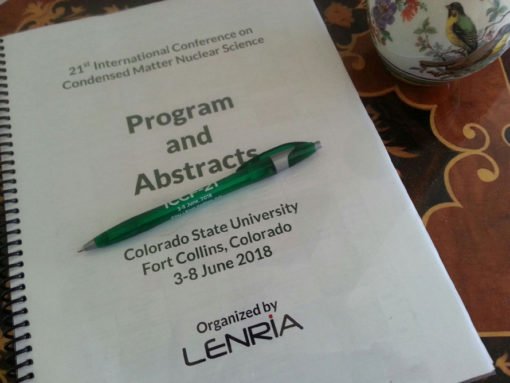
Dr. Boss and her colleagues presented at ICCF-21 proposing LENR-generated neutrons to fission uranium, eliminating the need for radioactive neutron source.

Pamela Mosier-Boss speaks on these topics as well as her career as one of the few woman in the CMNS field, and what needs to happen next to solve the LENR reaction mystery.

Listen to the Cold Fusion Now! podcast with Ruby Carat and special guest Dr. Pamela Mosier-Boss at https://coldfusionnow.org/cfnpodcast/ or subscribe in iTunes.


Big atomic THANKS to our new and continuing supporters. We are making it happen for a breakthrough energy future because of you. Go to our website at coldfusionnow.org/sponsors/ to be a Cold Fusion Now! SuSteamer or sign-up on Patreon.

Patreon is a platform for supporting creators. You can pledge as little as a dollar per episode and cap your monthly spending. When we deliver, you reward the work!

Visit us on Patreon to sign-up and become a Patron!


Dennis Cravens on the Cold Fusion Now! podcast

Physicist Dr. Dennis Cravens joins Ruby on the Cold Fusion Now! podcast for a discussion about experimental results gathered over a career of LENR research.

Dr. Cravens received his PhD from Florida State University and has been working on cold fusion since 1989. He has demonstrated multiple live LENR systems throughout the years, including NIWeek 2013 and more recently at the ICCF-21 conference, where he showed a live video feed of an active cell in Austin, Texas built with his associate Dennis Letts.

Collaborations between Dennis Cravens and Dennis Letts’ team have produced a unique cell, with cathode materials made by the team, ensuring consistency. They’ve closed in on a recipe to generating excess heat of an average of 7 Watts thermal for durational periods.

Episode 15 of the Cold Fusion Now! podcast with Dennis Cravens is available at our website https://coldfusionnow.org/cfnpodcast/ or subscribe in iTunes.


Atomic THANKS to our new and continuing supporters. We are making it happen because of you. Go to our website at coldfusionnow.org/sponsors/ to be a Cold Fusion Now! SuSteamer or sign-up on Patreon.

Patreon is a platform for supporting creators. You can pledge as little as a dollar per episode and cap your monthly spending. When we deliver, you reward the work! Visit us on Patreon to sign-up and become a Patron!



MFMP’s Alan Goldwater on the Cold Fusion Now! podcast

Welcome back to the Cold Fusion Now! podcast!

Our next episode features Alan Goldwater, an independent LENR researcher with the Martin Fleischmann Memorial Project.

He received a Bachelor’s degree in Physics from Columbia University and studied architecture and computer science before having a successful career in electronic design and embedded software. Returning to his first love physics, Alan has assembled a small laboratory to test LENR systems in a Live Open Science setting.

Off the heels of the 21st International Conference on Condensed Matter Nuclear Science, Alan Goldwater visited the Cold Fusion Now! Central Office in Eureka, California and Ruby took the opportunity to get his take on the state of the field as presented over the five-day science bonanza.

Alan also describes his ‘glow stick’ experiments, which he reports as having shown up to 18% excess heat. He also talks about the importance of live open science in an environment of non-disclosure agreements and intellectual property filings.

Listen to episode 14 of the Cold Fusion Now! podcast with Alan Goldwater at our website https://coldfusionnow.org/cfnpodcast/ or subscribe in iTunes.

Learn more about Alan Goldwater’s work with the Martin Fleischmann Memorial Project and Live Open Science at quantumheat.org.

Read about the glow stick work in the Journal of Condensed Matter Muclear Science Volume 21 [.pdf].

Big Atomic THANKS to our new and continuing supporters. Your dollars make a difference in our day, and we can’t do this without you. Go to our website at coldfusionnow.org/sponsors/ to be a Cold Fusion Now! SuSteamer or sign-up on Patreon. When we deliver, you reward the work!

Patreon is a platform for supporting creators. You can pledge as little as a dollar per episode and cap your monthly spending. Visit us on Patreon to sign-up and become a Patron!

Winning LENR essay published in Navy magazine

A Navy essay contest has landed a LENR article with second prize and featured in the September 2018 issue of U.S. Naval Institute Proceedings magazine (members only content online –.pdf here).


Low Energy Nuclear Reactions: A Potential New Source of Energy to Facilitate Emergent/Disruptive Technologies [.pdf] by M.Ravnitzky was the second place winner in The Emerging & Disruptive Technologies Essay Contest sponsored by the U.S. Naval Institute, cosponsored with Leidos Corporation.

He is also the Editor of Steven Krivit’s three volumes on the history of LENR, with its unfortunate repudiation of the name “cold fusion”, largely by belief in a specific theoretical model of the reaction focusing on electro-weak interactions. Sadly, the idea is yet unconfirmed, and just one of a half-dozen contenders for theoretical models, none of which can name a recipe to create and scale the reaction.

Nevertheless, this winning essay makes a strong case to the Navy advocating for research in LENR technology. The U.S. Navy adopted nuclear power early on submarines, and currently needs safe and clean solutions to power generation, just like everybody else.

Read The Emerging & Disruptive Technologies Essay Contest Second-place Winner Low Energy Nuclear Reactions: A Potential New Source of Energy to Facilitate Emergent/Disruptive Technologies [.pdf]


Michael McKubre at ICCF-21

LENR consultant and former Director of Energy Research at SRI International Michael McKubre presented at the 21st International Conference on Condensed Matter Nuclear Science held at Colorado State University in Fort Collins Colorado. The five-day conference ran June 3-8, 2018 and featured multiple groups reporting solid results in the generation of excess heat and transmutations.

Several labs are regularly able to produce between 6-20 Watts excess thermal power and are now experimenting with the various parameters in order to determine how to scale that output up. There were several theory sessions and more theories presented, but no consensus on modeling features of the reaction was determined.

In episode 13 of the Cold Fusion Now! podcast, we join Michael McKubre just starting his talk on Monday morning June 4 with The Fleischmann Pons Heat and Ancillary Effects: What Do We Know, and Why? How Might We Proceed?

Listen at our podcast page https://coldfusionnow.org/cfnpodcast/ or subscribe in iTunes.

Patreon supports creators like us, and we need you to join in. Go to our homepage on Patreon https://www.patreon.com/coldfusionnow and pledge your support. Just a few dollars brings the voices of breakthrough energy research to world attention.

Then take the next step and talk to your friends, talk to your family, talk to your teachers and students: there’s a new kind of energy discovered, based on the quantum effects of hydrogen interacting with metal, and it offers a green technological future with enough resources for everybody. We can make it happen, but there’s still work to do. Become a Cold Fusion Now! Patron on Patreon!

Find more notes, audio, and photos of ICCF-21 courtesy the Cold Fusion Now! Collective here.

Top