Q&A with Douglas R. McAllister: Mayor Pro-tem and Cold Fusion Author


Douglas R. McAllister is the Mayor Pro-tem of Murrieta, California, but he’s also the author of a novel with cold fusion technology at the center of the plot.

The suspense story is described on the official author website:

“In a world desperately in need of new energy sources, this fascinating scientific thriller will keep you on the edge of your seat. In 1989, two scientists announce they have created a cold fusion reaction. The public is thrilled at the prospect of a better option than oil. Mysteriously, the success could not be duplicated. A disappointed world deemed the project a failure. But was it?”

We may know the answer to that question, but we contacted the author to find out more about this elected official who’s explored a vision of the future where cold fusion is a reality.
The Sovereign Principles
The Sovereign Principles by Douglas R.McAllister
Q&A with Douglas R.McAllister

CFN What prompted you to start writing this novel?

DM I have always loved to write. Twenty years ago I decided to ‘just do it’ if only for the fun of it. Though I published 20 years later, it took only approximately a couple of years of actual working on the manuscript.

CFN Without giving it all away, can you tell us a little about the story? How does cold fusion fit in?

DM If there was a sub-title, it would be “The Consequence of Compromise.” The book is centered on domestic terrorism. In this case, a billionaire with a score to settle with America infiltrates a top secret effort to create a commercially viable form of cold fusion. Once he has control, he intends to use that technology as leverage to have his way with the world in general, and America in particular. The sub plots center around the complicated Dr. James Sovereign, his personal and professional life…not to mention hints of a life very few know about…and the mistake the billionaire makes when he attacks Sovereign’s family. Jim has learned first hand the consequence of compromise and has two children that hate him for it. In the end, it is that relationship that is the billionaire’s undoing…

CFN How did your idea of the story develop?

DM I like to start with real historical events and then ‘fill in the blanks,’ fictionalizing them under the category of ‘what if.’ In this case, it was all the hooplah over the claim in Utah in 1989 that a room temperature reaction of fusion had been achieved. It was reported to be false…but what if it really wasn’t….? From there I pulled upon areas of personal interest and created the plot that would highlight how the world would be changed with such an energy source…and why that was important. It was important to me to keep it authentic without getting so far down into the weeds to muddy the pace of the story. For this work, the plot seemed to develop as I wrote. It has multiple story lines that seem unrelated but all prove to be interrelated…so pay attention :0).

CFN Who did you write this book for? Who is your audience?

DM Originally I wrote it for me. I have always enjoyed writing and about 20 years ago I found myself in Australia with some time on my hands after a very nasty divorce. I guess you could say the project started out as therapy, but in the process it developed into a work of its own completely divorced (pardon the pun) from its original inspiration. Over the years it has taken on various iterations. It wasn’t until about two years ago, though, that I decided to see if I could get a publisher.

CFN What does the title of the book mean to you?

DM It is a bit of a play on words. The main character’s name is Jim Sovereign. The principles are those that his father, Richard Sovereign, taught him before he died. However, the principles themselves, in real life, are fairly ‘sovereign’ in that they apply pretty much universally.

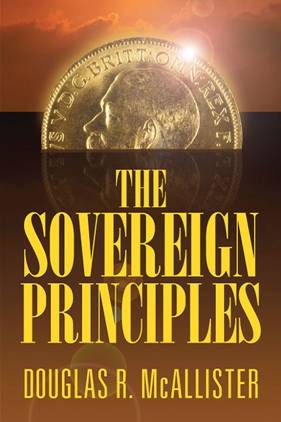
CFN What is the significance of the gold sovereign on the front of the book?

DM The Gold Sovereign on the cover is meant to represent several things. The most obvious is the name of the main character. However, the ‘value’ of the coin speaks to the financial impact Cold Fusion could have on the world. It sits in a sea of oil representing the ‘context’ out of which successful Cold Fusion technology would proceed to change the world. Using the coin to represent both the financial side and the main character is indicative of how the two issues cross paths in the process of the story.

CFN It was reported that you are currently writing a sequel. How is that progressing?

DM Yes, I am. It is called The Sovereign Politic. It is a sequel, picking up where Principles lets off. Principles was set primarily in Australia, but Politic will be set in the States, specifically Murrieta, CA. The sub-title is “All Politics is Local.” In this work I will wrap around the main plot authentic discussions of issues that government on ‘the Hill’ deal with theoretically that we on the local level deal with in real time. The primary plot will center around North Korea and a terrorist attack. I have the story mapped out in detail and while I am still doing research, I have started writing. This one is going to be a lot of fun, but I hope will also be important.

CFN Do you actively talk with people about cold fusion? How do people react when you talk to them about cold fusion?

DM Yes, I do…for the most part they don’t know the difference between fusion and fission. I try to educate and hope that my book will be an entertaining enough read that it will once again get folks focused in the direction of cold fusion for the future.

CFN What are some of the biggest impacts that you see coming from this technology?

DM Other than change the world as we know it, including the balance of economic power…you’ll need to read my book… :0)

CFN Are you aware of the new upcoming documentary The Believers? Do you feel that the public is becoming more aware of this despite the mainstream media’s lack of coverage?

DM No, I’m not, but now that I know about it, I look forward to it. I am investigating a plot line that would continue the discussion of cold fusion in the sequel, so any information I can find would be helpful.

CFN What is your opinion of the investment made in this technology so far? What are your thoughts on the recent developments involving the first commercial device invented by Andrea A. Rossi?

DM Any investment is money well spent, given the potential and positive impacts of success. I am not aware of this device, but I will ‘study up’ as per my answer to the previous question. I will definitely look into the recent developments as that will play into the next installment.

CFN How does being an author and an elected official for a city like Murrieta combine together in your life? When do you find time to write?

DM The combination makes for a very interesting calendar. I actually have two very compatible but separate full time jobs on top of my writing: Elected official and an executive with a multi-national telecommunications company. Finding the time to write is a challenge. Early mornings. Late at night. On planes… wherever and whenever I can find a chunk of time long enough to get into the mode. Working on the second installment, The Sovereign Politic that picks up where Principles leaves off, may take a while, but I am confident it will be a very satisfying sequel. I know I’m having a blast writing it! And as for the elected office and writing, for this second book I am able to do research 24/7 as I go about my day. And believe me, I see the best and the worst of politics. So there are intriguing plot lines to be explored…

I think one of the most enjoyable parts of creating new worlds and vision through writing is the research. I learn so much in the process of my efforts to make sure the story is authentic. To that end, I am looking forward to taking advantage of the resources I’ve discovered from your site to further expand on the future of Cold Fusion in a way that will get the attention of the reader. Perhaps through your work and my books we can get Cold Fusion back on the front page again…

CFN As Mayor Pro-tem, do you think Murrieta, California will be one of the first cities in the US to purchase a cold fusion device?

DM If I have my way, yes!

The Sovereign Principles by Douglas R. McAllister.

www.douglasmcallister.com
http://themcallisterreport.blogspot.com/

Shop Independent Bookstores
indiebound
www.indiebound.org

Infinite-Energy Bookstore
www.infinite-energy.com

Also available at:
www.amazon.com
www.barnesandnoble.com

Interviews with Rossi and Xanthoulis


Defkalion Green TechnologiesNearly a week after Defkalion Green Technologies S.A. held its press conference in Palaio Faliro, there appears to be no mention of the event in the mainstream media, perhaps the nearest thing being mentions of Andrea Rossi and the E-Cat in the comments to a CNET article on high-energy plasma fusion at MIT. Even DGT itself, which promised a video of the event with English subtitles on Monday or Tuesday of this week, has failed to deliver so far. The company has, however, recently released some information regarding press conference attendance on its website.

Meanwhile, Phizero, the producer of “Low Energy Nuclear Revolution”, has released a new video containing footage of interviews with Andrea Rossi and DGT board member Alexandros Xanthoulis, conducted after the press conference:

Two short interviews recorded after Defkalion’s press conference. from Giacomo Guidi on Vimeo.

The first interview, with Andrea Rossi, is very brief, and mostly concerns his research contract with the University of Bologna. According to Rossi the research will be conducted over two years, with the first results expected in one year. The study will consist of research and development to improve the E-Cat technology, and will involve running the reactor for 24 hours a day over a period of six months. Afterwards a metallurgical analysis will be conducted to examine the transmutation of the metals in the device.

The interview with Alexandros Xanthoulis revealed some new information. Among the highlights:

  • DGT is in discussions [with Ampenergo?] to sell their products in the USA.
  • DGT’s investors are a group of friends of the Greek diaspora who attended the same university in Canada.
  • The 5 to 30 kW modules are all the same size, the only difference being the pressure, so they will cost the same.
  • The 1 MW reactor is now being tested, and DGT is working on producing a 3 MW reactor.
  • DGT is only producing the units, not distributing or marketing them.
  • It will take five years of production for DGT to meet the demand of the orders they’ve received so far.
  • Every six months the units will be serviced by technicians employed by the distributors, but trained by Defkalion.
  • The reactors have twelve levels of security; nevertheless, somebody will break the security sooner or later. Defkalion is depending primarily on legal protections and the low cost of the units to discourage competitors from producing Hyperion knock-offs.

Thanks to Phizero for the video!

Related posts:

Early news from Greece — Ivy Matt June 22, 2011

The Defkalion website is live — Ivy Matt June 23, 2011

Low Energy Nuclear Revolution — Ivy Matt June 23, 2011

“Eppur s’accende…”: Professors Levi and Ferrari on Italian radio

Città del Capo Radio Metropolitana, a Bolognese radio station, recently interviewed Professors Giuseppe Levi and Loris Ferrari of the University of Bologna on their research contract with Andrea Rossi.  A summary of the interview is here.

The contract is for €500,000 plus value-added tax, and Rossi will be providing the equipment necessary to run the experiments. The study will last for at least a year, and it will take at least another six months for the results to be published, so the earliest we can expect to see the final results of the study is the end of 2012. However, the University of Bologna group may release some preliminary results as early as December, 2011.

The scope of the study will be to measure the energy efficiency and any emissions of radiation from the device Rossi provides. Some aspects of the research may be subject to trade secret protections.

Professor Ferrari acknowledged the need for repeatable results to demonstrate that the energy catalyzer does, in fact, work. He also acknowledged that the internal mechanisms by which the energy catalyzer is able to produce energy are unknown and says this will be “one of the key aspects to be investigated”. Professor Levi, for his part, is already certain of the device’s repeatability:

“Every time I was witness to a start-up of e-cat that produced energy. I’ve seen it many times now: It seems to repeat itself with great regularity, but I want to be prudent …” –Giuseppe Levi

New research is always welcome, especially if it leads to a workable (and testable) hypothesis on the functioning of the Energy Catalyzer. The University of Bologna research is unlikely to do much to sway the online debates on the E-Cat, however, as even the preliminary results are not expected until after Andrea Rossi’s October surprise.

(The summary of the radio interview in the link above is an English machine translation of the original story in Italian, which can be found here. Any corrections or clarifications by speakers of Italian are welcome.)

Related posts:

Query interviews Giuseppe Levi by Ivy Matt June 23, 2011

Krivit’s second report: Rossi evades scientific debate

For those who were wondering whether New Energy Times editor Steven Krivit was willing to burn his bridges with Andrea Rossi, the answer is an apparent “yes”. Krivit’s first report provoked a heated response from Rossi, who accused him of industrial espionage on behalf of an Italian competitor. Krivit’s second report, recently released, will likely do nothing to assuage Rossi’s feelings.

Krivit’s overall judgment on the E-Cat is that there could be “something real” about it, but that the “claimed quantities of excess heat have been exaggerated, possibly by as much as two orders of magnitude.” Krivit does not explain this claim in detail in this particular report, however, deferring such technical details until a later report, but he does summarize his technical concerns with the testing of Rossi’s device:

  1. Analytical error: possible mathematical error based on the assumptions of the energy capacity of the steam.
  2. Procedural error: possible use of an incorrect measurement instrument.
  3. Analytical error: possible failure to correctly interpret a signal from the experiment that is clearly visible using only the naked eye that was apparent during the experiments.

Instead, Krivit’s second report is mostly devoted to pointing out Rossi’s lack of scientific qualifications and what Krivit regards as his misuse of those who have such qualifications to bolster his own credibility, while at the same time attempting to evade the scientific debate that naturally arises as a result of his claims. In particular, Krivit is frustrated by the unwillingness or inability of the scientists closest to Rossi to provide specific details on the results obtained from the E-Cat tests.

Rossi, on the other hand, keeps himself busy responding to questions on his website, the Journal of Nuclear Physics, but either avoids or gives evasive answers to questions about results or experimental design, often simply promising that he will have a 1 MW reactor available in October, and telling the questioners they will just have to wait till then. That is his privilege as a businessman and a private citizen, but Krivit expects more from the scientists whose expertise he has sought, and who lend him their support.

If Rossi thought Krivit was working on behalf of an “Italian competitor” before, he will certainly find confirmation for that suspicion in this report. First, Krivit notes the similarity between Rossi’s device and that developed by Francesco Piantelli (a colleague of Rossi’s partner Sergio Focardi) in the ’90s. (The primary differences are that the E-Cat allegedly uses a catalyst of some sort, known only to  Rossi, and that it uses nickel in nanopowder form. Piantelli used nickel rods in most of his experiments, although he did mention the possibility of using “metallic powder” in his 1995 patent application.) Second, Krivit reports on the work of three researchers in Naples who have shown him an experiment—and scientific-data he regards as promising. Whether these researchers have any connection to Piantelli—or, indeed, to cold fusion research—is unknown, but Krivit promises to report on their findings after he is finished with his reports on the E-Cat.

Related posts:

Mr. Rossi talks E-Cat by Ruby Carat June 21, 2011

Mr. Rossi calculates the E-Cat’s energy by Ivy Matt June 24, 2011

Mr. Rossi calculates the E-Cat’s energy

Steven Krivit, editor of the New Energy Times, has another video out from his visit to Bologna. In this video Andrea Rossi calculates the energy produced by the E-Cat used in his demonstration to Mr. Krivit.

To summarize the video, Mr. Rossi calculates that the total energy produced in the E-Cat is 4906.1 watt hours per hour. The total energy consumed is 770 watt hours per hour. Thus, according to Mr. Rossi’s calculations the E-Cat used in his demonstration achieved an energy output/input ratio of approximately 6.37. In hot fusion terms the E-Cat (the one used in this particular demonstration, at least) appears to have achieved Q =  6.37.

To put this claim in perspective, the Joint European Torus (JET) magnetic confinement fusion experiment achieved Q = 0.67 in 1997, which still remains the world record for fusion power in the high-energy plasma fusion realm. Right now the focus of hot fusion research is on achieving Q = 1, with somewhat less attention being given to the practical concerns of converting useful amounts of fusion energy into electrical power. Lawrence Livermore National Laboratory’s  National Ignition Facility (NIF) laser fusion experiment is currently expected to achieve Q = 1 next year. The only other hot fusion experiment for which such a claim is made is dark horse Lawrenceville Plasma Physics‘ Focus Fusion-1 (FF-1), which is hoped to achieve Q = 1 in a similar time frame. What is widely regarded as the safest bet for fusion power, ITER, isn’t expected to achieve Q = 1 until at least 2026, assuming the current schedule holds.

By contrast, cold fusion researchers have been claiming an energy output/input ratio of greater than 1 for years now, though not to the extent that Mr. Rossi has. Rumors are that Francesco Piantelli, a former colleague of Mr. Rossi’s partner Sergio Focardi, will be announcing a similar claim soon, but for now it looks like Mr. Rossi is in the lead. The next hurdles: the University of Bologna’s tests on the E-Cat and the Greek authorities’ tests on Defkalion Green Technologies’ Hyperion products. If Mr. Rossi’s device makes it through these tests successfully it appears the way will be open for the final test: customer opinion.

Related links

Mr. Rossi talks E-Cat. — Ruby Carat June 21, 2011

Top