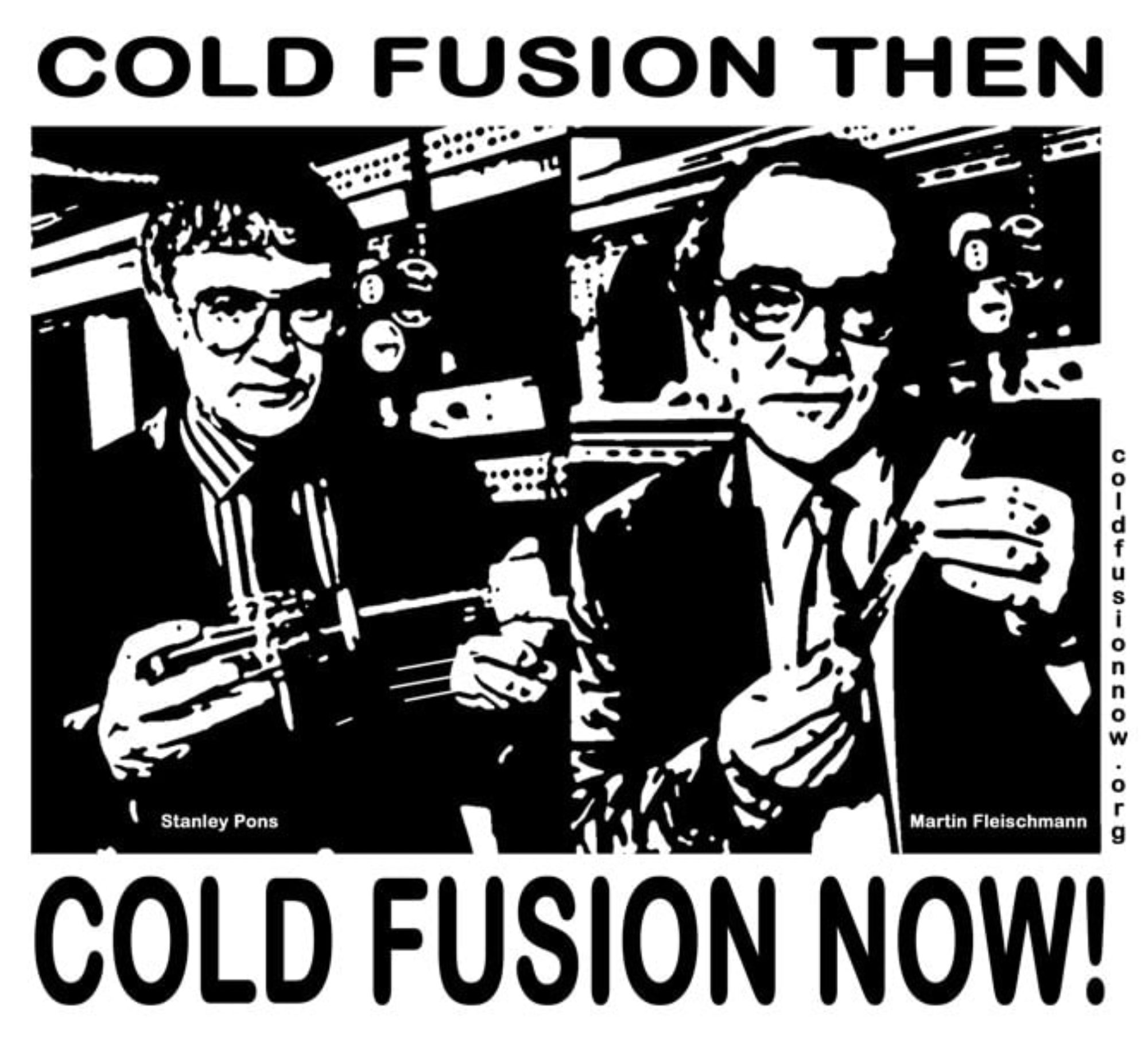
A new online petition from Quinton Crawford believes that “Cold Fusion atomic energy (non-radioactive) has been ignored and pushed aside in discussions/ presentations about alternative energy for too long.”
In his Overiew, Quinton has a link to a video describing the Palladium-Deuterium system as it is excited by Superwave.
You can digitally sign his online petition that states:
“World leaders in nations/unions such as Japan, The United States of America, Russia, South Africa, The European Union, and so on have the ability and power to fully engage in the building mass energy production plants now. Solar, Wind, Wave, Geothermal, etc., are not the only alternative energy resources.” –Quinton CrawfordPetition
Perhaps, if you are inclined to sign the petition as I was, you could post your favorite new energy video link. (You can choose to Show your signature, or not.)
Thank you Quinton.
We expect that cold fusion technology will be released for public use at some point in future, but we’d like to see it as soon as possible, and with a free and open development and implementation. Politicians should not decide what we use for energy.
We decide what we will use for energy.
Sign Quinton Crawford’s Cold Fusion Energy Petition here and show support for the public campaign towards a cold fusion technology targeting politicians and “world leaders”.
Lampadedromia, torch-race, and often simply, Lampas, was a game common throughout Greece.
A statement from Defkalion Green Technologies, now lighting the torch!:
GREECE’s ANSWER TO THE INTERNATIONAL CRISIS
HYDROGEN & NICKEL EXOTHERMIC REACTION
CHEAP, CLEAN & GREEN ENERGY
Today, there is great pessimism regarding the future energy needs of our planet. Energy will soon become universally cheap, clean and readily usable. Andrea Rossi and Sergio Focardi have discovered and patented a technology that will change the world’s energy field. This technology will be made commercially available by Defkalion Green Technologies s.a., a Greek company.
By combining Hydrogen and Nickel to create an exothermic reaction (at room temperatures and in a device that can be safely placed in households and also industry) heat is emitted on a 24-hour basis. This energy is produced at a fraction of the cost in comparison to currently available energy sources, it is clean and totally green. Furthermore, using conventional, readily available third-party technologies, the heat can also be used to produce electricity.
Defkalion Green Technologies s.a. has secured exclusive distribution rights for the entire world, except for the USA and military applications. It will start production and first distribution of its products from its factory in Xanthi for the Greek and Balkan markets, initially. Two more factories are scheduled within 2012. International sales are already strong in demand, which will spur exports.
Suffice to say, that Greece possesses 83% of Europe’s Nickel deposits, a key strategic consideration. Furthermore, at this time of the global financial crisis, Greece is faced with a golden opportunity to become energy self-sufficient, gain in employment in one of its most underdeveloped regions, as well as become a technological leader in this new scientific field.
The press conference will comprise of undisclosed to-date information relating the technology’s commercial and industrial applications, the company’s strategic placements, as well as commercial issues that are of interest not only to Defkalion’s future customers, but also to the political society of our country.
It goes without saying that such an important development also possesses a strong international dimension in many aspects.
“Dr. Steven Chu, Secretary of Energy is looking at Lattice-assisted Nuclear Reactions (LANR) Cold Fusion as a part of implementing President Obama’s ambitious agenda to invest in clean energy, reduce our dependence on foreign oil, address the global climate crisis, and create millions of new jobs.”
“This weekend at (MIT) Massachusetts Institute of Technology, Cambridge, MA, a global group of scientist and entrepreneurs met to discuss the latest advancements in LANR and CF.”
“On target with Dr. Chu vision to devote his recent scientific career to the search for new solutions to our energy challenges and stopping global climate change – a mission he continues with even greater urgency as Secretary of Energy. The event held at MIT brings together key players in the Cold Fusion LANR and other types of Nuclear Reactions.”
— from Steven Chu looks at Lattice-assisted Nuclear Reactions Cold Fusionhttp://the-explorer.com/steven-chu-looks-at-lattice-assisted-nuclear-reactions-cold-fusion/2011/3429583.html/
We sent Secretary Chu a few Cold Fusion Now stickers last fall with our letter signed with 30 signatures collected over a rainy energy outreach event. Check his bumpers!
We also sent a wad of stickers to Dr. Arun Majumdar, the Director of ARPA-E. I wonder where he slapped his?
It’s hard to understand the article. Did Secretary Chu actually attend the MIT conference?
This would be big news: LANR/Cold Fusion in the Secretary of Energy’s sight, and admitting it in public! This is just about as official as you can get. Can funding be far behind?
Let’s hope recent progress isn’t derailed, at the least.
According to the Congressional Research Service (using NEI data), there were 62,683 metric tons (138,192,360 lbs) of commercial nuclear spent fuel accumulated in the United States as of the end of 2009.
Of that total, 48,818 metric tons – or about 78 percent – were in pools.
13,856 metric tons – or about 22 percent – were stored in dry casks.
The total increases by 2,000 to 2,400 tons annually.
Before vacating the Cold Fusion Now HQ in beautiful Eureka, California and taking the show on the road, we squeezed in a visit to our local Pacific Gas & Electric Humboldt Bay Power Plant HBPP. A geologist friend of mine Bob MacPherson and I had made an appointment to see the Plant Manager Paul Roller to tour the facility.
Currently, providing 163 MW of power for Humboldt County, California from 10 brand new Wärtsilä natural gas engines, the HBPP is dismantling Units 1 and 2 of the original heavy fuel oil reactors from the late 50s which had then moved to natural gas in the 60s.
In addition, the facility is decommissioning a Unit 3 nuclear reactor built next to the old natural gas units, and underground 66 feet below sea level, in 1963 and which had been shut-down since 1976. (See HBPP timeline here.)
I wanted to see how the spent fuel assemblies were going to be stored on-site. Though the Unit 3 nuclear reactor had been closed for the past 35 years, the radioactive fuel rods had been stored at the plant in a pool of water 40 feet below the surface.
Spent fuel pools are steadily filling up in the US.
Most spent fuel in the US is stored in pools of water, but a geologically active region like the Pacific coast of the United States is challenged by both earthquakes and tsunami presenting added difficulty to safely storing this high-level radioactive waste, and this facility sits on the Cascadia Subduction Zone and Little King Salmon faults along the Ring of Fire.
In 1988, the HBPP was granted “site-specific permission” from the Nuclear Regulatory Commission to construct an Independent Spent Fuel Storage Installation (ISFSI), in what is called SAFSTOR. This meant that the plant operators could take the radioactive fuel assemblies out of the waterpools, and put them in more secure dry containers for interim storage. (See the NRC page on HBPP here.)
Mr. Roller is in charge of the decommissioning and first brought us up to his office to talk about the layout of the facility and how it changed over the decades. He mapped out what the power plant would look like after decommissioning. Then he showed us the method of SAFSTOR that they were implementing using models. It took about an hour as he was patient and careful about answering all of our questions.
Today’s conventional nuclear power poses a high contamination risk from mining the radioactive fuel through it’s eventual form of weapons or waste, and I was upfront about not wanting to invest scarce resources in any more of these types of power plants. However, I told him truthfully that I was glad to hear about their new design for storage of the fuel assemblies that could better prevent tragedy occurring on our coast, and I was grateful for his time and openness about the process.
Models of the inner and outer casks for storage of radioactive spent fuel assemblies. The stainless-steel inner cask on the right holds the fuel assemblies. The carbon-steel outer cask is on the left.
Mr. Roller described an inner cask made of 40 tons of stainless steel is big enough to take 80 used radioactive fuel assemblies – with the surrounding water. After setting down inside, the water is drained through a small hole near the bottom of the canister, and a 10,000 kilogram (22,000 pound) lid is robotically welded shut.
Again through the small hole, the container is evacuated and filled with helium gas. Then, the small hole is welded shut. The inner container is then put into a carbon steel canister with 54 bolts sealing the top and similarly filled with helium.
This is a model of the inner cask with its 10,000 kilogram lid welded shut.
The steel vaults stand 12 feet high and are partially buried so the top of the cask is at 44-feet elevation. This height accounts for a 40-foot tsunami wave hitting the low-elevation coastline. The nearby natural gas reactors stand at 12-feet elevation.
The casks are designed to maintain integrity and withstand 1.3 horizontal g-forces and 1.6 vertical g-forces. According to Mr. Roller, “At Fukushima, the vertical g’s recorded were 0.52. The only thing built to withstand these forces in Humboldt County are these storage facilities.”
After the Fukushima disaster, the HBPP issued a press release that was published in our local weekly, the Arcata Eye [1] outlining the strength of the facility:
“The Independent Spent Fuel Storage Installation (ISFSI) project was completed in 2008 and the facilities have been designed to withstand an 8.8 magnitude Cascadia subduction zone earth quake and a tsunami surge between 28 to 43 feet above sea level. The underground vault affords greater seismic stability, greater protection from tsunamis, reduced maintenance, enhanced aesthetics, and uses conductive cooling, making it completely passive, meaning that the facility is able to perform its job without requiring any actions to be taken by plant workers.”
We took a quick walk around the property. This is a view of the hill where the five vaults, which can hold a total 390 fuel assemblies, are located partially underground. Work is ongoing so it’s currently surrounded by those cement blocks and I took the photo through a chain link fence. Interestingly, being the highest elevation in the area, the nearby coastal town of King Salmon goes to this same hill during tsunami alerts.
Storage containers are being partially buried underground on the hill.
A rendering of the final landscaping shows the storage casks partially emerging from the top of the hill in the upper left. Just to the left you can see the edge of King Salmon.
The little spot on the top of the hill shows the top of the storage casks.
This site is only interim. There is no clear national policy in the US on long-term storage or recycling of toxic nuclear wastes. The 104 licensed commercial nuclear plants operating in the US are generally responsible for storing their own used fuel assemblies.
Because of another appointment, Mr. Roller wasn’t able to give us the full plant tour, but he showed us a few labs staffed by engineers who were also local residents and concerned about the safety of Humboldt Bay. I got the impression there was an excellent team running the facility.
Yes, that was some cold fusion materials in the Plant Managers office. Mr. Roller was very interested to learn of the recent developments in clean energy reactors and excited to receive some recent issues of Infinite-Energy magazine, as well as a copy of Nuclear Transmutation: The Reality of Cold Fusion by Dr. Tadahiko Mizuno.[4] Genuinely interested in hearing about cold fusion, Mr. Roller was bewildered at why, if this was so promising for clean energy, weren’t more people working on this, and indicated that he would investigate himself. I gave him a couple of complimentary Cold Fusion Now stickers to enjoy after his surely imminent conversion.
The Humboldt Bay Power Power plant generates 163 MW of electrical power using 10 natural gas reactors that can be dialed down below baseline to accommodate new power sources. I’ll be following up with Mr. Roller soon to see if he is ready to dial down a few Wärtsilä’s and purchase a some ultra-clean E-Cat modules as replacements.
How about making an appointment with your local power plant for a tour? Be friendly, and you’ll learn how your local power is generated. Have a conversation and communicate with those who maintain and operate your local power station and see the level of commitment the staff has.
Bring some information about LENR with you, and tell them where they can order an ultra-clean replacement for those rods.
But yo yo yo – the left coast here is Ruby’s sales territory!
Related links
Arcata Eye PG&E Statement On The Humboldt Bay Power Plant – March 21, 2011
Nuclear Energy Institute, Key Issues from an industry-funded association.
Nuclear Regulatory Commission HBPP public webpage here.
Pacific Gas & Electric’s Humboldt Bay Power Plant public webpage here.
Times-Standard Officials say Humboldt Bay Power Plant fears unwarranted March 26, 2011.
Tokyo Electric Power Company presented Integrity Inspection of Dry Storage Casks and Spent Fuels at Fukushima Daichi Nuclear Power Station 6-1_powerpoint November 16, 2010 at ISSF 2010.
Italian Nuclear Physicist Fulvio Frisone on Cold Fusion
“In fact, thanks to cold fusion, we could have unlimited energy, at low price and, most of all, environmentally friendly (in fact the only reaction’s product is helium-4!). ”